

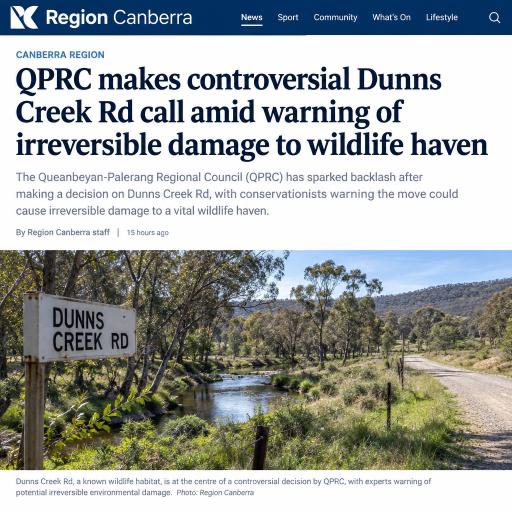
QPRC makes controversial Dunns Creek Rd call amid warning of irreversible damage to wildlife haven
A divisive road proposal in the Queanbeyan region has been pushed back onto the agenda, despite sharp warnings from conservationists that the selected route could seriously harm a protected bushland refuge.
Queanbeyan-Palerang Regional Council has voted to continue pursuing a section of Dunns Creek Road that would eventually link South Jerrabomberra with the ACT and connect through to Old Cooma Road. The move keeps alive a long-debated transport corridor intended to provide another access route for the growing area, which currently depends on a single main connection.
The decision came after councillors reconsidered earlier advice that had recommended stepping away from the second stage of the project. Instead, the council chose to revive a route identified years ago as a preferred alignment, even though that path cuts through the Wandiyali~Environa Wildlife Sanctuary.
The chosen alignment, known in planning papers as Option Five, had first been endorsed by the former Queanbeyan City Council more than a decade ago. Supporters of the route argued that the community has long expected the road to be built and that shelving the corridor now would amount to abandoning that commitment.
Backers also said the alternatives carried their own heavy costs. Several other routes were set aside, including options passing through the Fernleigh Park area, where dozens of homes could potentially have been affected. Another possibility involving an overpass near Jerrabomberra Circle was also excluded from further study.
But the decision has triggered alarm among those managing and restoring habitat within the sanctuary, where years of conservation work have begun to show results. Of particular concern are recent koala sightings, viewed by local custodians as a sign that long-term efforts to repair and reconnect habitat are paying off.
Those working on the land say the sanctuary represents decades of ecological restoration by residents, Indigenous rangers, community groups and conservation partners. For them, the prospect of a roadway cutting through the site threatens to undo years of patient recovery in an area increasingly valuable for native fauna.
The sanctuary has also attracted formal conservation backing through a long-term partnership aimed at strengthening protection for wildlife and habitat. Environmental advocates say the area provides refuge for threatened species and demonstrates the value of sustained investment in private land conservation.
They warn that constructing a major road through the property could fragment habitat, increase noise and traffic pressure, and create lasting impacts on species already under stress. In ecological terms, roads can do more than remove vegetation: they can isolate animal populations, disrupt movement corridors and increase the risk of vehicle strikes and weed invasion.
These concerns were echoed during council deliberations, where the financial and planning challenges of the proposal were also raised. One councillor opposed pressing ahead with Option Five, arguing that a major transport corridor was fundamentally at odds with a landscape that residents had spent years rehabilitating. Questions were also raised about whether the money needed to complete such a large infrastructure project was realistically available, given other existing council commitments.
Even supporters of the route acknowledged that progressing it would be difficult. The alignment is expected to face significant environmental scrutiny and would likely require complex approvals. Council leaders indicated that any attempt to advance the proposal could involve a prolonged struggle with biodiversity regulators and state authorities.
Despite that, the council chose not to abandon the idea. Instead, it resolved to investigate the environmental consequences in more detail and continue planning work around the route.
The next step will be a certified biodiversity development assessment focused on the impacts of Option Five. The council also plans to seek confirmation around funding for the first stage of Dunns Creek Road and look into other measures that could improve the broader road network in the district.
The outcome leaves the region facing a familiar tension: how to accommodate urban growth and transport demand without sacrificing hard-won ecological gains. In this case, the debate is not simply about traffic efficiency or future housing access. It is also about the long-term value of a sanctuary that many see as a rare example of landscape repair in action.
With koalas recently returning to view and habitat restoration still underway, the fight over Dunns Creek Road now appears set to become a defining test of whether infrastructure expansion can be reconciled with biodiversity protection in one of the region’s most sensitive natural areas.



Leave a Reply