

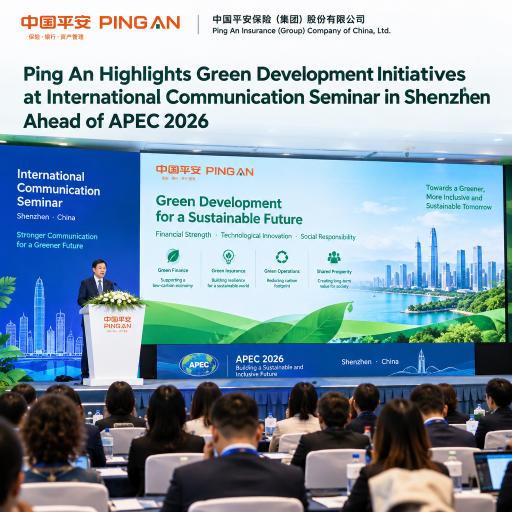
Ping An Insurance (Group) Company of China, Ltd.: Ping An Highlights Green Development Initiatives at International Communication Seminar in Shenzhen Ahead of APEC 2026
As Shenzhen prepares to host APEC 2026, a major seminar on corporate green development placed environmental cooperation, low-carbon transition and biodiversity protection at the center of the conversation. Held at Ping An Finance Center, the event brought together business leaders, academics, policy specialists and institutional representatives to examine how companies can contribute to ecological resilience while supporting economic growth.
The discussions aligned closely with the broader themes expected to shape APEC 2026, especially openness, innovation and cooperation. Participants focused on how Chinese and international enterprises can share practical experience, deepen partnerships and accelerate environmental action across the Asia-Pacific region.
More than 100 attendees from private firms, state-owned enterprises, multinational companies, research bodies, universities and media circles took part. The seminar served as a platform for exchanging ideas on climate governance, sustainable finance, ecosystem restoration and new models for green collaboration.
Ping An used the occasion to showcase how it is embedding sustainability into its wider business strategy. The group said green development is being integrated not only into corporate planning, but also into financial products, technological tools, philanthropy and international cooperation. Its approach connects environmental protection with insurance, risk management and digital innovation.
Finance as a tool for ecological protection
One of the company’s central messages was that finance can do more than absorb losses after environmental disruption. It can also help preserve habitats, stabilize rural livelihoods and support long-term conservation work. Ping An highlighted several examples in which insurance mechanisms have been adapted to local ecological challenges.
In agricultural regions, the insurer has introduced products designed to reduce economic uncertainty for farmers while encouraging more sustainable land use. These include coverage linked to flower prices and coffee production costs, paired with support in financing, technology, production and market access. The intention is to protect income streams while reducing pressure on fragile ecosystems.
The company also pointed to a public welfare insurance program covering wild mushroom poisoning, a recurring risk in some rural communities. By reducing health-related financial shocks, such programs can strengthen resilience in areas where livelihoods are closely tied to natural landscapes.
In eastern China, Ping An worked with local forestry authorities on what it described as the country’s first rescue insurance policy for Oriental storks. The model combines insurance funding with wildlife rescue efforts, illustrating how financial tools can be structured to support species protection directly.
Urban towers, wetlands and ancient trees
Ping An also presented biodiversity measures that extend beyond traditional insurance activities. In Shenzhen, where migratory birds pass through one of the region’s important flyways, reflective skyscraper glass can pose a deadly hazard. To reduce bird collisions, the company installed dot-patterned markers on the glass surfaces of Ping An Finance Center, making the façade more visible to birds.
Wetland conservation was another focus. The company has backed mangrove protection through a charitable trust and expanded support for projects in Shenzhen Bay that combine habitat conservation, species protection and environmental education. It has also invited public participation in wetland stewardship, linking habitat protection to broader civic engagement.
Another strand of its green agenda involves ancient and notable trees, many of which face mounting pressures from urbanization, storms, pests and neglect. Ping An said it provides insurance protection for tens of thousands of heritage trees across China, with coverage reaching into the billions of yuan. The initiative is paired with public-interest programs that connect tree preservation with cultural tourism and youth-focused activities.
Technology in service of wildlife monitoring
The company used the seminar to unveil a broader biodiversity plan centered on endangered and vulnerable species. One of the new priorities is support for the conservation of Przewalski’s gazelle, a rare species found around Qinghai Lake and considered under significant ecological pressure.
To assist field conservation, Ping An’s property and casualty arm is deploying agricultural drones in protected areas. These aircraft are intended to help teams monitor wildlife populations, inspect habitats and detect injured animals or ecological disturbances across large and remote landscapes. The company said the use of drones can improve efficiency while easing pressure on frontline staff.
Another newly announced measure is a dedicated egret rescue fund. The funding will support specialized organizations working with a monitored egret habitat, with resources directed toward rescuing eggs and chicks requiring intervention, treating injured birds and caring for migratory species found in distress.
From local pilots to regional ambition
Beyond China, Ping An is exploring how its environmental risk-management model might be adapted overseas. One pilot under consideration involves full-cycle insurance support for the rubber sector in Laos, where ecological restoration and industrial development are being pursued in parallel. The concept reflects a wider ambition to export integrated insurance and technology solutions to environmental projects across the region.
The seminar also produced a joint call for stronger ecological cooperation between Chinese and international enterprises. The shared agenda emphasized five broad goals: prioritizing ecology, advancing innovation, encouraging open collaboration, improving green communication and expanding participation by multiple stakeholders.
For Ping An, the event was as much about shaping a narrative for APEC 2026 as it was about detailing individual projects. By linking insurance, conservation and digital tools, the company is positioning itself within a larger conversation about how corporations can influence the green transition.
With biodiversity loss, climate risk and land degradation climbing higher on the policy agenda, the message from Shenzhen was clear: environmental protection is no longer a side program for major companies. It is becoming part of how they define growth, manage risk and build legitimacy in an increasingly climate-conscious region.



Leave a Reply