

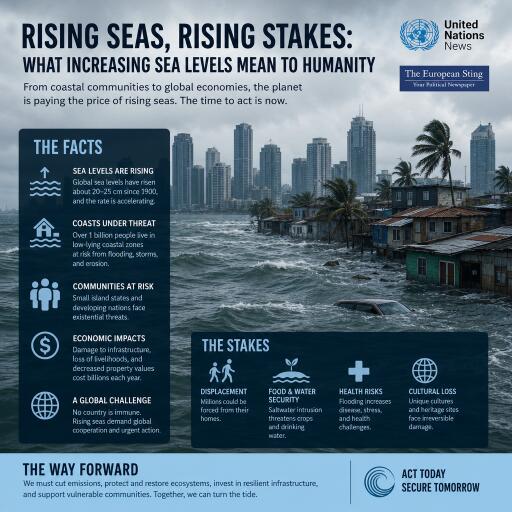
Rising seas, rising stakes: What increasing sea levels mean to humanity – The European Sting – Critical News & Insights on European Politics, Economy, Foreign Affairs, Business & Technology – europeansting.com United Nations News –
The ocean is swelling faster than at any point in modern records, and the consequences are already lapping at our doorsteps. Shorelines are eroding, homes are flooding, and livelihoods are being upended, forcing families to seek safer ground. This is not only an environmental emergency; it is a profound test of human rights, public health, cultural continuity and economic stability. The pace and scale of action taken now will determine whether sea-level rise is a challenge we manage or a crisis that defines a generation.
What is sea-level rise?
Sea level is climbing largely because of human-driven warming. From 2014 to 2023, the global average rose by about 4.7 millimetres per year. In 2024, it leapt to a record 5.9 millimetres—an alarming acceleration. Even under the most hopeful emissions pathway, oceans are projected to be up to 0.55 metres higher by 2100. Under high-emissions scenarios, the rise could exceed one metre, with a small but consequential possibility of nearly two metres by century’s end.
Why it’s happening
- Rapid melt of glaciers and the Greenland and Antarctic ice sheets.
- Thermal expansion: warmer seawater takes up more space.
- The ocean absorbs about 91 per cent of excess planetary heat, locking in additional rise as warming continues.
People on the front line
Roughly 770 million people—about one in ten—live within five metres of today’s high-tide line. For many, the threat is no longer abstract.
- Saltwater intrusion is contaminating freshwater wells and degrading farmland.
- Floods are battering hospitals, schools and wastewater systems.
- Exposure to waterborne disease is rising, compounding mental health strains as communities face repeated disasters.
- Fisheries and tourism—pillars of countless coastal economies—are being disrupted.
- Some analyses suggest up to 1.2 billion people could be displaced by 2050 as they seek safety and new livelihoods.
- Emerging research indicates risks may be undercounted in certain regions, leaving tens of millions more vulnerable than previously estimated.
Beyond the physical damage lies an irreplaceable loss: cultural heritage, ancestral gravesites and traditional ways of life are disappearing beneath the waves, leaving deep psychological scars.
The mounting bill
- Damage to coastal infrastructure has already surpassed $1.8 trillion.
- Without adaptation, annual global losses could approach $1.4 trillion.
- Small Island Developing States lost an estimated $153 billion to climate hazards between 1970 and 2020.
- In disaster-prone areas, US home insurance premiums rose by about 33 per cent from 2020 to 2023.
- Ports—through which more than 80 per cent of world trade flows—face growing flood risk, threatening supply chains and food and energy security.
Who is most exposed?
- Small island nations: Many Pacific islands are experiencing relative sea-level rise more than twice the global average, making frequent high-tide flooding the new norm.
- Low-lying delta hubs: Cities like Dhaka, Mumbai and Kolkata sit on the front line, with more than 14 million people at risk of losing homes, jobs and, in extreme cases, their lives.
- Coastal megacities: Miami, New York and Guangzhou could see losses in the trillions if critical infrastructure is inundated.
Can we stop it?
Some rise is already baked in due to past emissions. How much more the seas climb depends on how quickly and deeply we cut greenhouse gases now. One pivotal concern is Antarctica’s Thwaites Glacier—an ice mass roughly the size of Great Britain. Its destabilization could unleash a rapid, irreversible jump of more than half a metre in global sea level—a potential tipping point with global repercussions.
Preparing for what’s already underway
Phasing out fossil fuels is essential to slow further rise, but adaptation can’t wait. Communities need protection, planning and funding today.
- Early warning systems that safeguard lives and assets before storms and surges hit.
- Layered coastal defenses: restoring mangroves and dunes, building sea walls where needed, and planning strategic retreats from the most at-risk areas.
- Robust monitoring networks: many regions still lack basic data on tides, waves and subsidence.
- Legal clarity: agreements on maritime zones, resource rights and statehood if land becomes uninhabitable or submerged.
Financing remains the chokepoint. Developing countries require an estimated $310–$365 billion annually for adaptation, yet global adaptation finance in 2023 was roughly $26 billion—nowhere near the scale of need.
The choice ahead
Sea-level rise may feel inexorable, but its ultimate toll—who bears the brunt and how severe the damage becomes—hinges on choices made now. Rapid emissions cuts can limit the climb. Ambitious adaptation, backed by predictable finance, can keep homes, hospitals and heritage from being lost. Recognizing sea-level rise as a standing global priority, ensuring that statehood and rights endure even as shorelines shift, and investing in resilient coasts are not optional extras—they are the foundation of a livable future for hundreds of millions. The seas are rising; the stakes are, too. Our window to act decisively is still open, but narrowing.



Leave a Reply