

Coral Reefs Decline 9.5 Percent as Marine Heatwaves Block Recovery – Archyde
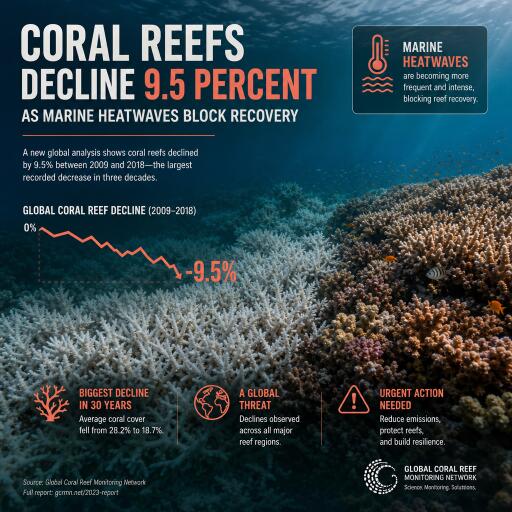
Coral reefs are slipping into a perilous feedback loop as marine heatwaves grow hotter, longer, and more frequent, leaving too little time for ecosystems to heal between shocks. A new global assessment, compiled from more than 21 million observations across 36,800 reef sites in 124 countries, regions, and territories and presented in Palau by the Global Coral Reef Monitoring Network (GCRMN), finds that stony coral cover has fallen markedly in recent years—roughly a ten percent slide globally—while the window for natural recovery is rapidly constricting.
Heatwaves on repeat, recovery on pause
Since 1998, the planet’s reefs have been struck by four worldwide mass bleaching events, each driven by exceptional heat stress that forces corals to expel the symbiotic algae they need to survive. The cumulative toll has been stark:
- 1998–1999: hard coral losses of about 6.5 percent
- 2010–2011: about 9.9 percent
- 2016–2017: about 6.6 percent
- 2023–2024: about 8.9 percent
Bleaching is not an instant death sentence. If temperatures fall quickly enough, corals can reacquire symbionts and slowly regain strength. In the past, many reefs had decades between severe disturbances, and that breathing room made real recovery possible. Between 2017 and 2019, for instance, global hard coral cover rebounded by roughly six percent—proof that, given time, reefs can heal.
That time is now vanishing. The interval between severe bleaching events has shrunk to about five or six years on average. In places hammered by extreme heat and amplified by El Niño, the respite can shrink to barely a year—far short of what most corals need to rebuild structure, reproduce, and restore fish habitat.
Why regeneration is failing
The immediate losses from heat are only part of the story. Reefs are also strained by chronic, local stressors that chip away at resilience. Overfishing removes the fish that keep seaweeds in check. Nutrient and sediment pollution from land smother and stress corals. Rapid coastal development alters currents and degrades water quality. When a marine heatwave hits, these weakened systems are less likely to withstand the insult or bounce back afterward.
The result is an ecological debt that grows with each event: fewer surviving corals, reduced reproduction, and more space ceded to algae. With recovery windows growing shorter, many reefs never fully rebuild before the next heatwave arrives.
High stakes for nature and people
Reefs occupy less than 0.2 percent of the ocean floor, yet they underpin at least a quarter of all known marine species, serving as nurseries, feeding grounds, and shelter. Their loss reverberates far beyond biodiversity. Approximately 104 million people live within five kilometers of a reef—a figure that has risen by about 46 percent over the past two decades—and depend on these ecosystems for food security, coastal protection from storms, livelihoods, and tourism revenue. As reefs erode, fisheries falter, shorelines become more vulnerable to flooding, and local economies face rising risks.
Record ocean heat underscores urgency
The GCRMN findings land amid a broader climate signal: global sea surface temperatures have climbed to unprecedented levels in the modern record. The daily global average reached 21.1 degrees Celsius on August 22, narrowly surpassing the previous record set in March 2024. Such heat supercharges marine heatwaves, expands the geographic footprint of bleaching, and intensifies the pressure on already stressed reefs.
Bridging the gap between warnings and action
Scientists and conservation practitioners stress that the solutions are known; the barrier is implementation at the necessary speed and scale. Cutting greenhouse gas emissions remains the single most important action to curb long-term ocean warming. But while global negotiations continue, local and regional management can buy crucial time for reefs that still have the capacity to recover.
Immediate lifelines for reefs
- Protect water quality: reduce nutrient and sediment runoff from agriculture, wastewater, and construction to limit algal blooms and disease.
- Safeguard fish populations: enforce sustainable fisheries and protect herbivorous fish that control algae and help corals recruit.
- Plan coastal development wisely: maintain natural buffers like mangroves and seagrasses, regulate dredging, and preserve water flow.
- Shield refuges: identify and protect thermally resilient reefs and connectivity corridors that can seed recovery after disturbances.
- Invest in monitoring and early warning: track heat stress and reef condition to target rapid response and restoration where it can be most effective.
What happens next
The GCRMN, working with scientific partners and conservation organizations, is building the most comprehensive picture yet of reef health and its trajectory. Whether the world’s remaining coral ecosystems can outrun the shrinking recovery clock will depend on two parallel efforts: swift, deep cuts to global emissions to cool the oceans over time, and decisive local action to reduce the everyday stressors that make reefs brittle. The science is unequivocal; the timeline is tight. What remains is the collective will to act while recovery is still possible.



Leave a Reply