

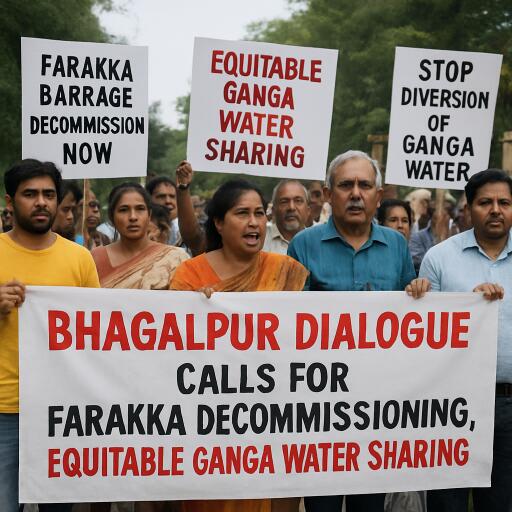
Bhagalpur Dialogue calls for Farakka decommissioning, equitable Ganga water sharing
A gathering of river campaigners, researchers, fishers’ representatives and community voices in Bhagalpur has renewed calls to retire the Farakka Barrage, arguing that the structure has become a symbol of the wider ecological distress affecting the Ganga basin. Yet participants were equally clear on one point: any move to dismantle Farakka should not be used to weaken Bangladesh’s rightful access to shared river waters.
Over two days of discussions, delegates from Bihar, West Bengal, Uttar Pradesh and Jharkhand examined how the barrage is tied to a chain of interlinked crises along the Ganga: heavy siltation, bank erosion, worsening floods, shrinking fish populations, ecological fragmentation and the deepening vulnerability of river-dependent communities in an era of climate instability.
Speakers stressed that Farakka cannot be treated as an isolated engineering issue. In their view, the barrage is part of a much larger pattern in which dams, embankments and diversions have repeatedly interrupted the natural movement of water, sediment and aquatic life. That disruption, they argued, has imposed costs on floodplain farmers, fishing families, char dwellers and others whose survival depends on a living river rather than a controlled channel.
The meeting also took up the future of water sharing between India and Bangladesh. Participants rejected the idea that opposition to the barrage should be framed as opposition to cross-border sharing. Instead, they backed the continuation of existing arrangements until Farakka is phased out, while calling for future agreements to rest on scientific assessment, ecological realities and fairness for all regions touched by the river system.
Several contributors argued that rivers long predate political borders and should not be turned into tools of nationalism or strategic posturing. They warned against the rise of “water nationalism,” saying that downstream rights must be respected just as states within India expect a fair allocation of the Ganga’s flow. In that framework, Bangladesh’s claim to water was described as legitimate and inseparable from any serious discussion of the river’s future.
Another recurring theme was the need to see the Ganga as one connected ecological system, not a series of disconnected stretches divided by administrative lines. Participants said that interventions in one part of the basin reverberate elsewhere, affecting sediment transport, fisheries, wetlands, smaller distributaries and even delta ecosystems farther downstream.
Concerns were raised about the cumulative impact of large numbers of dams and barrages across the Ganga and its tributaries. According to those attending the dialogue, these structures have altered the seasonal pulse of the river, blocked migration paths for fish and degraded aquatic habitats over a vast area from the Himalayan foothills to the plains.
The effects on livelihoods were described in stark terms. In parts of Bihar and West Bengal, speakers said, sediment build-up has made sections of the river shallower, aggravating floods while also intensifying erosion in vulnerable districts. Communities from Malda and other erosion-prone zones recounted the loss of land, homes and farms as the shifting river undercut embankments and settlements.
Fish diversity emerged as another major concern. The decline of hilsa and other species was cited as evidence that river engineering has disrupted breeding cycles, migration routes and water quality. Participants also pointed to broader ecological changes, including impacts on aquatic plants, smaller organisms and the freshwater balance reaching the Sundarbans.
Climate change sharpened the urgency of the debate. Attendees linked recent extreme weather and disasters in the Himalayan region to a development model that attempts to over-control rivers and mountain systems. Large dams in fragile landscapes were criticised for increasing downstream risks, including floods, drought-like conditions, landslides and other cascading environmental damage.
At the close of the dialogue, participants adopted a common declaration urging an independent and credible assessment of Farakka’s full consequences, from upstream siltation to downstream erosion and biodiversity loss. The declaration called on authorities to create an expert body to examine how the barrage could be decommissioned and what alternatives would be needed for settlements and sectors now dependent on it.
The statement also pressed for broader scrutiny of river infrastructure across the basin, including other dams, barrages and embankments that may be amplifying ecological stress. Particular attention was drawn to the need for fresh evaluations of interventions on the Kosi and other rivers in Bihar, as well as projects that have altered flow regimes elsewhere in eastern India.
Delegates further argued that any institution negotiating river sharing should expand beyond official and diplomatic channels. Farmers, fishers and other riverbank communities from both India and Bangladesh, they said, must have a meaningful voice in bodies that shape decisions over allocation and management.
The Bhagalpur meeting also highlighted inequities within India. Some participants said Bihar bears a disproportionate burden as upstream uses absorb waters from tributaries while the state continues to face flood damage, erosion and its own developmental pressures. For that reason, they called for a more just internal distribution of Ganga waters alongside any international arrangement.
Underlying the entire discussion was a larger ecological principle: a river’s health depends on continuity. When flow is repeatedly blocked, diverted or tamed for narrow economic goals, the damage spreads far beyond the structure itself, affecting biodiversity, sediment balance, floodplains and social stability.
The message emerging from Bhagalpur was not simply anti-barrage. It was a call to rethink river governance around free-flowing ecosystems, climate resilience and shared rights. In that vision, dismantling Farakka is seen as a step toward restoring the Ganga’s natural vitality, while equitable water sharing with Bangladesh remains essential to justice in a connected river basin.



Leave a Reply