

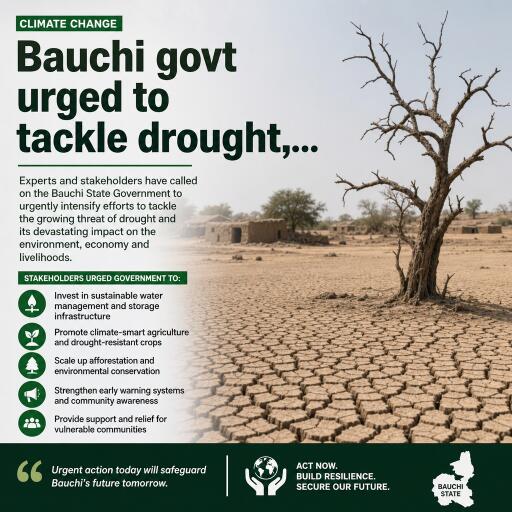
Climate change: Bauchi govt urged to tackle drought, deforestation and land access gaps
Environmental advocates and farmer groups in Bauchi State have called on the government to intensify enforcement against deforestation and illegal mining, warning that unchecked degradation is worsening drought impacts and undermining efforts to keep women and young people on the land.
The appeal came at a one-day policy roundtable on sustainable access to farmland for women and youths in Bauchi, convened under the Resilient and Inclusive Agrifood Systems Empowering Women and Youth in Nigeria (RISE) Project. Participants examined how to remove barriers to land access, strengthen climate resilience, and improve agricultural productivity in communities already strained by erratic rainfall.
Charcoal economy under scrutiny
Stakeholders raised alarm over the surge in tree felling for charcoal, describing it as a driver of soil erosion, biodiversity loss and declining rainfall reliability. According to the Bauchi State Network of Civil Society Organisations (BASNEC), enforcement crackdowns in some neighboring states have pushed charcoal operations into Bauchi, where forests are being cleared and truckloads of charcoal reportedly move out to markets elsewhere.
Speakers argued that the environmental costs—diminished watersheds, rising temperatures at the local scale and shrinking wildlife habitat—are being borne by rural communities who depend on healthy ecosystems to grow food. They stressed that drought and shortened rainy seasons have already taken a toll on harvests this year, with many farmers reporting withered crops and failed plantings.
Calls for stronger enforcement and community safeguards
Civil society representatives urged the state to fully apply existing laws that restrict indiscriminate logging, charcoal production and illegal mining, and to close loopholes that allow resource extraction in protected areas. They also called for clearly defined penalties and consistent patrols, coupled with community forest management committees to monitor hotspots and report violations.
Participants said the state environmental agency has, at times, intercepted charcoal shipments but alleged that political interference has undermined sustained action. They called for public accountability mechanisms to shield regulators from pressure and for transparent reporting on seizures, prosecutions and outcomes to deter repeat offenses.
Women and youth at the center of land reform
Beyond enforcement, the roundtable focused on removing long-standing barriers that keep women and young people from accessing productive land. Recommendations included streamlined land registration, simplified lease agreements, gender-responsive land allocation, and mediation services to resolve disputes swiftly before planting windows close.
Participants emphasized that secure tenure is fundamental to climate adaptation: farmers are more likely to invest in soil conservation, agroforestry and water harvesting when they have confidence in their rights. They called for targeted support—such as seedlings for reforestation, small-scale irrigation kits, and climate-smart advisory services—so that new and smallholder farmers can rehabilitate degraded plots and stabilize yields.
From deforestation to resilience
The forum outlined a transition pathway away from forest dependence toward cleaner energy and diversified rural livelihoods. Suggested measures included:
- Scaling up access to alternative cooking fuels and efficient cookstoves to reduce woodfuel demand.
- Establishing community woodlots and expanding tree planting along farms and waterways to restore microclimates and protect soils.
- Promoting drought-tolerant crops, intercropping and mulching to improve soil moisture and buffer against rainfall shocks.
- Encouraging water harvesting, small reservoirs and drip irrigation to make every liter count through dry spells.
- Strengthening early warning systems and climate information services so farmers can adjust planting dates and inputs.
Whole-of-society collaboration
The roundtable brought together representatives of government ministries and agencies, traditional and religious institutions, civil society organizations, farmer cooperatives, women and youth associations, members of a project steering committee and other development partners. Discussions highlighted the need for a coordinated approach that links law enforcement with livelihood support, so that communities are not forced to choose between immediate income and the long-term health of their environment.
Participants urged the state to pair tougher penalties for environmental crimes with incentives for compliance—such as community grants for reforestation, recognition programs for forest guardians, and access to finance for enterprises that create jobs without degrading land and water.
Urgency amid a changing climate
With climate change tightening its grip through hotter temperatures and more erratic rainfall across northern Nigeria, attendees warned that the cost of inaction will be measured in failed harvests, rising food prices and deepening rural poverty. They called for immediate steps to halt deforestation, strengthen institutions, and prioritize women and young farmers as engines of recovery.
The message from the forum was clear: protect forests, enforce the law, secure land rights, and invest in climate-smart farming. Doing so, participants argued, will help Bauchi State move from a cycle of resource depletion and drought to one of regeneration and shared resilience.



Leave a Reply