

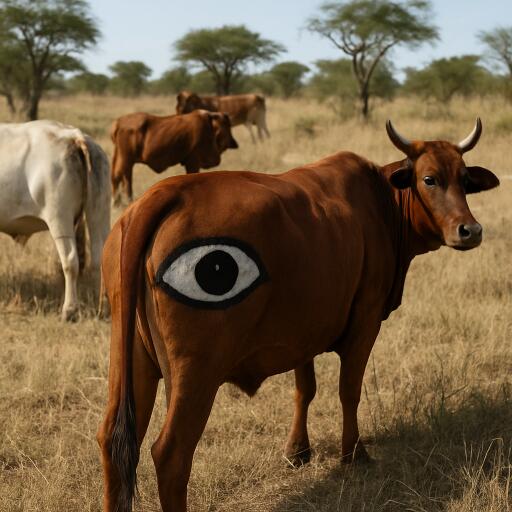
In 2020, researchers painted fake eyes on the rumps of cattle in Botswana and no eye-marked cows were killed by lions: A low-cost trick tested to reduce retaliatory killings of predators
On the grasslands of northern Botswana, an unusually simple experiment offered a fresh way to ease one of conservation’s most difficult tensions: protecting livestock without driving further declines in large predators. The idea was strikingly low-tech. Researchers painted eye-like patterns on the backsides of cattle to see whether lions, which depend on stealth, would hesitate to attack animals that seemed to be watching them.
The result drew attention for a reason that went beyond its novelty. During the trial, cattle marked with realistic false eyes were not killed by lions, while attacks did occur among animals that were either unpainted or marked with a different symbol. The finding suggested that a cheap, fast and non-lethal method could help farmers reduce losses while also lowering the risk of retaliatory killings of lions.
A conflict with high stakes for people and predators
In many parts of Africa, cattle, goats and other livestock graze in landscapes shared with lions and other carnivores. When predators kill these animals, the impact on households can be severe. A single loss may represent food, income or savings. For farmers and herders living close to wildlife, repeated attacks can quickly turn tolerance into anger.
That response has major ecological consequences. Lions already face pressure from shrinking habitat, fragmented ranges and reduced wild prey. When livestock killings trigger revenge hunts or poisoning, local lion populations can decline even faster. Conservationists have therefore been searching for ways to reduce attacks without removing predators from the ecosystem.
Why painted eyes might work
The logic behind the Botswana test comes from predator behaviour. Lions are ambush hunters. Instead of chasing prey over long distances, they usually try to creep in unseen and launch a short, decisive attack from close range. Surprise is central to that strategy.
If a lion thinks it has been noticed, the chances of success drop. A prey animal that appears alert is more likely to flee or defend itself, making the attack riskier and less efficient. That possibility is the basis of what behavioural scientists often describe as the detection hypothesis: predators may abandon a hunt if they believe their target has already spotted them.
Nature offers many examples of this visual trick. Eye-like markings appear on butterflies, fish, reptiles and insects, sometimes to startle enemies and sometimes to create the illusion of awareness. The Botswana trial applied that same concept to livestock protection, not by trying to scare lions outright, but by making cattle seem less easy to ambush.
How the trial was set up
The experiment took place in the Okavango Delta region, where cattle often move through areas also used by lions. Researchers worked with local herds under ordinary grazing conditions rather than in an artificial test setting, making the results especially relevant to real farming life.
The cattle were split into three categories. One group received carefully painted eye patterns on their rumps. A second group was marked with simple crosses, allowing the researchers to test whether any visible paint might deter lions. A third group had no markings at all.
The animals then went out to graze as usual while predator encounters and livestock losses were monitored over time.
What happened
The most notable outcome was straightforward: none of the cattle bearing realistic eye symbols were killed by lions during the study period. By contrast, lion attacks did occur among cattle with no paint and among those marked only with crosses.
That comparison mattered. It indicated that the protective effect was not just caused by putting paint on an animal. The specific eye pattern appeared to be the important detail. In other words, lions may have responded to the illusion of being watched, not merely to an unfamiliar mark.
Even so, researchers treated the result cautiously. The test was limited to one landscape and one set of predator populations. Lion behaviour can vary between regions, prey conditions and levels of exposure to people. More studies would be needed to know how reliably the method works elsewhere and whether predators might eventually learn to ignore it.
A cheap tool, not a miracle fix
What makes the idea so compelling is its simplicity. Painting eye shapes on cattle requires little equipment, no advanced infrastructure and minimal cost compared with fences, electronic deterrents or permanent barriers. For communities with limited resources, that matters.
But the method is best understood as one tool among many, not a stand-alone solution. Livestock protection usually works best when layers of defence are combined. Close herding, secure nighttime enclosures and practical barriers still play an important role in reducing predation. Paint also fades and would need to be reapplied.
There is also an open scientific question: will lions become accustomed to the markings over time? If they do, the effect could weaken. On the other hand, even a temporary reduction in attacks could ease pressure on both farmers and carnivores during critical periods.
Why the study matters
The Botswana experiment stands out because it shows how behavioural ecology can produce practical conservation tools. Rather than relying on force, exclusion or expensive technology, the strategy exploits a weakness in an ambush predator’s decision-making process.
That approach reflects a wider shift in wildlife management. Increasingly, the goal is not to separate people and predators at all costs, but to design realistic ways for them to coexist in the same landscapes. In that context, even modest interventions can have outsized value if they reduce economic losses and prevent revenge killings.
For lion conservation, the implications are significant. Every avoided livestock death may help preserve a household’s income. Every prevented retaliatory response may also spare predators that are already under strain. A few strokes of paint will not solve the deeper challenges facing African carnivores, but this field test showed that sometimes a small, behaviour-based idea can open a new path between rural livelihoods and species protection.



Leave a Reply