

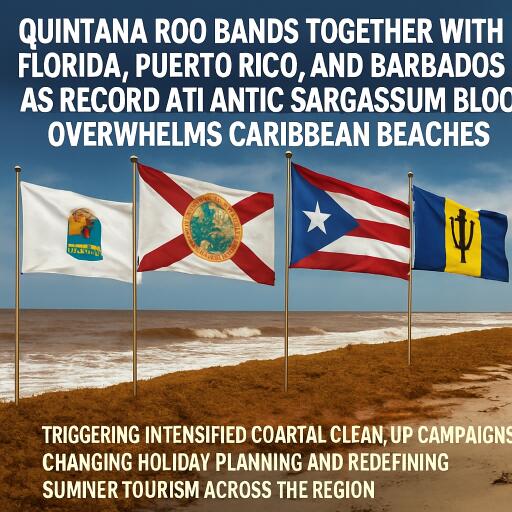
Quintana Roo Bands Together With Florida, Puerto Rico, and Barbados as Record Atlantic Sargassum Bloom Overwhelms Caribbean Beaches, Triggering Intensified Coastal Clean-Up Campaigns, Changing Holiday Planning and Redefining Summer Tourism Across the Region: A Vital Update for Caribbean Holidaymakers
A vast sargassum surge is once again transforming parts of the Caribbean coastline, and in 2026 the problem has grown into one of the region’s biggest environmental and tourism tests. From Mexico’s Quintana Roo to Florida, Puerto Rico, and Barbados, governments and coastal businesses are stepping up clean-up efforts as exceptionally large mats of brown seaweed wash ashore during the peak holiday season.
Scientists tracking the Atlantic-Caribbean basin reported that sargassum levels in June reached roughly 33.6 million metric tonnes, placing this year among the most severe ever recorded. The Caribbean Sea itself logged its highest June concentration since monitoring began, while the Gulf of Mexico also saw unusually high volumes. The bloom developed earlier than normal, with abnormal build-up detected in January, stretching the season and putting beach destinations under pressure for longer than usual.
For travellers, the result is a far more unpredictable beach landscape. One shoreline may be freshly cleared and swimmable, while another nearby can be covered in seaweed only hours later. Winds, currents, and coastal geography are dictating where the seaweed lands, making local conditions highly variable across the region.
Quintana Roo intensifies its response
In Mexico’s Caribbean tourism hub, authorities have expanded containment and removal operations in an effort to protect major resort areas. Federal and state agencies are working along beaches and offshore zones near Isla Mujeres, Cancún, Puerto Morelos, Cozumel, Playa del Carmen, Tulum, and Othón P. Blanco.
The strategy increasingly focuses on stopping sargassum before it reaches the shore. Offshore barriers, collection vessels, and coordinated shoreline crews are being used to reduce build-up on tourism-dependent beaches. The scale reflects how serious the issue has become: sargassum management is no longer treated as a temporary seasonal nuisance but as a permanent coastal operations challenge.
Officials and tourism operators continue to stress that not every beach is equally affected, and many remain open and usable. Still, maintaining those conditions now requires continuous monitoring, faster response times, and growing investment from hotels and municipalities.
A Caribbean-wide problem, not just a Mexico story
The same bloom is affecting a much wider geography. In Florida, coastal authorities have faced elevated beaching risk, especially along the south-east coast, where seaweed arrivals have periodically intensified during summer. In Barbados, often one of the first Caribbean islands in the path of the drifting mats, officials have been expanding offshore collection systems and mechanised shoreline clean-ups. Puerto Rico is also keeping close watch on changing beach conditions, particularly along areas more exposed to Atlantic currents.
This broader spread shows how sargassum has evolved into a regional issue tied to both ecology and the visitor economy. What once seemed localised now demands coordination across island and mainland destinations that share exposure to the Great Atlantic Sargassum Belt.
Why this year is different
Researchers say 2026 stands out not only because of the sheer volume of sargassum, but because the season started so early. That early growth gave the bloom more time to expand and more opportunities to reach coastlines during the busiest travel months.
Although scientists are still studying the exact drivers, the trend appears to be linked to a combination of warmer ocean waters, nutrient-rich marine conditions, large-scale current patterns, and shifting winds. The result is a more persistent and recurring phenomenon than the Caribbean faced before 2011, when these massive regional blooms were far less common.
How tourism is adapting
Hotels, resorts, and local tourism boards are changing the way they deal with beach holidays. Instead of treating sargassum as an occasional disruption, many are planning for it year-round. Beach grooming teams are larger, containment systems are more common, and some properties are investing in specialised machinery to clear shorelines before guests arrive in the morning.
At the same time, communication has become a crucial tool. Visitors increasingly want real-time updates about beach conditions, swimming options, odour levels, and alternative activities. Many travellers are now choosing resorts based not only on location and price, but on how well they manage seaweed events.
That shift is influencing booking habits. Travellers heading to the Mexican Caribbean are more likely to compare the exposure of different coastlines, ask whether a resort has active mitigation measures, and build flexibility into their itineraries. Sheltered beaches, islands protected by reef systems, and properties with strong maintenance programmes are drawing extra attention.
Geography matters more than ever
One of the key lessons for holidaymakers is that sargassum does not blanket every destination equally. Even within Quintana Roo, conditions can vary sharply between nearby beaches. Atlantic-facing stretches tend to receive heavier landings, while more protected areas may remain clearer due to local currents and shoreline orientation.
This means travellers should avoid assuming an entire destination is either ruined or unaffected. Beach quality can shift quickly with weather and ocean changes, and clean-up operations can sometimes restore access within hours.
From waste to resource
Another major development is the effort to turn collected sargassum into usable material rather than treating it solely as waste. Public agencies and private companies are developing ways to convert it into products such as fertiliser, building materials, packaging inputs, and other bio-based goods.
If these efforts scale successfully, they could reduce disposal costs while creating new value from an environmental burden. For coastal economies repeatedly hit by large blooms, that would mark a significant shift from emergency response to circular-economy adaptation.
What travellers should know now
Despite the severity of the 2026 bloom, Caribbean travel is far from off the table. Many beach areas remain attractive, and countless visitors are still taking successful holidays across the region. The difference is that planning now requires more flexibility and better information.
For anyone heading to Quintana Roo, Florida, Puerto Rico, Barbados, or other affected Caribbean destinations, the smartest approach is to check recent beach updates, ask accommodation providers about clean-up measures, and be open to changing daily plans. Inland excursions, cenotes, reef trips, cultural visits, and west-facing beaches can offer strong alternatives when seaweed levels rise.
The larger picture is clear: sargassum is no longer a once-in-a-while inconvenience. It is becoming part of how Caribbean tourism works, planned for alongside storms, heat, and coastal conservation. The region’s response is growing more sophisticated, but for now, summer travel in the Caribbean increasingly comes with a new reality—beach conditions can no longer be taken for granted.



Leave a Reply