

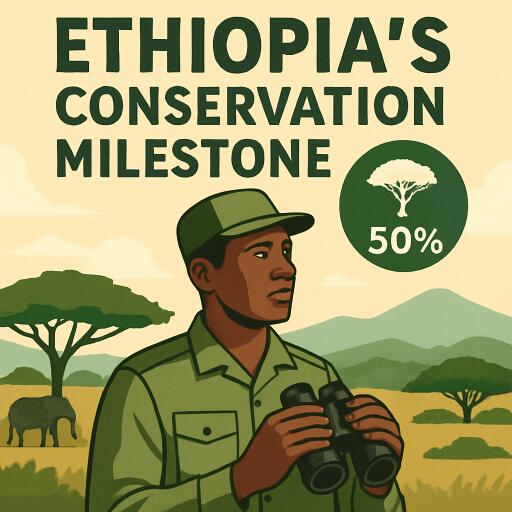
Ethiopia’s conservation milestone
Ethiopia is reaching a landmark moment in environmental protection as the country celebrates six decades of formal wildlife conservation. The anniversary is more than a ceremonial date. It highlights how one of Africa’s most ecologically important nations is trying to protect its forests, grasslands, wetlands and drylands while facing the mounting pressures of climate change, land degradation and population growth.
The occasion has also renewed discussion about what modern conservation should look like in Africa. Increasingly, experts argue that wildlife protection can no longer focus only on parks, patrols and endangered species lists. It must also include rural livelihoods, water security, land management and the smart use of technology. In that broader vision, Ethiopia is seen as a country with the potential to help shape the continent’s next conservation chapter.
Ethiopia’s ecological importance is difficult to overstate. Its varied landscapes support rare and iconic animals found nowhere else or in very few places, while also sustaining farming and pastoral communities that depend directly on natural resources. The country sits at a critical junction of ecosystems in the Horn of Africa, meaning that what happens inside its borders can affect biodiversity far beyond them.
That is why this anniversary carries weight across the region. It is a reminder that conservation is not a short campaign but a long institutional effort requiring continuity, public trust and adaptation. Protecting wildlife over 60 years means surviving political change, drought cycles, shifting land use and evolving economic demands. Few conservation systems can endure without strong public institutions and local cooperation.
Today, the conversation is shifting toward a more integrated model. Rather than isolating wildlife from human activity, many conservation planners now support approaches that connect protected areas with working landscapes. Under this model, farms, grazing lands and community-managed territory can become part of a larger ecological network. The aim is to allow both people and wildlife to persist in shared environments instead of forcing a rigid separation that often fails in practice.
This community-centered approach is especially important in rural Africa, where families living near wildlife often bear the costs of conservation directly. Livestock losses, crop damage and restricted access to land can fuel resentment if local people see few rewards in return. By contrast, when communities gain jobs, tourism revenue, training, infrastructure or a stronger role in land management, support for conservation tends to rise.
Supporters of this model point to a simple principle: coexistence works best when it is practical. That means giving communities tools to reduce conflict, whether through improved livestock protection, better land-use planning, early-warning systems or locally managed conservation areas. In many parts of Africa, these strategies have helped shift wildlife from being viewed as a threat to being seen as a shared asset.
Economic value is a crucial part of that equation. Ecotourism, if designed fairly, can create income, strengthen small businesses and encourage habitat protection. But conservation-based development cannot stop at tourism alone. Restoration projects, sustainable agriculture, rangeland management and other nature-based enterprises can also generate local benefits while improving ecosystem health. The most durable conservation models are often those that treat healthy landscapes as the foundation of productive local economies.
Technology is becoming another powerful force in this transition. Conservation teams across Africa are increasingly using satellite imagery, camera traps, drones, GPS collars, genetic analysis and artificial intelligence to monitor wildlife and habitats with far greater precision. These tools can help identify migration routes, detect habitat loss, track poaching risks and even give farmers warnings when predators move nearby.
Still, technology is not a substitute for field knowledge. Data systems can improve decisions, but they work best when combined with local experience and long-term ecological understanding. In Ethiopia, as in many other countries, the challenge will be to ensure that scientific innovation supports community stewardship rather than displacing it.
Among the species that illustrate the urgency of this work is the cheetah, whose survival remains under pressure across much of Africa. The threats are interconnected: shrinking habitat, fragmented landscapes, declining prey, conflict with farmers, illegal trafficking and climate stress. Because many cheetahs live outside protected areas, their future depends heavily on how well broader landscapes are managed.
The illegal wildlife trade adds another layer of danger. Smuggling networks continue to remove animals from the wild, feeding demand that devastates already vulnerable populations. The trade is not only an environmental crime but also a law-enforcement challenge tied to cross-border trafficking routes and organized criminal activity. Tackling it requires stronger intelligence sharing, coordinated policing and efforts to reduce demand as well as supply.
Ethiopia’s milestone arrives at a time when African conservation is being forced to evolve. Older models centered almost exclusively on protected areas are giving way to strategies that blend science, governance and community participation. Countries are also learning that successful ideas cannot simply be copied from elsewhere. They must be adjusted to local cultures, landscapes and political realities.
For Ethiopia, that means building on its biodiversity strengths while creating systems that are resilient enough for the future. It means training the next generation of conservation professionals, improving collaboration between government agencies and researchers, and involving communities as active decision-makers rather than passive observers.
The broader lesson is that conservation is not just about preventing extinction. It is about safeguarding water sources, protecting soils, stabilizing climate-sensitive landscapes and preserving natural systems that support human life. In that sense, Ethiopia’s 60-year milestone is not only a celebration of wildlife protection. It is also a statement about the kind of development Africans increasingly want: one where ecological security and economic progress are treated as partners, not rivals.
As the country looks ahead, the real measure of success will not be the anniversary itself but what follows. If Ethiopia can deepen cooperation among scientists, policymakers and local communities while embracing modern tools and regional partnerships, it could help define a new conservation model for the Horn of Africa. In a century of environmental disruption, that would make this milestone far more than symbolic.



Leave a Reply