

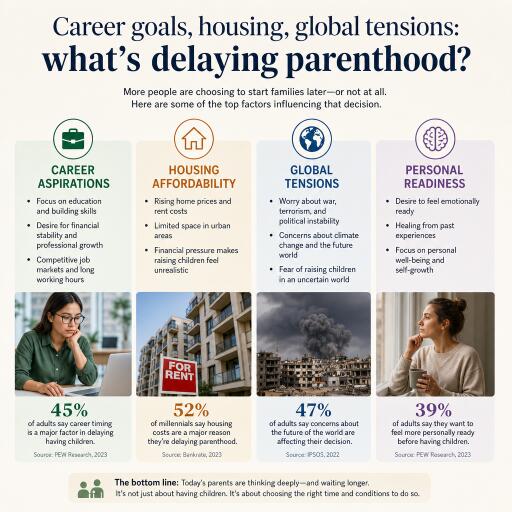
Career goals, housing, global tensions: what’s delaying parenthood?
Luxembourg closed 2024 with its lowest recorded fertility rate: 1.25 children per woman, far from the 2.1 generally considered the replacement threshold. Just 6,459 babies were born over the year, and population growth leaned more on newcomers than on births. Behind those numbers lies a changing landscape of priorities, pressures and profound questions about the future.
It’s not a simple “no”—it’s “not now”
Among people contemplating parenthood, hesitation often sounds like a scheduling problem rather than a definitive refusal. Many describe a desire to stabilize their careers, build savings or finish studies first. Yet even with those boxes ticked, some still perceive a moving target—an elusive “good moment” that never quite arrives. Postponement becomes the plan, and years slip by.
When the home you need feels out of reach
Housing acts as a crucial fulcrum. Prospective parents point to steep rents, high purchase prices and limited space as decisive deterrents. The calculation is pragmatic: children require rooms, proximity to childcare and reliable transit. If the right home can’t be found—or funded—plans are delayed. Families already raising kids report that upsizing is daunting, while younger adults fear getting locked into cramped or precarious arrangements just as their needs expand.
The climate era’s shadow over family planning
Ecological reality—rising temperatures, extreme weather and biodiversity loss—has moved from distant storyline to lived experience. That shift nudges family planning decisions in subtle and not-so-subtle ways. Some weigh the resilience of local infrastructure in heatwaves or floods; others wonder what kind of world their children would inherit by mid-century. There’s also a moral puzzle: balancing the wish for a family with worries about environmental footprints. Even those who still hope to have children may delay until they feel more prepared to navigate an era of compounding risks.
Geopolitics and economic volatility: the ambient uncertainty
Beyond ecology, people cite wars, shifting alliances, inflation and job insecurity as reasons to hesitate. Big life commitments thrive on predictability, and the past few years have delivered anything but. Some argue that no subsidy can offset the feeling of living on unsettled ground—whether that’s anxieties about energy prices, the next crisis or access to stable employment. In short, the background noise of global tension is loudly present in intimate decisions.
Redefining adulthood—and the meaning of “enough”
Not everyone views a lower birth rate as a social ill. For some, a smaller family—or no children—is a deliberate, positive choice that aligns with personal goals. Travel, education, professional growth and financial independence are not mere detours; they are destinations. Parenthood is no longer assumed as the default end point of adulthood, and that cultural shift is reshaping timelines. There’s also an ecological counterpoint: fewer births can mean lower consumption pressure, a consideration that resonates with those prioritizing environmental stewardship.
What could change minds?
Asked what might make parenthood feel more feasible, people tend to converge on practical supports—and diverge on whether they would be enough. Common suggestions include:
- Truly affordable, family-ready housing with access to green space and transit
- Lower childcare costs, expanded places and reliable schedules
- Generous, flexible parental leave for all caregivers
- Predictable working hours and secure contracts
- Targeted relief from the cost-of-living squeeze
Yet others insist the calculus won’t change without something deeper: visible climate adaptation, a clearer sense of long-term stability and institutions that feel resilient to shocks. If the core concern is uncertainty, cash alone may not close the gap.
Immigration’s quiet role
With births declining, population growth increasingly reflects arrivals from abroad. That dynamic can ease labor shortages and add cultural vitality, but it can also mask how fragile the domestic birth trend has become. Relying on migration while local fertility slides raises questions about long-term planning for schools, housing and social services—especially in a small, high-demand country.
A choice that’s gotten heavier
The decision to have a child has never been purely personal; it’s braided into economics, climate, culture and policy. What has changed is the weight of each strand. Housing and affordability now sit at the center. The climate crisis, once abstract, is personal. Geopolitics feels close. And the script for adulthood is more open-ended than it used to be.
Whether these forces prove cyclical or structural remains to be seen. For now, the message behind the statistics is clear: parenthood is less a question of “Do I want children?” than “Under what conditions would bringing a child into this world feel responsible, secure and fair?” Until that answer becomes easier, many will keep waiting—and some will choose a different path altogether.



Leave a Reply