

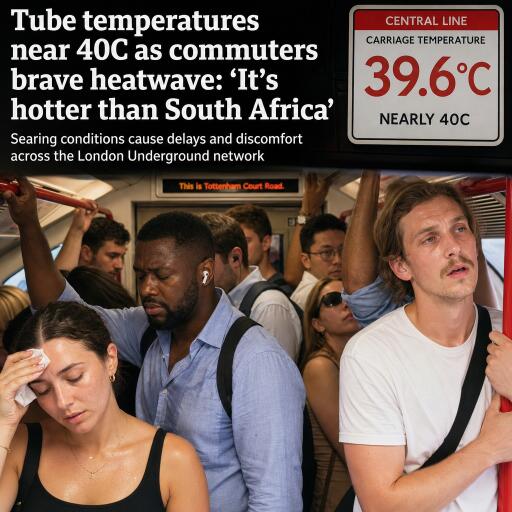
Tube temperatures near 40C as commuters brave heatwave: ‘It’s hotter than South Africa’
Rush-hour passengers sweltered in near-40C heat on the London Underground as a fierce June heatwave toppled UK temperature records and forced speed restrictions across parts of the rail network. With fewer than half of Tube trains fitted with air conditioning, many commuters described journeys that felt more like a sauna than public transport.
Records tumble as red heat warning bites
Meteorologists confirmed a provisional outdoor high of 36.1C at Gosport in Hampshire, eclipsing the long-standing June benchmark of 35.6C set in 1976. The threshold was surpassed repeatedly through the afternoon, underlining how exceptional the heat was for the time of year. A rare red extreme heat warning covered swathes of southern England into Thursday, prompting some schools and workplaces to close and pushing local authorities to open cool spaces for residents without access to air conditioning.
Underground turns into an oven
Spot measurements taken by passengers on older deep-level lines reported carriage temperatures as high as 39.4C on the Central line, one of the capital’s busiest routes. In stark contrast, routes running newer, air-conditioned stock — including the Metropolitan and Elizabeth lines — hovered around 22C. The problem: only about 40 per cent of London Underground trains currently have built-in cooling, leaving many riders to endure stifling conditions in packed carriages.
“I didn’t dare cycle today,” said one office worker who opted for the Victoria line despite its reputation for heat. “The only reason I came in was the office air con.” Another commuter, wearing a basketball jersey, admitted even that wasn’t enough to keep cool, adding that they planned to spend the evening at a local community centre to escape the worst of the heat. “I love the summer buzz,” they said, “but this is pushing it.”
Visitors were also taken aback. A tourist from Johannesburg laughed that the family had landed “for the hottest spell in memory,” noting that it was 9C back home. “It’s hotter than South Africa,” he joked.
Delays, speed limits and a plea for patience
Transport officials warned that extreme heat can cause track temperatures to soar well beyond the air temperature, risking rail expansion and necessitating temporary speed restrictions. That, in turn, can reduce service frequency and lead to delays. Passengers were urged to plan ahead, carry water, and consider whether their journeys were essential during the hottest periods of the day.
City leaders acknowledged that London’s infrastructure — from Victorian-era tunnels to dense, paved streets — remains poorly adapted to high-30s heat. They called for patience during disruptions and reiterated the need to accelerate urban cooling measures, including greening streets, expanding shade, and upgrading rolling stock to withstand more frequent extremes.
What’s driving the heat — and why climate change matters
The broiling conditions have been linked to a “heat dome,” a persistent high-pressure system parked over western Europe that traps hot air and suppresses cloud formation, allowing temperatures to build day after day. Scientists say human-driven climate change is increasing the likelihood, intensity, and duration of such events. By elevating baseline temperatures, global warming makes new records more attainable and hot spells more dangerous, particularly for people with underlying health conditions and those living in poorly insulated or overcrowded homes.
Night-time heat is a growing concern in cities like London, where concrete and brick radiate warmth after sunset. Elevated overnight temperatures limit the body’s ability to recover from daytime stress, compounding health risks and increasing demand for emergency services.
Staying safe and keeping London moving
- Hydrate regularly and carry water on all journeys.
- Avoid travelling at the hottest times where possible; consider flexible hours or remote work.
- Seek out cooler routes or air-conditioned lines when available, and allow extra time for potential delays.
- Use community cooling spaces such as libraries and community centres if home or workplace temperatures are uncomfortable.
- Look out for vulnerable neighbours, including older adults and those with health conditions.
As temperatures edge closer to 40C, London’s daily rhythm is being stress-tested by a climate that no longer plays by old rules. For millions of riders, the priority is simply getting from A to B without overheating. Longer term, the city faces a deeper challenge: redesigning transport and public spaces so that a searing day on the Tube no longer feels inevitable.



Leave a Reply