

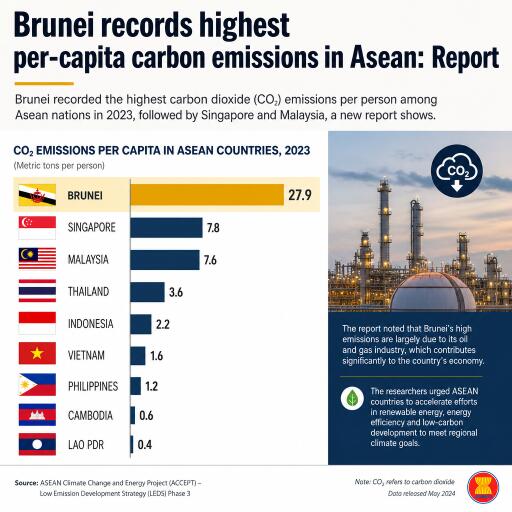
Brunei records highest per-capita carbon emissions in Asean: Report
Brunei Darussalam has emerged as the highest per-capita carbon emitter in Southeast Asia in 2024, outpacing Singapore and Malaysia. While the country’s total greenhouse gas output is modest on a global scale—about 15.2 megatonnes of CO2 equivalent, or roughly 0.03% of worldwide emissions—its per-person footprint is strikingly large at an estimated 32.8 tonnes annually. By comparison, Malaysia’s per-capita emissions stand at 8.16 tonnes, well above the global average of 4.73 tonnes.
Small population, big footprint
Brunei’s outsized per-capita figure reflects a structural dilemma common to small, hydrocarbon-dependent economies. A large share of national income and exports still comes from oil and gas. With a relatively small population, the nation’s energy-intensive production and consumption are spread across fewer people, pushing up the per-capita metric. Carbon dioxide—the main driver of planetary warming—stems primarily from fossil fuel use, industrial processes, and land-use change, all of which remain central to Brunei’s economic model.
A regional trend of rising emissions
The broader picture across Asean shows that per-capita emissions have generally climbed over the past three decades alongside industrialization and demand for energy. Malaysia, for instance, has nearly doubled its per-person emissions from 4.41 tonnes in 1994 to 8.16 tonnes in 2024. While economies have diversified and grown, energy systems in much of the region still rely heavily on fossil fuels, with coal and gas often providing baseload power for expanding urban and industrial hubs.
Policy response and transition efforts
Brunei has set out a national roadmap to curb emissions and bolster climate resilience through the Brunei Darussalam National Climate Change Policy (BNCCP). The policy framework aims to cut greenhouse gas output while ensuring economic stability and future-proofing growth. Key priorities include:
- Reducing industrial emissions through cleaner processes and better controls
- Scaling up energy efficiency across buildings, industry, and public services
- Accelerating renewable energy deployment to diversify power generation
- Expanding electric mobility to reduce dependence on internal combustion engines
- Exploring carbon pricing and market mechanisms to steer investments
- Strengthening forest protection and carbon sinks as natural climate solutions
Authorities have also signaled plans to increase renewable energy capacity and deepen sustainability initiatives, aiming to align economic development with long-term climate goals.
Balancing prosperity with decarbonization
For a resource-rich nation like Brunei, the transition presents both risk and opportunity. On one hand, fossil fuel revenues underpin public finances and social programs; on the other, global momentum toward clean energy is reshaping markets, technology, and capital flows. Managing this pivot requires careful sequencing: expanding efficiency measures now, building out low-carbon infrastructure, and nurturing emerging industries that can thrive in a decarbonizing global economy.
What it takes to bend the curve
Experts consistently point to a package of solutions that, combined, can drive steep emissions cuts:
- Rapid deployment of cleaner power generation, including solar and other renewables
- Grid modernization and storage to integrate variable energy sources
- Efficiency upgrades in industry, transport, and buildings
- Technological innovation, from low-carbon fuels to carbon capture where feasible
- Robust policies and incentives to accelerate private investment
While per-capita emissions place Brunei at the top of the regional ranking, the underlying dynamics—energy demand growth, industrialization, and legacy dependence on fossil fuels—are familiar across Asean. The current figures underscore an urgent but navigable path: aligning economic diversification with decisive climate action to bring emissions down, per person and in total, over the decade ahead.



Leave a Reply