

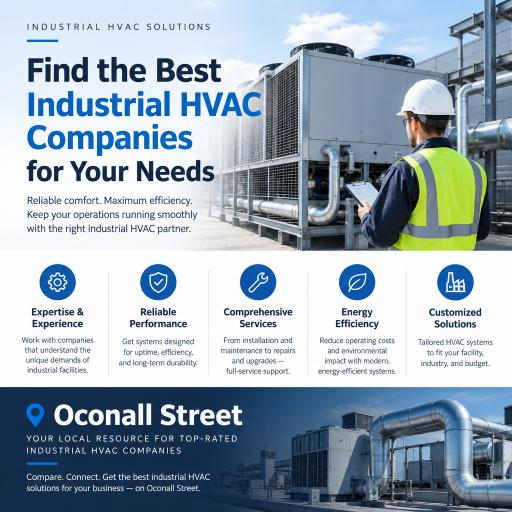
Find the Best Industrial HVAC Companies for Your Needs – Oconall Street
Industrial heating, ventilation, and air-conditioning systems influence far more than indoor temperature. They affect production continuity, worker safety, air quality, product consistency, energy consumption, and a facility’s environmental footprint. Selecting the right HVAC company therefore requires a careful review of technical capability, service quality, and long-term operating value.
Define Your Facility’s Requirements First
Before approaching contractors, document the conditions the HVAC system must manage. Include production schedules, temperature and humidity ranges, ventilation rates, process emissions, contamination risks, available space, and anticipated expansion.
Requirements vary significantly by industry. Food plants may need precise humidity control and hygienic equipment, while fabrication facilities often require powerful extraction for dust, fumes, and excess heat. Laboratories and clean manufacturing spaces may also depend on pressure zoning and advanced filtration. A clear project brief makes proposals easier to compare and reduces the risk of an unsuitable design.
<>
Examine Engineering Experience
A qualified industrial HVAC provider should demonstrate experience with facilities comparable to yours in size, process, and operating conditions. Ask whether the company employs engineers who can conduct load calculations, model airflow, assess heat-generating equipment, and design custom control strategies.
Confirm that the contractor holds all licenses and certifications required in your jurisdiction. Quality-management credentials and recognized industry training can provide additional assurance, but they should be supported by evidence of successful field performance.
Review Comparable Projects
Request examples of completed installations involving similar operational challenges. Useful project documentation should explain the original problem, selected equipment, commissioning process, energy results, and any improvements in reliability or air quality.
Where practical, arrange a visit to an operating site. This can reveal the standard of workmanship, accessibility of components, noise levels, control-system usability, and maintenance requirements. It may also help verify whether promised efficiency gains were achieved under real production conditions.
Prioritize Efficiency and Environmental Performance
Industrial HVAC equipment can represent a substantial portion of a facility’s electricity or fuel demand. Contractors should be able to identify opportunities to reduce consumption without compromising safety or process stability. Possible measures include:
- Variable-speed motors for fans, pumps, and compressors.
- Heat recovery from exhaust air or industrial processes.
- High-efficiency chillers, boilers, and heat pumps.
- Smart controls that respond to occupancy and production loads.
- Improved duct sealing, insulation, and airflow balancing.
- Integration with suitable renewable or low-carbon energy systems.
Ask bidders to state how projected savings were calculated. Estimates should use realistic operating hours, local energy prices, weather conditions, and production loads rather than idealized assumptions.
Assess Maintenance and Emergency Support
Even a well-designed system can become inefficient when filters, coils, sensors, belts, or controls are neglected. Compare preventive maintenance programs carefully, including inspection frequency, covered components, reporting procedures, and performance testing.
For facilities where climate control is production-critical, establish how quickly technicians can respond to failures. Confirm access to replacement parts and specialist support for control systems. Service agreements should define response times, exclusions, labor rates, and responsibilities clearly.
Compare Total Ownership Costs
The lowest installation quote is not always the most economical choice. Evaluate each proposal over the expected service life of the equipment. The analysis should include:
- Purchase and installation costs.
- Projected energy and water consumption.
- Routine maintenance and replacement parts.
- Expected equipment lifespan.
- Warranty coverage and exclusions.
- Potential losses caused by downtime.
- Future upgrades required for regulatory compliance.
Request itemized pricing so that equipment, controls, commissioning, training, and maintenance can be evaluated separately. Performance guarantees can add protection when they define measurable targets and explain how results will be verified.
Check Training and Documentation
Operators need to understand how to use the system efficiently and recognize early signs of trouble. Strong providers offer on-site instruction, maintenance schedules, equipment records, control diagrams, and clear operating manuals. Periodic optimization reviews can also help facilities adapt HVAC settings as production patterns change.
Create a Structured Selection Process
- Prepare a detailed description of operational and environmental needs.
- Develop a shortlist of appropriately licensed industrial specialists.
- Request comparable technical and financial proposals.
- Verify experience through completed projects and references.
- Review compliance with safety, building, emissions, and energy rules.
- Conduct technical meetings to test design assumptions.
- Negotiate warranties, service standards, and performance commitments.
Final Questions Before Signing
- Does the design address present demand and future expansion?
- Are energy calculations transparent and independently verifiable?
- Can essential components be serviced without lengthy shutdowns?
- Are emergency response obligations included in writing?
- Will staff receive adequate training and documentation?
- Does the proposal provide measurable efficiency and air-quality targets?
A capable industrial HVAC partner should combine sound engineering, responsive service, transparent pricing, and credible environmental planning. By comparing providers on lifetime performance rather than initial cost alone, facility managers can secure safer operations, lower emissions, and more predictable energy expenses.



Leave a Reply