

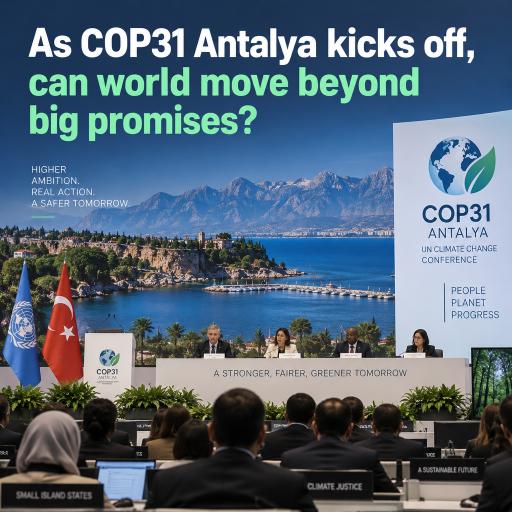
As COP31 Antalya kicks off, can world move beyond big promises?
As diplomats converge on Turkey’s Mediterranean coast for COP31, the polished presentation surrounding the summit contrasts sharply with the worsening climate emergency outside the conference halls.
From November 9 to 20, representatives from nearly every country are due to meet in Antalya, with Turkey hosting the event and Australia guiding the negotiations. Their central challenge is familiar but increasingly urgent: turning years of climate pledges into policies that rapidly reduce emissions and protect vulnerable communities.
The talks follow another season marked by drought, destructive floods, wildfires, extreme heat and shrinking water supplies. Across Europe, record temperatures and low river levels disrupted communities and economic activity. In parts of Asia, catastrophic flooding linked to unstable mountain ice and rising temperatures swept through settlements and caused heavy loss of life.
Meanwhile, global greenhouse gas emissions continue to climb. The internationally agreed ambition of limiting warming to 1.5 degrees Celsius above pre-industrial levels is slipping beyond reach without immediate and exceptionally steep cuts.
Fossil fuels return to the negotiating table
Coal, oil and gas remain the largest sources of human-caused global warming. Yet governments have repeatedly failed to agree on a clear, enforceable timetable for replacing them with cleaner energy.
The Paris Agreement did alter the world’s trajectory. Before its adoption in 2015, projections suggested the planet could warm by roughly 3 to 3.5 degrees Celsius. If countries fully deliver their current commitments, estimates now point to warming of around 2.6 degrees.
That improvement matters, but it is nowhere near safe. Warming at that level would intensify heatwaves, food and water insecurity, ecosystem destruction, coastal flooding and displacement worldwide.
The structure of the UN climate process also limits what any single summit can achieve. Major decisions generally require consensus, allowing a small number of resistant countries to weaken or block ambitious language. Wars, trade disputes, debt pressures and energy-security concerns further complicate negotiations.
Smaller alliances may move faster
With universal agreement difficult, attention is increasingly turning to smaller coalitions of willing governments, businesses and industries. Such partnerships can target specific sectors—including shipping, aviation, heavy industry and electric transport—without waiting for almost 200 countries to adopt identical policies.
A meeting in Colombia earlier in 2026 illustrated this approach. Representatives from dozens of countries and key industries discussed practical routes away from fossil fuels after opposition from oil-producing nations had obstructed stronger language at the previous climate summit.
These alliances cannot replace the UN process, which gives every country a voice and establishes shared global expectations. But they may provide a faster route for testing policies, mobilizing investment and creating markets for low-carbon technology.
Electrification offers an economic argument
Turkey and Australia have placed clean energy and green industrial development among COP31’s priorities. One proposed objective is to raise electricity’s share of global energy consumption from about one-fifth today to 35% by 2035.
If powered by low-carbon sources, wider electrification could reduce emissions from vehicles, buildings and industry. It could also cut fossil-fuel import bills by hundreds of billions of dollars by the middle of the next decade, making the transition attractive to countries seeking greater energy independence.
However, targets alone will not transform energy systems. Governments must expand and modernize electricity grids, accelerate renewable generation, build storage capacity and reform regulations that delay new infrastructure. They must also ensure that households and workers are not left carrying the costs.
Resistance is expected from economies dependent on fossil-fuel exports. Some major producers have repeatedly opposed language calling for a phaseout. China, despite its extraordinary expansion of solar and wind power, also remains wary of international demands that could be interpreted as restricting national energy policy.
Climate finance remains a test of trust
Money will be another major fault line in Antalya. Developing countries have contributed relatively little to historical emissions but often face the most severe impacts. Many need substantial support for flood defenses, resilient agriculture, early-warning systems, clean energy and recovery from unavoidable losses.
At COP29 in Baku, wealthy countries agreed to mobilize at least $300 billion annually in climate finance by 2035. The source, quality and distribution of that money remain disputed. Developing nations are particularly concerned about support arriving as loans that increase already heavy debt burdens.
Recent reductions in development and international climate budgets have deepened mistrust. When industrialized countries fail to meet financial commitments, they weaken their ability to persuade poorer nations to adopt more ambitious emissions targets.
What would make COP31 meaningful?
A credible outcome would require more than another carefully worded declaration. Delegates would need to show how fossil-fuel dependence will decline, how clean electricity systems will be built and how promised finance will reach countries facing the gravest risks.
Progress could include measurable deadlines for grid expansion, renewable energy and battery storage; stronger national climate plans; clearer mechanisms for climate funding; and practical agreements among countries prepared to move faster.
COP31 is unlikely to resolve every conflict within global climate diplomacy. Its real test is whether Antalya produces decisions that change investment, infrastructure and emissions—not merely promises to revisit the same questions at the next summit.



Leave a Reply