

From delight to despair: Indonesians furious as data centre boom drains taps
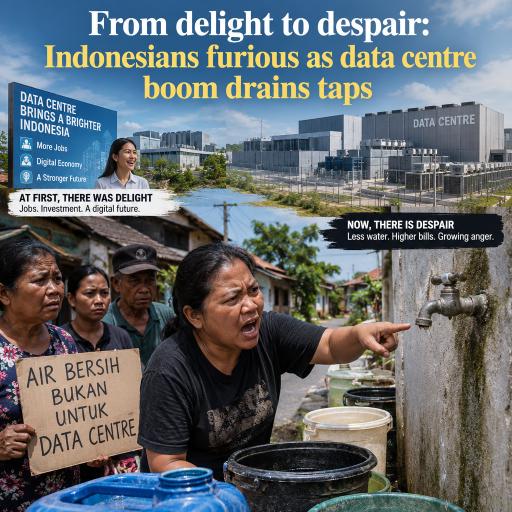
When technology companies began investing in Batam, many residents welcomed the promise of jobs and economic growth. Today, enthusiasm on the Indonesian island has given way to anger as prolonged water disruptions coincide with the rapid expansion of data centres.
In several communities, dry taps have made cooking, washing and running small businesses increasingly difficult. Some households have rationed bottled water, while residents of the coastal village of Mata Ikan have resorted to seawater for basic sanitation.
“Sometimes I skipped my shower,” said Juniardi Adinda Sembiring Gurukinayan, a 54-year-old tradesman. He added that the crisis had affected essential daily tasks, from preparing rice and vegetables to keeping homes clean.
Batam has endured low rainfall and an extended drought intensified by a strong El Niño weather pattern. The local water operator, Air Batam Hilir, has also attributed part of the disruption to an electrical fault affecting distribution infrastructure.
Even so, many residents suspect the island’s growing digital industry is adding pressure to limited resources. Data centres house thousands of servers that generate substantial heat. Depending on their design, the facilities may require large volumes of water for cooling.
Public frustration culminated in demonstrations outside Nongsa Digital Park, a special economic zone containing data centres and other technology businesses. During one protest, residents arrived carrying buckets and demanded the restoration of a reliable supply. A police officer helped fill some of the containers.
At her home in Mata Ikan, 38-year-old Sulastri used water from a plastic bottle to clean dishes. She said shortages had existed for about a year but had become significantly worse during the previous six months.
The disruption has also hurt local livelihoods. Residents who operate food stalls can no longer produce ice as they once did. Tanker deliveries arranged by the authorities have offered limited relief, with some recipients complaining that the distributed water appeared yellow and had an unpleasant smell.
Dispute over the source of the crisis
Officials reject claims that data centres are responsible for Batam’s recent outages. They maintain that climate conditions, falling reservoir levels and technical failures are the main causes.
The Nongsa area is supplied by a reservoir that has fallen to critically low levels, according to the utility. Industry representatives have said the technology park draws water from a different reservoir, although the distinction has done little to ease public concern.
Developers have now been instructed to include seawater desalination plants for cooling, reducing dependence on freshwater intended for communities. Some operators also promote closed-loop systems, which repeatedly circulate the same water instead of continually drawing new supplies.
Such measures are becoming more urgent as drought and rising temperatures increase competition for water. Batam’s utility is considering dredging six reservoirs to improve their capacity, while cloud seeding has been raised as a possible response during exceptionally dry periods.
AI expansion reshapes Southeast Asia
Batam’s dispute reflects a broader challenge across Southeast Asia. Demand for cloud computing and artificial intelligence is driving unprecedented construction of digital infrastructure, particularly in Indonesia and Malaysia.
Regional data-centre capacity is expected to triple between 2025 and 2030 as AI use grows sharply. While this expansion can attract investment and create jobs, it also places additional pressure on water systems and electricity grids that remain heavily dependent on fossil fuels.
The construction wave accelerated after land and resource constraints prompted Singapore to pause approvals for new facilities between 2019 and 2022. Developers increasingly looked to neighbouring locations with available land, undersea cable connections and supportive investment policies.
Malaysia’s Johor state, directly north of Singapore, has emerged as one of the region’s fastest-growing digital hubs. Its operational and planned capacity has risen from roughly 10 megawatts five years ago to about 2.1 gigawatts.
The environmental implications are significant. Projections indicate that data centres could account for around a third of Malaysia’s electricity use by 2035. Authorities have consequently said new projects should proceed only where adequate water and power can be guaranteed.
Communities in Johor have also raised concerns about dust, construction traffic and flash flooding as large industrial sites move closer to residential neighbourhoods. Researchers warn that the state can become a model for sustainable digital development only if utilities, land use and environmental impacts are carefully managed.
Communities demand a voice
Opposition has already altered some development plans. In Kota Damansara, near Kuala Lumpur, a proposed data-centre site remains undeveloped after residents organised a petition, contacted political representatives and campaigned publicly. More than 9,000 people signed the petition before the developer withdrew its planning application.
Neighbours feared constant noise and additional strain on existing infrastructure. They also questioned whether water-intensive facilities should be approved in places vulnerable to shortages when rainfall declines.
The experiences of Batam and Kota Damansara highlight a growing tension at the heart of Southeast Asia’s digital transformation. Communities may welcome investment, but they increasingly expect authorities and companies to prove that new infrastructure will not undermine access to water, clean energy or a safe living environment.
For residents facing empty taps, promises of technological progress offer little comfort. Their message is clear: economic development cannot be considered sustainable if nearby households must sacrifice basic needs to support it.



Leave a Reply