

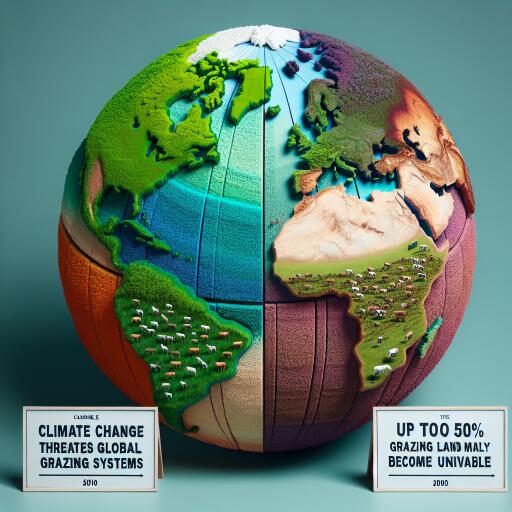
Climate Change Threatens Global Grazing Systems; Up to 50% Grazing Land May Become Unviable by 2100
Global heating is on track to squeeze the world’s great grasslands, with new scientific analysis indicating that 36–50 percent of land currently suitable for open-range livestock could fall outside safe environmental limits by the end of the century. The fallout would reverberate through food systems, rural economies, and cultures that rely on pastoralism.
Grass-based livestock systems span roughly one-third of Earth’s land surface, making them the planet’s most extensive form of agriculture. They provide meat and milk, store carbon in soils, support biodiversity when well managed, and anchor livelihoods for hundreds of millions of people. Yet these systems function only within a “safe climatic space” — a set of conditions that animals, vegetation, and herders can reliably cope with year after year.
A shrinking “safe climatic space”
Researchers assessed four environmental levers that together define grazing suitability: temperature, precipitation, humidity, and wind. Historically, successful grazing has occurred where annual mean temperatures hover from about −3°C up to roughly 29°C, rainfall ranges from roughly 50 to around 2,600 millimetres per year, relative humidity sits near 39–67 percent, and typical wind speeds fall between 1 and 6 metres per second. As the planet warms, more regions are projected to exceed one or more of these thresholds, degrading forage quality, stressing animals, heightening heat and disease risks, and increasing the likelihood of droughts or damaging storms.
Modeling shows that by 2100, compounding climatic shifts could contract the global area suitable for grazing by more than a third, and in a high-emissions future by as much as half. The rapidity of these changes challenges the adaptive capacity of both ecosystems and communities that depend on them.
Who stands to be hit hardest
The people most exposed to shrinking grazing opportunities are, overwhelmingly, those with the fewest resources. Between 51 and 81 percent of affected populations live in low-income countries where undernutrition, political instability, gender inequities, and economic precarity already strain resilience. For these households, livestock are not only food and income; they are savings accounts, dowries, draft power, and social insurance. When grazing falters, the shock multiplies across every facet of life.
Africa’s unique vulnerability
Across continents, Africa emerges as a hotspot of risk. Projections indicate that suitable climatic zones for grazing in key regions — including the Ethiopian Highlands, the East African Rift, the Kalahari, and the Congo Basin — will tend to drift southward. Unlike in the Northern Hemisphere, where climates can shift poleward across vast landmasses, the southern margin of Africa is bounded by the Southern Ocean. As a result, the “safe” zone may effectively slip off the continent altogether, translating into a net loss of viable rangeland rather than a simple relocation.
This geographic trap compounds existing pressures: finite water resources, land-use competition, fencing and cropland expansion that block mobility, and in some places conflict that curtails traditional migration routes.
Why conventional coping strategies may not suffice
Pastoralists have adapted for centuries by moving herds, rotating pastures, and shifting species or breeds. But the coming changes are projected to be broader, faster, and more synchronized across regions than in the past. If climatic conditions push multiple environmental limits at once — hotter temperatures, more erratic rainfall, and altered wind and humidity patterns — simply relocating herds or swapping cattle for sheep, goats, or camels will only partially offset losses. In many areas, there may be nowhere climatically suitable to move to at the necessary scale.
Consequences for food systems and landscapes
- Food security: Tighter grazing space can reduce local supplies of meat and milk, raising prices and nutrition risks, particularly for children.
- Rural livelihoods: Income volatility may spike, prompting distress sales of animals and deepening poverty traps.
- Ecosystems: Concentrating herds into shrinking areas heightens the risk of overgrazing, erosion, and biodiversity loss; attempts to push into marginal or forested zones could amplify land-use conflicts and emissions.
- Public health: More frequent heat stress and disease outbreaks in livestock can undermine productivity and animal welfare.
Rethinking policy and practice
Reducing greenhouse gas emissions remains the most powerful lever to keep more rangelands within safe climatic limits. In parallel, adaptation must accelerate and broaden in scope. Priorities include:
- Protecting and reopening mobility corridors while improving transboundary cooperation for pastoral movement during droughts.
- Investing in water infrastructure, forage reserves, drought-resilient pastures, and heat-tolerant breeds — guided by local knowledge and rigorous climate risk mapping.
- Strengthening social protection, from cash transfers to index-based livestock insurance, to prevent irreversible asset loss during shocks.
- Diversifying incomes in pastoral regions through value-added dairy and meat processing, renewable energy, and ecosystem restoration jobs.
- Building early-warning systems that integrate climate, forage, and market signals to trigger anticipatory action.
The message is stark but not defeatist: without swift climate mitigation and smarter land stewardship, vast swaths of today’s rangelands could slide out of reach for grazing within decades. The choices made this decade — in energy, land management, and rural investment — will determine whether pastoral societies can adapt and whether the world’s largest agricultural system can continue to nourish people and landscapes in a warming world.



Leave a Reply