

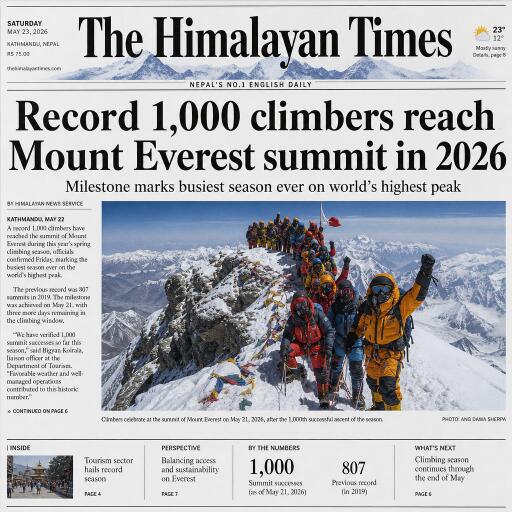
Record 1,000 climbers reach Mount Everest summit in 2026 during busiest season ever
Mount Everest’s 2026 spring season has entered the record books, with more than 1,000 people standing on the 8,849-metre summit — the highest tally ever recorded and a stark illustration of how the world’s tallest peak is changing under the dual pressures of climate and commercial demand.
A historic surge fueled by a rare weather window
Nepalese authorities confirmed that this year’s summit total surpassed the previous record of 877 set in 2019. A lengthy stretch of unusually stable weather opened the door to a dense wave of summit pushes, including an estimated 275 climbers topping out on 21 May alone — the busiest single day of the season.
Nepal issued a record 494 climbing permits to foreign climbers for the south-side route, while the northern approach through Tibet remained closed. The closure funneled nearly all attempts onto the Nepalese side, amplifying crowding on critical sections of the route.
Success, but at a cost
Despite the unprecedented number of successful ascents, the season was not without tragedy: at least five people died. Over the decades, more than 300 climbers and workers have lost their lives on Everest, underscoring that even in banner years, risk remains non-negotiable. Search and rescue teams reported one remarkable survival story: veteran guide Hillary Dawa Sherpa was found and evacuated near Base Camp on 4 June after vanishing below Camp IV, around 25,000 feet, nearly six days earlier.
Amid the celebrations, the debate over capacity intensified. Seasoned professionals urged tighter controls to reduce bottlenecks and exposure in high-hazard zones. Nepal has floated rule changes that would require summit hopefuls to first climb at least one 7,000-metre peak in the country before receiving an Everest permit — a move aimed at improving preparedness and reducing environmental impacts.
Warming Himalaya reshapes the mountain’s risks
Climate change loomed over the season. While a rare calm in the jet stream created an extended weather window, the mountain’s ice is increasingly volatile. A massive, unstable serac — a towering block of glacial ice — hung above a key section of the route and delayed progress for more than two weeks. The route-setting team known as the “icefall doctors,” specialist workers from the Sagarmatha Pollution Control Committee, were forced to wait before installing the ladders and ropes that form the season’s lifeline through the Khumbu Icefall.
Such delays are becoming more common as warming thins and fractures glacial features. Shorter, less predictable freeze periods and changing snowpack stability can amplify the hazards of icefall collapse, crevasse openings, and rockfall. Scientists and global leaders have warned that Himalayan glaciers are retreating at an alarming rate, with consequences for mountaineering safety and for the hundreds of millions of people downstream who rely on high-mountain water towers for drinking, irrigation, and hydropower.
Crowds, commerce, and shifting demographics
Despite rising travel costs and geopolitical uncertainties, demand for Everest remained strong. While participation from some Western countries has softened, the number of climbers from across Asia has grown steadily, reshaping the demographics on the mountain. The convergence of a long weather window, the closure of the northern route, and a record number of permits set the stage for heavy traffic and complicated logistics on summit days.
Veteran climbers and guides continue to call for smarter crowd management — from stricter experience requirements to daily caps on climbers entering high-risk sections — to avoid queueing in the “death zone,” where thin air and fatigue magnify the consequences of any delay.
Icons and milestones
Among this year’s highlights, renowned Nepali guide Kami Rita Sherpa notched his 32nd Everest summit, a testament to the expertise and endurance of the local workforce that makes modern Himalayan mountaineering possible. His achievement also sharpened focus on the Sherpa community’s outsized exposure to risk, especially in unstable areas like the Khumbu Icefall.
Protecting a fragile summit ecosystem
Everest is more than a mountaineering prize; it is a fragile high-alpine ecosystem straining under increased human pressure. While waste management and route maintenance have improved markedly thanks to local initiatives, the sheer number of climbers compounds challenges: human waste disposal at high camps, microplastic and gear debris, and trail degradation. As the mountain warms, permafrost thaw can destabilize slopes, and glacial retreat alters the route year to year, complicating clean-up and safety efforts.
Balancing access, safety, and stewardship will define Everest’s near future. Proposals on the table — from prior high-altitude experience requirements to stricter limits on daily traffic and enhanced oversight of expedition operators — aim to curb risk while reducing environmental harm. Better weather forecasting, oxygen management, and rescue capacity can mitigate some dangers, but none fully offsets the underlying trends of a warming, increasingly brittle mountain.
What 2026 tells us
This was Everest’s busiest season ever, a confluence of favorable winds, record permitting, and pent-up demand. It also served as a reminder that climate change is reshaping the rules at the roof of the world. The path forward will likely require fewer people in the most hazardous zones at the same time, more rigorous preparation, and deeper investment in the communities and ecosystems that sustain Himalayan mountaineering.
In the shadow of record-breaking success, the mountain is sending a clear message: adapt, or the margin for error will continue to shrink.



Leave a Reply