

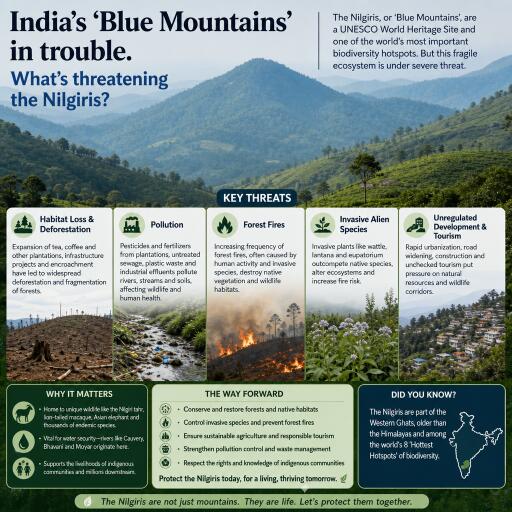
India’s ‘Blue Mountains’ in trouble. What’s threatening the Nilgiris?
Where the Deccan plateau heaves upward into cool air and drifting mist, a highland mosaic of shola forests and rolling grasslands holds together one of South Asia’s most extraordinary natural systems: the Nilgiris. Named for the kurinji, the purple-blue wildflower that cloaks these slopes once every 12 years, this upland is both sanctuary and lifeline—an ecological engine that hums beneath the bustle of southern India.
The living engine of South India
Spanning the tri-junction of Tamil Nadu, Kerala and Karnataka, the Nilgiris anchor India’s first UNESCO Biosphere Reserve—about 5,520 square kilometers of montane habitats interlaced with working landscapes. Beyond postcard views, these hills regulate water, modulate climate and shelter biodiversity that links evolutionary threads to both Africa and Southeast Asia.
A refuge of rare life
The reserve supports roughly 3,500 species of flowering plants, about 100 mammals, more than 550 birds, some 30 reptiles and amphibians, and at least 300 butterflies. Endemic icons such as the Nilgiri tahr—sure-footed on steep, grassy escarpments—and the ebony-coated Nilgiri langur survive here and nowhere else. Their future rises and falls with the health of high-altitude grasslands and evergreen shola forests that stitch the ridgelines and valleys together.
Water, climate and carbon—quiet services with vast reach
From these slopes spring the Bhavani, Moyar, Pykara and Sigur, headwaters that feed the Cauvery basin and, downstream, households and farms across states. The shola–grassland mosaic acts like a giant sponge, soaking up monsoon rain, releasing it gradually, and recharging aquifers far beyond the hills. These ecosystems also function as a significant carbon sink, locking away atmospheric carbon in living biomass and deep soils—quiet climate work with regional benefits.
Warning signs mount
Over the past two decades, satellite analyses show hill temperatures rising by roughly 1°C, growing seasons shifting and, in some forest types, a drop in living biomass. Those changes hint at weakening carbon storage and altered water regulation—the ecological equivalent of a pulse gone irregular. Meanwhile, pressure on the landscape is intense: much of the Nilgiris has long since been converted to tea estates, farms, roads, towns and resorts, fragmenting habitats and narrowing the room for wildlife to move and feed.
Weather on a tilt
Mountain communities describe monsoons that now arrive later and in shorter, more violent bursts. Records reflect the trend: a long-term decline in rainy days since the mid-20th century, even as temperatures keep climbing. Erratic downpours batter hillslopes, disrupt tea and vegetable harvests, and challenge water storage. During El Niño years, lean rainfall can push the system toward crisis—tightening the screw on both ecosystems and local economies.
Invasives, fragmentation and wildlife at the doorstep
Non-native plants—especially wattle, lantana and eucalyptus—have colonized large swathes of the plateau, outcompeting native shrubs and grasses and altering fire, water and nutrient dynamics. On degraded upper slopes where natural forage thins, large mammals wander closer to human settlements. High-elevation towns are seeing more frequent elephant incursions, a visible symptom of frayed ecological buffers and shrinking wild larders. When rainfall falters, encounters spike as people and wildlife converge on the same scarce water and food.
Tourism’s footprint
Mass tourism brings revenue but also roads, traffic and waste to a fragile montane system. Without checks, congestion can jam wildlife corridors and erode streamsides, while the hum of constant vehicles fragments the quiet that many species use as a cue for movement and feeding. The hills’ ability to absorb visitors depends on careful limits and infrastructure that respects ecological thresholds.
Signs of a course correction
Local authorities and conservation groups are pushing a suite of practical measures that—if scaled and sustained—can bend the curve:
- Visitor controls: A mandatory e-pass caps vehicular entry to reduce congestion and pollution—6,000 vehicles on weekdays and 8,000 on weekends—easing pressure on roads, wildlife crossings and hill-town air quality.
- Climate and decarbonisation planning: A district-scale roadmap to 2050 targets emissions cuts, climate resilience and restoration, pairing clean energy and transport with water security and habitat recovery.
- Invasive removal at scale: More than 38,000 hectares have been cleared of aggressive exotics, opening space for native grasses and shola saplings to reclaim ground and revive the sponge effect.
- Flagship species recovery: A dedicated programme for the Nilgiri tahr focuses on restoring high-altitude grasslands and reconnecting fragments. Surveys report numbers rising—from just over a thousand individuals in 2024 to about 1,300 in 2025—and the species is returning to cliffs where it had vanished for years.
What must come next
Safeguarding the Blue Mountains requires aligning livelihoods with landscape function. That means:
- Protecting and expanding shola–grassland mosaics through assisted natural regeneration, native plant nurseries and incentives for private land stewardship.
- Targeted invasive control linked to long-term maintenance, not just one-time clearing.
- Securing wildlife corridors with fencing where needed, smart lighting, and road-calming to cut collisions and ease animal movement.
- Water-wise agriculture—soil mulching, rainwater harvesting, agroforestry and less water-thirsty crops—to buffer erratic monsoons.
- Tourism that pays for its footprint: limits enforced year-round, waste recovered at source, and revenues reinvested in local conservation and community benefits.
- Continuous ecological monitoring to track phenology, fire risk, groundwater and carbon stocks, so decisions keep pace with a changing climate.
The Nilgiris is not a fortress wilderness but a working landscape where towns, estates and wildlife are tightly interwoven. Its future hinges on keeping the ecological machinery—water regulation, climate buffering, biodiversity—intact. Do that, and the plateau’s mist and grass will continue to underwrite life and livelihoods far beyond the ridgelines. Fail, and the consequences will roll downhill, felt in taps, fields and city heat across southern India.



Leave a Reply