

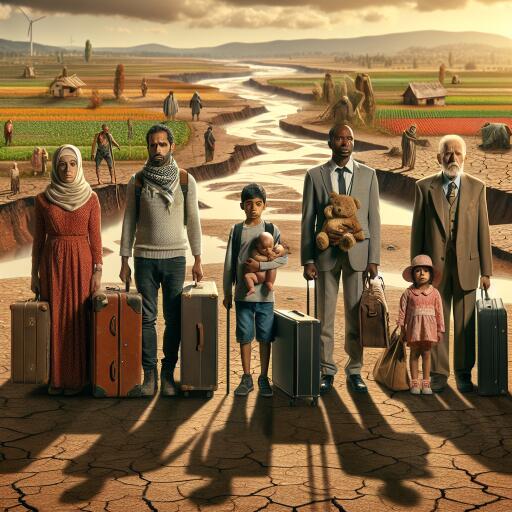
‘We had to leave everything behind’: Meet Europe’s climate migrants
In a matter of hours, familiar places across Europe have become unlivable for people who never expected to move. Extreme floods, ferocious wildfires and longer droughts are pushing families to pack up and start again—often just a few towns away, sometimes across the country. What used to be an abstract forecast is now a lived reality: internal climate migration is here, reshaping communities from the Aegean to the North Sea.
Greece: After the waters, a reckoning
On a September night in 2023, a father and son clung to the roof of their semi-truck as floodwaters surged through Palamas, in central Greece. For nine hours, they watched the water climb toward their feet. Their eventual rescue felt like a miracle; the days that followed did not. “You start fearing every cloud,” the father says. He moved his family to higher ground, unwilling to test fate twice.
Many neighbors had fewer options. Some scattered to nearby cities, others to Athens, and a few abroad. Greece has seen hundreds of thousands displaced by wildfires, storms and floods since 2008, with Storm Daniel a brutal turning point. The shock lingers. Residents talk openly of sleepless nights and the weight of starting over with nothing but paperwork and memories.
Numbers behind the exodus
Across the European Union, an international displacement center estimates more than 400,000 people have been uprooted by weather disasters since 2008. The year 2023 was the worst yet, driven largely by wildfires and storms. Behind the statistics are fractured routines: schools closed, jobs paused, medical care disrupted, neighborhoods dispersed.
Germany: Fire in the pines, fury in the rivers
In Germany’s northeast, parched forests now ignite with unsettling ease. Recent years have brought the most extensive wildfires on record there, and farmers watch the sky for rain that rarely comes. Elsewhere, especially in the south and west, the danger is water in terrifying excess. Since 2008, most of the country’s internal displacements have been caused by floods.
The Ahr Valley deluge in 2021 remains a national scar: more than a hundred lives lost, tens of thousands affected, bridges and wastewater systems torn away. Aid coordinators say thousands were at least temporarily homeless, their houses gutted or gone. Temporary container settlements, meant as stopgaps, lingered for years. Even after the waters receded, the shortages—of doctors, pharmacies, reliable transport—kept daily life precarious.
When a village splits in two
In the Thessalian plain of central Greece, Vlochos sits at the region’s lowest point—an unlucky geography that locals have never forgotten. Floods in living memory scar the timeline: the 1950s, the 1990s, and then 2023, when water climbed nearly to the ceilings in many homes. Solidarity was spontaneous at first: younger residents ferried supplies, older neighbors opened spare rooms, and families shared whatever survived the mud.
Then came the hardest question: rebuild here or move the village uphill? Authorities offered relocation if a clear majority agreed. In nearby Metamorphosis, a place hit repeatedly by flooding, the answer was decisive—most households voted to move. But Vlochos is torn. Some argue the site is untenable; they’ve already resettled elsewhere and want a safer, collective future for their home community. Others cannot imagine leaving ancestral ground. Voices rise, tempers fray, and friends avoid the topic. “We were all shaken,” one resident admits. “It sits in your nerves like a storm that never ends.”
France: The north drowns, the south burns
In Blendecques, northern France, one winter flood swallowed a lifetime in a day. A father of two grabbed documents, a few keepsakes, and looked back at a house where his children’s first steps once echoed—a ground floor now under more than a meter of water. The town had flooded before, but the pace and power kept escalating. Labeled a high-risk zone, homes became nearly impossible to sell. “We were stuck,” he says. He and hundreds of others left that day, joining a reluctant procession to higher ground. Safety returned slowly; the anxiety at the sound of rain did not.
France is contending with a triple squeeze: swollen rivers in the north, wildfire seasons creeping wider in the south, coastlines eroding and glaciers retreating in the Alps. A recent national survey suggests that nearly one in four residents would consider moving because of climate risk where they live. In 2022 alone, tens of thousands were displaced by environmental disasters, underscoring that internal climate migration is no longer marginal—it is a policy challenge unfolding in real time.
What 2050 could bring
By mid-century, Europe is projected to be around 2.5°C warmer than in pre-industrial times. The Mediterranean will see longer, harsher droughts and more dangerous heatwaves. Central and western regions face heavier downpours and flash floods. As hazards intensify, relocation will become both a personal calculus and a collective negotiation: proximity to work and schools, access to basic services, and whether communities can afford to adapt in place—or must retreat.
Demographers warn that internal mobility tied to climate stress will rise steadily. Some places can be defended with smarter planning—restored floodplains, fire-resilient forests, cooling infrastructure. Others will need managed retreat, fair compensation, and social support that keeps communities intact even as they move. The choice is not between staying or going, but between drifting in crisis or moving with dignity.
For Europe’s new climate migrants, the road ahead is not just about a new address. It is about securing a sense of home that can outlast the next storm, the next spark, the next season that refuses to behave like the last.



Leave a Reply