

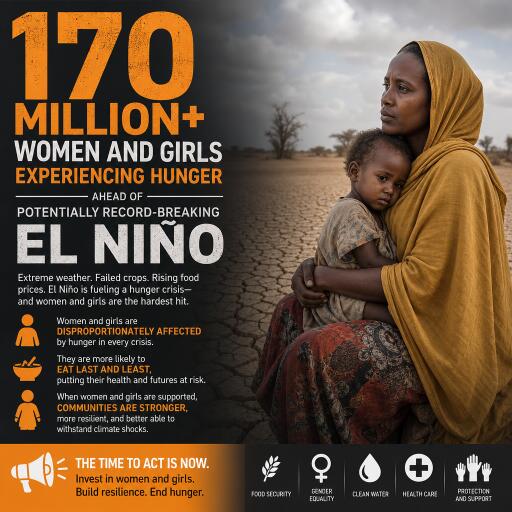
170 million+ women and girls experiencing hunger ahead of potentially record-breaking El Niño
A powerful El Niño is taking shape over the Pacific, warping weather across the globe and setting the stage for a sharp rise in hunger, disease and displacement from the Horn of Africa to South Asia and the Andes. Women and girls are poised to shoulder the heaviest burden: an estimated 172.3 million are already experiencing food insecurity in the countries most exposed to El Niño’s impacts. As drought grips some regions and others are hit by destructive floods, existing inequalities mean that in 20 of 22 high‑risk countries, women and girls are going hungrier than men.
Why the impacts are gendered
El Niño does not strike a blank slate. It collides with poverty, conflict, fragile health systems, and rising costs of living, transforming a climate pattern into a humanitarian emergency. Women and girls are more likely to eat last and least within households, have less access to land, credit and markets, and face higher barriers to recovery after a shock. When crops fail or prices surge, girls are also at greater risk of dropping out of school, early marriage and gender-based violence. These dynamics intensify during prolonged crises and displacement.
Drought here, deluge there — and cascading crises
The last blockbuster El Niño in 2015–2016 affected roughly 60 million people. Today, the baseline is far worse: more people are already displaced or food insecure, fertilizer prices remain volatile, and health systems are still strained by recent epidemics. El Niño acts as a threat multiplier, with extreme conditions and hunger likely to persist into 2027.
In Southeast Asia, several provinces face deepening drought and poor harvests, followed by forecasts of fewer but stronger typhoons later in the year — a one-two punch for rural households already squeezed by higher rice and fuel prices. In the Horn of Africa, nearly one in three people in Somalia struggles to find enough to eat. Repeated cycles of drought and flood leave families rebuilding again and again, while late humanitarian funding makes it difficult to prevent crises before they escalate.
Malnutrition costs are climbing
Treating child malnutrition is becoming more expensive and logistically challenging. Increased commodity prices, disrupted supply chains and aid cuts have pushed up the average cost of therapeutic supplies by about $40 per child in many El Niño-affected countries. For the nearly 7 million children already facing malnutrition, that translates into roughly $275 million in additional costs — even before the full impacts of this El Niño arrive. Delays now will mean steeper bills and preventable loss of life later.
Act before disaster strikes
The fastest, most cost‑effective relief is the kind that arrives before crops fail or rivers burst their banks. Investing in anticipatory action, preparedness and rapid response — especially in high‑risk countries — consistently saves lives, protects livelihoods and reduces overall humanitarian spending. Crucially, putting women at the center of planning and delivery makes these interventions more equitable and effective.
Across climate‑vulnerable regions, women‑led and community‑based groups are already building early‑warning systems and local response plans tailored to the realities they face. When these efforts are resourced in advance, households can take practical steps that blunt the blow of extreme weather:
- Protecting crops and livestock ahead of forecast droughts or floods
- Securing safe water supplies and pre‑positioning essential health and nutrition commodities
- Providing anticipatory cash so families can buy food and pay for transport, shelter or medical care
- Expanding climate‑resilient farming, including drought‑tolerant seeds and locally produced fertilizers
- Supporting women’s leadership, training and decision‑making in local disaster committees
Women’s leadership is a force multiplier
When women design and lead local preparedness — from setting risk “triggers” for early action to organizing grassroots response teams — aid reaches those most in need faster and with services they actually prioritize. This can mean ensuring safe distribution points for food and cash, integrating protection from gender‑based violence into relief, and keeping girls in school during crisis. Evidence from past El Niño events shows that such locally led, gender‑responsive strategies cut losses and speed recovery.
The window is closing
With ocean temperatures climbing and forecasts pointing to a strong event, the world has a narrowing window to prevent a surge in hunger and disease. A coordinated push is urgently needed to:
- Scale up anticipatory financing in the most exposed countries
- Reinforce national safety nets and nutrition programs before peak lean seasons
- Lower barriers for women‑led and local organizations to access funds quickly
- Pre‑position health, water and nutrition supplies where access could be cut off
- Safeguard education for girls and integrate protection services into all responses
El Niño will always be a climate driver. Whether it becomes a humanitarian catastrophe depends on what we do now. Investing early — and trusting the leadership of women on the frontlines — remains the surest way to keep families fed, safe and resilient in the months ahead.



Leave a Reply