

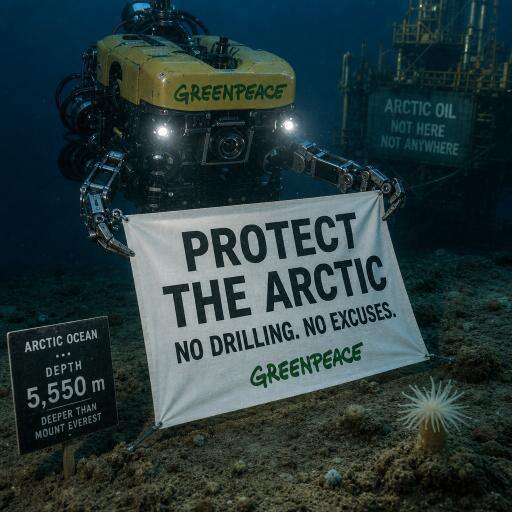
Greenpeace Robot Stages Deepest Arctic Seabed Protest
In a striking blend of science and activism, a Greenpeace-led research team has unfurled a protest banner more than two kilometers beneath the Arctic Ocean’s surface, making a symbolic stand for deep-sea protection at one of the planet’s most enigmatic undersea landscapes.
The action took place along the Arctic Mid-Ocean Ridge, where the expedition’s remotely operated vehicle descended to approximately 2,315 meters and paused at a hydrothermal vent field known as Loki’s Castle. Here, superheated fluids—reaching around 300 to 320 degrees Celsius—vent from the ocean crust, feeding a thriving community of microbes and specialized fauna. Scientists regard sites like this as biodiversity hotspots and evolutionary touchstones, with some proposing that similar conditions may have nurtured the earliest roots of complex life on Earth.
Greenpeace’s team emphasized that the dive was first and foremost a scientific survey of largely unexplored deep-sea ecosystems. The banner—imploring global leaders to heed scientific evidence—was a deliberate, visual reminder that political pledges to safeguard the ocean need to be matched with concrete action. Governments have repeatedly endorsed global conservation targets, including the commitment to protect 30 percent of the world’s ocean by 2030. Researchers and campaigners argue that achieving those goals is incompatible with opening fragile deep-sea regions to industrial extraction.
The Arctic is warming at more than twice the global average, redrawing the boundaries of ice, ecosystems, and industry. As sea ice retreats and technologies advance, commercial interest in the deep ocean—from fishing to potential seabed mining—has intensified. Scientists warn that mining the seabed could cause irreversible damage: habitat destruction on the seafloor, sediment plumes that smother life across vast areas, chronic noise and light in perpetual darkness, and the release of pollutants that could travel through deep currents and food webs.
During the expedition, the lead scientists underscored that it is still possible to avert the worst outcomes if policymakers move decisively. They advocated for a precautionary approach: establish a global network of ocean sanctuaries that includes vulnerable deep-sea zones, and pause any new industrial activity—particularly deep-sea mining—until science can conclusively show it will not compromise biodiversity or undermine ocean health.
Loki’s Castle and nearby seamounts represent more than scientific curiosity. These volcanic landscapes host unique lifeforms adapted to extreme conditions—organisms that rely not on sunlight, but on chemical energy from vents. Disturbing these systems could erase species before they are even described, while degrading processes that help regulate the ocean’s chemistry and, by extension, the planet’s climate stability.
The team also used the mission to publicly share real-time observations from the seafloor, aiming to bridge the gap between inaccessible science and public understanding. Their message: the deep ocean is not an empty expanse. It is intricate, living, and vulnerable—and decisions made in the coming years will determine whether these ecosystems persist.
Policy debates in the region have become more urgent. A large swath of the Arctic Mid-Ocean Ridge was opened for potential deep-sea mining in 2024, though implementation has stalled amid pushback from environmental groups, fishers, scientists, and political leaders concerned about long-term impacts. Across the globe, a growing number of governments, companies, and communities support a moratorium on deep-sea mining until robust safeguards and scientific certainty are in place.
Greenpeace’s expedition calls on decision-makers to align rhetoric with reality: deliver on climate commitments, fully implement emerging ocean protection frameworks that can secure at least 30 percent of marine areas by 2030, and enact an immediate pause on deep-sea mining. Protecting critical habitats like Loki’s Castle, they argue, would create a buffer against accelerating climate shocks, bolster the resilience of marine life, and preserve evolutionary heritage that may hold clues to life’s origins and future biotechnological breakthroughs.
For now, the banner held by a small robot in the dark reaches of the Arctic carries a simple instruction from the scientific community: listen to the evidence. Whether that message translates into protected waters and intact seafloors will depend on choices made far above the waves, in policy rooms where the deep ocean has too often been out of sight and out of mind.



Leave a Reply