

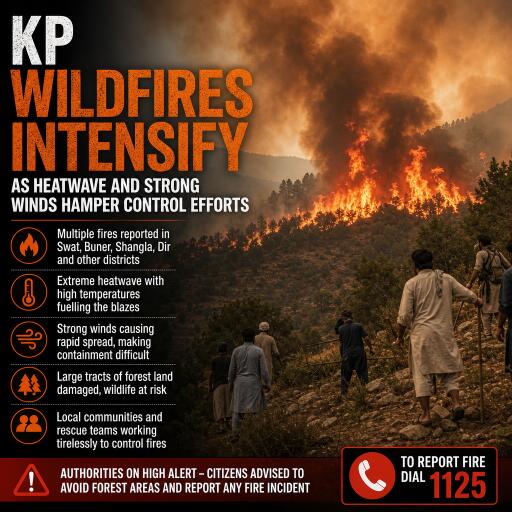
KP Wildfires Intensify as Heatwave and Strong Winds Hamper Control Efforts
Wildfires in the Upper Dir district of Khyber Pakhtunkhwa are escalating amid a punishing heatwave and gusty winds, overwhelming ground crews and heightening risks for nearby communities and ecosystems. Officials say fast-changing weather, bone-dry vegetation, and rugged terrain are combining to fuel unpredictable fire behavior across several forested zones.
Heat and Wind Create a Dangerous Feedback Loop
The current conditions are a classic recipe for rapid wildfire spread. Prolonged high temperatures have desiccated grasses, shrubs, and leaf litter, turning the understory into a tinderbox. Strong, shifting winds are then driving flames across slopes and ridgelines, lofting embers into unburned areas and igniting new spot fires. In such terrain, even small changes in wind direction can cut off access routes and complicate containment lines.
Fire crews report that smoke columns and hot, erratic gusts have limited visibility and made direct attacks hazardous. Water delivery is difficult in remote sections, and narrow mountain roads slow the movement of personnel and equipment. These constraints make rapid containment unlikely while the heatwave persists.
Communities on Alert as Crews Work Around the Clock
Local administration teams, rescue services, and forest department staff—supported by volunteers—are engaged in nonstop operations to hold the line where they can. Their priorities include protecting settlements, keeping evacuation routes open, and preventing the fire from jumping into new valleys. Residents close to affected zones have been urged to remain vigilant, monitor official advisories, and prepare to move if conditions deteriorate.
Authorities have flagged multiple areas with active fire and dense smoke, some in hard-to-reach locations. Air quality has worsened intermittently as plumes drift downslope, posing respiratory risks for children, older adults, and people with existing health conditions. Temporary shelters and medical support are being kept on standby where needed.
Ecological Stakes: Forests, Wildlife, and Watersheds
Environmental specialists warn that extended burning could exact a heavy toll on biodiversity. Many of the forests in Upper Dir provide habitat corridors for wildlife, stabilize mountain soils, and regulate local hydrology. Intense fire can scorch tree canopies, consume ground cover, and leave steep hillsides vulnerable to erosion and flash flooding once monsoon rains arrive. Loss of seed banks and nesting sites can set back forest regeneration and fragment wildlife ranges.
There is also a climate dimension: when forests burn, they release stored carbon into the atmosphere, while the loss of mature trees reduces the landscape’s capacity to absorb future emissions. Repeated severe fires can push ecosystems toward less diverse, more fire-prone states.
Why This Season Is Especially Volatile
The surge in fire activity aligns with a broader pattern of extreme heat across much of the country. Hotter, drier spells increase the likelihood that routine ignitions—whether from human activity or natural causes—expand into fast-moving fires. In mountainous regions, warming can also shorten the moist season and reduce fuel moisture for longer periods, effectively lengthening the fire window. Combined with strong winds, these conditions strain response systems and limit safe opportunities for containment.
What Authorities and Residents Can Do Now
While large-scale control hinges on a break in the weather, immediate actions can reduce risks:
- Avoid any open burning or activities that produce sparks near dry vegetation.
- Report smoke or new fire starts promptly through local hotlines.
- Clear flammable debris from around homes and community buildings; store fuel and gas cylinders safely.
- Prepare go-bags with essentials, medications, and identification in case of evacuation.
- Limit outdoor activity when smoke is heavy; use masks if available to reduce inhalation of fine particles.
- Follow evacuation instructions without delay if ordered by authorities.
Building Resilience for Future Fire Seasons
Experts emphasize that reducing wildfire risk in the long term requires a layered strategy. Priorities include strengthening early warning systems, improving fuel management through targeted thinning and controlled burns where appropriate, and creating defensible spaces around villages and infrastructure. Investment in training, communications, and rapid deployment—potentially including aerial support when feasible—can help responders act during the narrow windows when weather favors suppression.
Post-fire recovery is equally critical. Replanting with native, fire-resilient species, stabilizing slopes, and restoring riparian buffers can curb erosion and speed ecological recovery. Community education and fire-safe planning—integrated with climate adaptation policies—will be essential as heat extremes become more frequent.
Outlook
With temperatures still elevated and winds variable, officials caution that conditions could worsen before they improve. Monitoring remains intensive, and emergency teams continue to prioritize life safety and the protection of critical forest assets. Any sustained cooldown or humidity increase could provide a window to expand containment lines. Until then, vigilance and coordinated action will be vital to limit damage and safeguard communities and ecosystems in Upper Dir and beyond.



Leave a Reply