

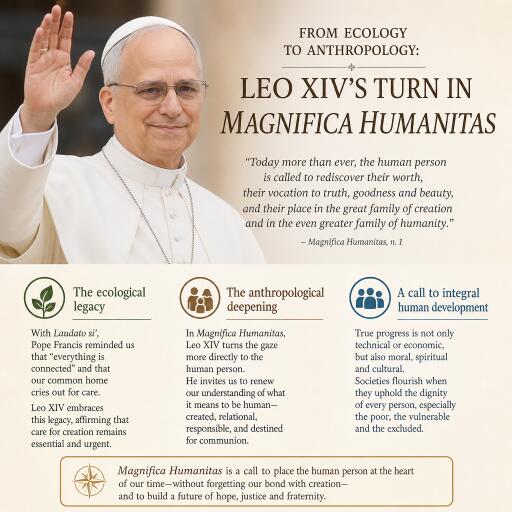
From ecology to anthropology: Leo XIV’s turn in Magnifica Humanitas
The first encyclical of Leo XIV signals a notable change in emphasis within recent Catholic teaching. Care for the environment remains present, as does concern about runaway technology and an economy cut loose from ethical restraint. Yet the heart of the document lies elsewhere. Rather than making the planet the main lens through which every crisis is viewed, the pope places the human person at the center of the analysis.
This is more than a change in vocabulary. It is a reordering of priorities. The text suggests that ecological decline, social fragmentation, and technological excess all stem from a deeper disorder: humanity has become uncertain about what it is. The key problem is no longer framed first as damage done to the Earth, but as damage done to the human being.
That shift gives Magnifica Humanitas a distinct tone. Environmental language does not disappear, but it no longer dominates. In its place comes a richer anthropological and theological vocabulary: truth, human nature, freedom, vulnerability, grace, limit, and the meaning of embodiment. Leo XIV appears less interested in asking how humanity manages nature than in asking what humanity is becoming.
From an ecology-and-technology perspective, this pivot is highly significant. In many public debates, environmental concerns have increasingly been bundled with digital governance, economic planning, global coordination, and technological optimization. Leo XIV does not reject those concerns. Instead, he warns that any solution built on shallow assumptions about the person will fail. If people come to see themselves as programmable systems, modifiable bodies, or data points in a technical network, then no amount of sustainable rhetoric will address the real crisis.
The encyclical therefore treats technocracy not simply as a model that exploits natural resources, but as a force that can reshape human identity itself. This is where the document becomes especially relevant to the age of artificial intelligence, biometric surveillance, predictive systems, and platform-driven culture. The danger is not only that machines replace labor or increase efficiency at a moral cost. It is that technological systems begin to mediate memory, attention, judgment, and even desire.
In that sense, AI appears not merely as a tool but as an environment of influence. When algorithms determine what people see, what they value, and what they consider credible, technology moves from the level of instrument to the level of interior formation. Leo XIV’s concern is that a civilization governed this way may lose something essential: the capacity for inward freedom.
The encyclical’s treatment of transhumanism sharpens this critique. Leo XIV identifies in it an old temptation wrapped in futuristic language: the belief that the human condition can be overcome through technical power alone. The dream of abolishing limits, eliminating vulnerability, redesigning the body, and escaping dependence is presented as progress. But the pope reads it as a profound misunderstanding of human dignity.
His answer is not based on nostalgia or fear of scientific innovation. It is rooted in a theological claim: vulnerability is not a defect to be erased at any cost, and the body is not raw material awaiting endless redesign. Human greatness does not come from self-manufacture. It comes from receiving life as a gift and directing it toward truth and grace.
This is where Magnifica Humanitas clearly departs from a purely environmental framework. The document suggests that the gravest modern threat is not only a wounded biosphere, but a wounded anthropology. A polluted river can be restored; a culture that no longer knows what a human being is faces a much deeper unraveling.
That does not weaken ecological concern. On the contrary, it gives it a different foundation. If people lose their sense of creatureliness, they will also lose the moral basis for caring about creation. A society determined to manipulate everything—including sex, birth, death, memory, and identity—will not stop at forests or oceans. The same mentality that refuses limits in human life is unlikely to respect limits in the natural world.
Leo XIV also links this anthropological crisis to the erosion of memory, culture, and belonging. In a digitized global order, rootless individuals and uprooted communities are easier to manage. The loss of historical continuity and shared identity may be advertised as liberation, but it can also produce passivity and dependence. The defense of peoples, traditions, and cultural inheritance therefore appears in the encyclical as part of the defense of the person.
Seen this way, ecology becomes one dimension of a broader struggle against total manipulation. The question is no longer just how to protect the environment, but how to preserve reality itself from being treated as infinitely malleable. Nature, the body, culture, family, and faith all come under pressure when technical power is accepted as the final authority.
That is why this encyclical may mark a turning point. It does not discard the environmental concerns that shaped much of recent Catholic discourse. It absorbs them into a larger vision. The decisive term is no longer “planet” but “person.” The central warning is that a civilization can speak endlessly about saving the Earth while quietly hollowing out the human being.
For observers of religion, ecology, and technology, this is a consequential development. Leo XIV appears to be saying that environmental repair without anthropological clarity is unstable. Sustainability, if detached from a sound account of human dignity, can become another managerial slogan. Technological progress, if detached from moral truth, can become an elegant form of domination.
Magnifica Humanitas ultimately argues that the defense of creation begins with the defense of the human person. Not because humanity stands apart from the rest of creation, but because the crisis of the age begins when people forget that they are creatures, not engineers of their own essence. In Leo XIV’s vision, the environmental emergency remains real, but it is nested within something more fundamental: a civilizational crisis over what it means to be human.
That is the encyclical’s most striking intervention. It shifts the debate from climate and systems to conscience and identity, from ecosystems alone to the drama of human self-understanding. In doing so, it reframes the Church’s public voice for a century increasingly defined not only by ecological pressure, but by the technological remaking of life itself.



Leave a Reply