

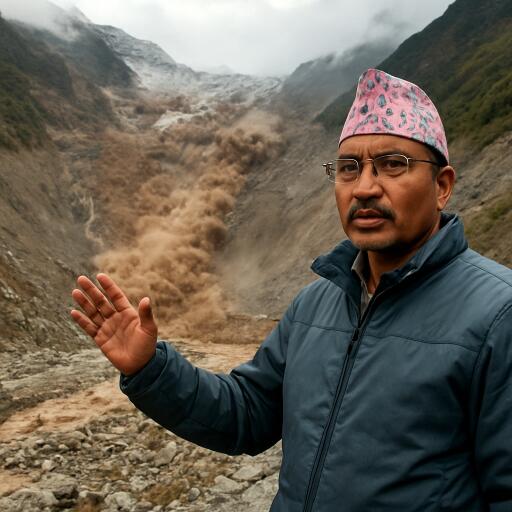
Nepalese expert: Cross-border mudslide triggered by climate-driven glacier collapse in Nepal
A disaster specialist from Nepal says a destructive cross-border mudslide was most likely set in motion by the collapse of a glacier system destabilized by climate change in the high Himalayas. According to the expert’s assessment, prolonged warming at extreme elevations has accelerated the melting of snow and ice, weakening frozen rock-and-ice formations that normally help hold steep mountain slopes together.
As temperatures rise over long periods, glaciers and seasonal snowpacks in the Himalayas can lose structural integrity. In this case, the expert said, that gradual deterioration appears to have reached a tipping point. Once the upper ice mass gave way, the collapse triggered intense ground vibrations and sent ice and rock plunging through narrow mountain channels.
The material racing downhill did not remain a simple avalanche for long. As it descended, it entrained loose glacial sediment, broken rock and other debris scattered across the slope. That mixture rapidly transformed into a dense, fast-moving debris flow with enough force to cross borders and inflict major destruction downstream.
Climate pressure in the high mountains
The analysis highlights a wider concern facing the Himalayan region: climate-driven instability is increasing the risk of compound disasters in glacier-fed landscapes. In high-altitude zones, warming does not just melt ice; it can also loosen rock faces, alter drainage patterns and make entire mountain systems more prone to collapse.
Such processes are especially dangerous because they can turn a localized failure high in the mountains into a much larger event. What begins as an ice or rock collapse can evolve, within minutes, into a debris-laden torrent capable of traveling long distances and devastating valleys, infrastructure and communities far from the initial rupture point.
Why rescue is so difficult
The specialist noted that emergency operations in the affected area face severe logistical constraints. The disaster occurred in a remote, elevated zone where steep slopes, unstable ground and harsh weather sharply limit access. These conditions hinder not only rescue teams searching for survivors, but also the delivery of medical aid, relief supplies and heavy equipment.
Mountain disasters of this kind often unfold in places with little room for machinery, temporary shelters or sustained field operations. Unpredictable weather can delay aerial support, while continued slope instability may expose responders to secondary collapses or additional debris flows.
Because of those challenges, the expert urged stronger operational coordination between Nepal and China in handling the aftermath. Drawing on advanced technical capacity, specialized rescue tools and broader emergency management experience could help speed up response efforts and reduce further losses.
A shared Himalayan risk
The expert emphasized that hazards in the Himalayas do not stop at political boundaries. Glaciers, river basins and mountain ecosystems are interconnected, meaning that environmental disruption in one area can have consequences across borders. For that reason, the protection of high-mountain ecosystems and the management of transboundary geological threats should be treated as a joint responsibility.
He pointed to the value of deeper cooperation in several areas critical to disaster resilience: glacier observation, geological surveys, hazard monitoring, early-warning systems and emergency coordination. Stronger data-sharing and more consistent communication between neighboring countries could improve the ability to detect instability before it escalates into catastrophe.
Technology and preparedness
The case also underlines the growing role of science and technology in disaster prevention. Satellite observation, remote sensing, terrain mapping and real-time monitoring networks are becoming increasingly important for tracking changes in glaciers, snow cover and mountain slopes. In regions as difficult to access as the Himalayas, such tools can offer early signs of structural weakening that may not be visible on the ground.
Preparedness, however, depends on more than equipment alone. It also requires trained personnel, compatible emergency protocols and cross-border planning for scenarios in which landslides, glacier collapses or debris flows move from one country into another. Experts say that without those systems in place, response efforts can lose precious time during the most critical hours.
Call for long-term cooperation
Looking beyond the immediate disaster, the Nepalese specialist called for a sustained regional approach to mountain risk management. He said long-term cooperation should include ecological protection of glacier zones, joint scientific research, continuous monitoring of high-risk terrain and stronger forecasting capacity for extreme events linked to climate change.
As warming reshapes the Himalayas, the threat from glacier-related collapses and transboundary mudslides may become harder to ignore. The latest event serves as a stark reminder that in one of the world’s most fragile mountain systems, climate stress, geology and disaster response are now tightly intertwined.



Leave a Reply