

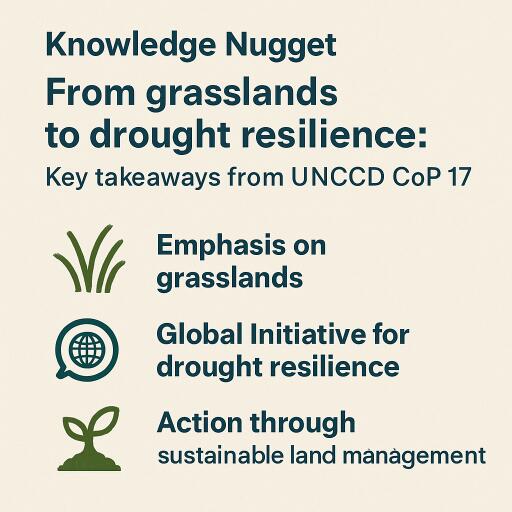
Knowledge Nugget | From grasslands to drought resilience: Key takeaways from UNCCD CoP 17
The 17th Conference of the Parties to the United Nations Convention to Combat Desertification (UNCCD CoP 17), held in Ulaanbaatar, Mongolia, placed land degradation and drought squarely at the center of the global environmental agenda. Framed by the theme “Restoring Land. Restoring Hope.”, the summit underscored a growing reality: healthy land is not just an ecological asset, but a foundation for food security, water stability, climate resilience and rural livelihoods.
For countries facing rising heat, erratic rainfall and stressed ecosystems, the meeting highlighted a clear shift in global thinking—from treating drought as a periodic disaster to preparing societies to live with increasing climate uncertainty.
What is the UNCCD?
The UNCCD, adopted in 1994, is the world’s only legally binding international framework focused specifically on desertification, land degradation and drought. It brings together nearly every country in the world along with the European Union, creating a common platform to coordinate action on restoring damaged landscapes and reducing the impacts of prolonged dry conditions.
Its highest decision-making forum is the Conference of the Parties, where governments review progress, negotiate priorities and shape future cooperation. Since 2001, these meetings have been held every two years, evolving into a key venue for addressing how land systems intersect with climate change, biodiversity loss and development pressures.
Why CoP 17 mattered
CoP 17 stood out for its emphasis on practical resilience. The discussions moved beyond broad commitments and focused on how countries can strengthen ecosystems and communities before crises deepen. Three ideas dominated the meeting: restoring rangelands, investing in drought preparedness and improving long-term finance for land recovery.
Grasslands and rangelands moved to the forefront
One of the most important signals from the summit was the rising recognition of rangelands and other open natural ecosystems. These landscapes are often overshadowed by forests in conservation policy, yet they are essential for biodiversity, livestock economies, water regulation and carbon cycling.
Delegates highlighted that grasslands are not “empty” lands awaiting conversion, but living ecosystems that support pastoralist cultures, wildlife habitats and ecological balance. In dryland regions especially, healthy rangelands help buffer communities against drought by sustaining fodder, reducing soil erosion and improving moisture retention.
India used the platform to stress the importance of community-led restoration of rangelands, pointing to the role of local herders and pastoralist groups in managing landscapes that are both environmentally fragile and socially vital.
A new push for drought resilience
Another major takeaway from CoP 17 was the call to replace reactive drought relief with proactive resilience planning. Instead of responding only after crops fail, reservoirs shrink or migration rises, governments are being urged to invest earlier in warning systems, preparedness and landscape management.
This approach includes better forecasting, coordinated institutional responses, local adaptation plans and technologies that help communities anticipate and absorb shocks. The broader message was simple: drought can no longer be treated as a short-term emergency alone. In many parts of the world, it is becoming a structural risk tied to climate change and poor land stewardship.
India presented its own multi-layered model that combines early warning mechanisms, mitigation planning, relief measures and community resilience strategies, reflecting the wider international push toward integrated drought governance.
India’s new guide to open ecosystems
A notable development during the conference was the release of India’s first guide dedicated to grasslands and other open natural ecosystems, often referred to as ONEs. The publication marks an important effort to bring scientific and policy attention to landscapes that have historically received less recognition than forests.
The guide maps the diversity of these ecosystems across the country—from Himalayan and Terai grasslands to the Thar and Banni regions, rocky plateaus, scrublands, ravines, savannas, coastal stretches and desert habitats. It also documents their ecological characteristics, biodiversity value and links to communities and tribal groups that depend on them.
Equally important, the guide broadens the policy conversation by including themes such as pastoralism, fire ecology and carbon sequestration. That matters because open ecosystems are often misunderstood, misclassified or diverted toward other land uses despite their environmental importance.
Finance seen as a resilience tool, not a side issue
Funding for restoration emerged as another central theme. Countries argued that repairing degraded land should not be viewed as a financial burden, but as an investment with returns in food systems, water security, ecosystem services and livelihoods.
At the summit, India called for more diversified and sustained international finance for land restoration and drought resilience. This includes support for adaptation projects, sustainable agriculture, forestry, afforestation and biodiversity conservation. The underlying message echoed across many interventions: without durable financing, restoration targets risk remaining aspirational.
Global spotlight on rangelands
The focus on dryland ecosystems at CoP 17 aligns with broader international momentum. Each year, 17 June is observed as the World Day to Combat Desertification and Drought, intended to raise awareness and accelerate action on land degradation. In 2026, the theme centered on rangelands with a strong message to recognize, respect and restore them.
The United Nations has also designated 2026 as the International Year of Rangelands and Pastoralists, reinforcing the idea that these landscapes are critical to both ecological resilience and human survival in arid and semi-arid regions.
India’s restoration progress in a wider context
The conference discussions also resonated with India’s broader restoration agenda. The country has reported significant recovery of degraded and deforested land over the past decade through approaches such as planted forests, natural regeneration, agroforestry, silviculture and mangrove restoration.
These efforts connect to the Bonn Challenge, a global restoration initiative launched in 2011 to revive degraded and deforested landscapes at massive scale. The challenge set restoration goals of 150 million hectares initially, later expanded to 350 million hectares by 2030. It is widely seen as a practical route to support climate goals, biodiversity protection and sustainable development.
India has progressively raised its own restoration ambition under this framework, linking land recovery to broader national priorities such as watershed development, afforestation and ecosystem management.
The bigger lesson from CoP 17
The real significance of UNCCD CoP 17 lies in how it reframed land. The summit made clear that degraded soil, disappearing grasslands and recurring drought are not isolated environmental issues. They are deeply connected to hunger, migration, water stress, economic insecurity and climate vulnerability.
From Mongolia’s dryland setting, the conference delivered a consistent message: restoring land is not only about repairing nature, but about strengthening societies. The future of drought resilience will depend not just on emergency response, but on how well governments protect grasslands, empower communities, build early warning systems and finance long-term ecological recovery.
In that sense, CoP 17 was less about a single event and more about a policy transition already underway—one that sees healthy landscapes as infrastructure for survival in a warming world.



Leave a Reply