

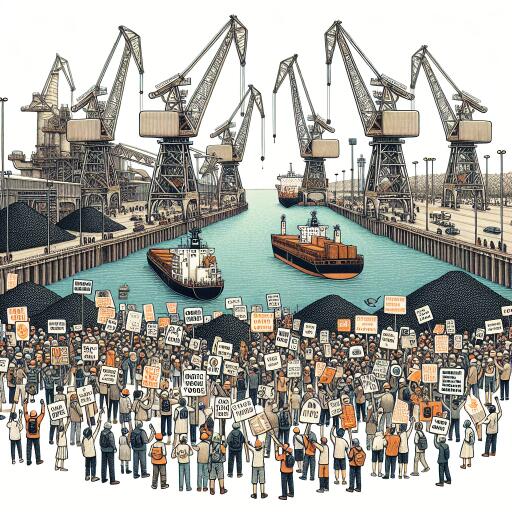
Protests disrupt Australia’s Newcastle coal port | Latest Market News
The latest UN climate summit in Belém closed without a collective commitment to pivot away from fossil fuels. Instead, the Brazilian presidency pledged to convene a separate process to draw up two voluntary roadmaps: one to guide a managed transition from fossil fuels and another to reverse deforestation. Governments and organizations will be invited to contribute, with progress updates due at Cop 31 in late 2026.
A broad coalition of at least 80 countries — including EU members, the UK, several Latin American governments, island states and UN-designated least developed countries (LDCs) — had pressed for the final decision to explicitly chart a course away from oil, gas and coal. That effort did not land in the agreed text. Instead, negotiators endorsed a “global implementation accelerator” and the “Belém Mission to 1.5,” initiatives designed to sharpen delivery of national climate pledges and keep the Paris Agreement’s 1.5°C limit within reach.
While new workstreams on a just energy transition and mitigation were adopted, the final documents avoided any reference to a fossil fuel phase-out or phase-down. Nonetheless, countries collectively recognized that the shift toward low-emissions, climate-resilient development is already underway and irreversible.
Several governments that had hinted at withholding support ultimately allowed the package to pass quickly. One European minister argued that blocking the outcome would have broadcast disengagement rather than resolve at a time when cooperation is fragile.
What the “Mutirão” package covered
The central decision — branded “Mutirão,” a Portuguese term evoking community action and collective mobilization — attempted to bridge gaps on four politically charged issues that had not made the formal agenda: climate finance, unilateral trade measures, how to respond to national climate plans that collectively miss Paris-aligned pathways, and emissions reporting.
On adaptation, developing countries pushed hard for greater resources to cope with intensifying climate impacts. The decision calls for efforts to at least triple adaptation finance by 2035, urging developed countries to raise the trajectory of support. This sits alongside a Cop 29 commitment for developed nations to mobilize $300bn per year in climate finance by 2035. Many vulnerable countries, including the LDCs and small island developing states, also argued for adaptation finance to reach $120bn annually by 2030 — an earlier ramp-up that remains unresolved. Some European capitals feared that rejecting the text would allow major oil producers to paint them as obstructing finance for poorer nations.
On trade, the Mutirão decision affirmed that countries should work together to maintain an open and supportive international economic system that advances sustainable growth. It also stressed that climate measures — including unilateral ones — should not amount to arbitrary or unjustifiable discrimination or disguised trade restrictions, language that many developing nations have sought in light of emerging border carbon measures.
Flashpoints over fossil fuel language
Tensions peaked when Colombia objected to the mitigation work programme, insisting it include language on a shift away from fossil fuels. Proceedings were briefly paused while the presidency sought a path forward. Oil-exporting countries, including Saudi Arabia and Russia, were reported to have forcefully resisted any such wording throughout the talks. Nigeria cautioned that a successful transition cannot be imposed and warned against measures that could trigger a sudden economic contraction.
Colombia has emerged as a vocal advocate for a fossil fuel phase-out, announcing plans to co-host dedicated talks with the Netherlands in April. Its summit declaration calling for a phase-out drew signatures from several producers, among them Australia, Mexico and Denmark.
What comes next
The Brazilian presidency’s two proposed roadmaps — one on managing a fossil fuel transition and one on halting deforestation — will be developed outside the formal negotiation track, with submissions welcomed from countries and non-state actors alike. Progress will be reported next at Cop 31, slated for late 2026 in Turkey. LDC representatives, disappointed by the lack of ambition in Belém, said they will intensify preparations for Cop 31 and aim to secure key demands by Cop 32, to be hosted in Ethiopia.
Despite the headwinds, the UN climate chief characterized the outcome as evidence that nearly every nation remains committed to climate cooperation, even amid “stormy political waters.” The signal from Belém is mixed: there is no collective mandate to exit fossil fuels, but there is a clear acknowledgement that the global economy is already bending toward low-carbon and climate-resilient development — and that finance, fairness and trade rules will heavily shape the pace of that change.



Leave a Reply