

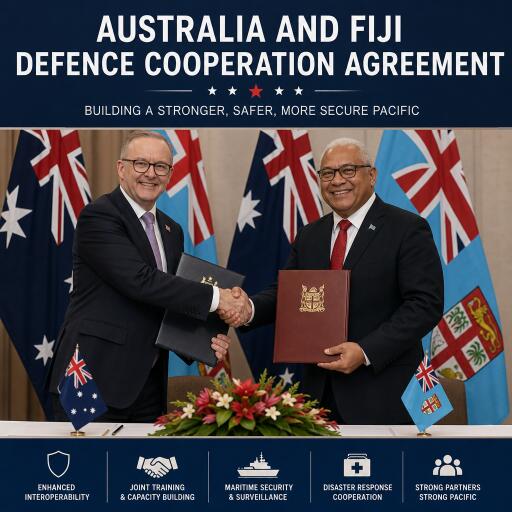
Australia signs off on major defence alliance with Fiji
Australia and Fiji have locked in a sweeping security partnership designed to steady the Pacific at a time of accelerating climate disruption and rising strategic competition. Signed in Suva by Australian Prime Minister Anthony Albanese and Fijian Prime Minister Sitiveni Rabuka, the new framework puts ocean stewardship and human security alongside defence cooperation—an approach that reflects how climate change now shapes the region’s security priorities.
Ocean of Peace Alliance: a new security anchor for the Pacific
At the heart of the deal is the Ocean of Peace Alliance, a formal mutual-assistance pact. If either Australia or Fiji faces an armed attack, the other is obligated to help. The agreement also requires both governments to consult swiftly if security concerns arise that could threaten either country’s sovereignty—an important mechanism for de-escalation and coordination as geopolitical pressures intensify across the Blue Pacific.
The pact breaks new ground for Fiji, marking the country’s first formal defence alliance. For Australia, it becomes the fourth such alliance, joining longstanding arrangements with the United States, New Zealand, and Papua New Guinea. The Ocean of Peace Alliance also leaves the door open to a broader regional framework: other Pacific states may be able to accede, provided all existing members agree, setting up a potential Pacific-led security arc grounded in collective consent.
Vuvale Union: linking security with livelihoods, health, and climate
Complementing the defence accord, the two countries finalised the Vuvale Union, a broad cooperation package spanning economic development, public health, migration pathways, and climate action. The design is intentional: Pacific communities experience “security” not just at the border, but in reliable health systems, resilient infrastructure, and the ability to move safely in response to disasters and sea-level rise.
Under the Vuvale umbrella, priorities are expected to include disaster preparedness and response, renewable energy and grid resilience, support for adaptation projects from coastal protection to water security, and measures to expand lawful, humane mobility options within the region. Together, the agreements are backed by a funding commitment of $1 billion over the next decade, aimed at turning diplomatic pledges into practical programs.
Security through climate resilience
The timing underscores how fast climate impacts are reshaping Pacific security. Intensifying cyclones, coral bleaching, saltwater intrusion, and collapsing fisheries all carry direct societal costs and indirect security risks. The new alliance can help close critical capability gaps by:
- Boosting maritime domain awareness to deter illegal, unreported, and unregulated fishing—an ecological and economic threat to Pacific livelihoods.
- Improving joint search-and-rescue and rapid disaster response, including pre-positioned supplies and interoperable communications.
- Scaling investment in clean energy and climate-resilient infrastructure to reduce vulnerability to extreme weather.
- Advancing ocean conservation, from coral reef restoration to blue carbon initiatives in mangroves and seagrasses that store carbon and buffer storm surges.
By treating climate and ecological integrity as core pillars of stability, the partnership reframes “defence” to include the systems that keep communities secure between crises—not just during them.
Regional context and trajectory
The deepening Australia–Fiji alignment comes amid expanded engagement by larger powers across the Pacific. Canberra has been stepping up its regional footprint with recent compacts, including a $500 million development agreement with Vanuatu known as the Nakamal Agreement and a defence pact with Papua New Guinea, commonly referred to as the PukPuk Treaty. The new Fiji accords are intended to complement, rather than crowd out, Pacific-led priorities and institutions.
Crucially, the option for other Pacific nations to join the Ocean of Peace Alliance—subject to unanimous consent—could allow the framework to grow organically, at a pace and scale set by island states themselves. That approach aligns with the region’s emphasis on sovereignty, consensus, and the primacy of climate action.
What changes on the water and on the ground
In practice, the agreements could deliver:
- Faster, better-coordinated responses to cyclones, floods, and maritime incidents.
- More joint patrols to protect fisheries and clamp down on destructive practices that degrade reefs and food security.
- Greater investment in resilient infrastructure—ports, hospitals, and power systems—built to withstand a hotter, stormier climate.
- Expanded skills exchanges and training across health, emergency services, and environmental management.
- Structured migration pathways that recognise climate-driven mobility pressures while safeguarding rights and community cohesion.
A turning point for Pacific-led security
For Fiji, the alliance elevates its role as a convener on climate, oceans, and regional stability. For Australia, it signals a willingness to bind its security to Pacific priorities that put people, ecosystems, and sovereignty at the centre. Together, the Ocean of Peace Alliance and the Vuvale Union sketch a model of partnership where defence commitments and climate resilience are not competing agendas but mutually reinforcing ones—an approach that may define the Pacific’s next chapter.



Leave a Reply