

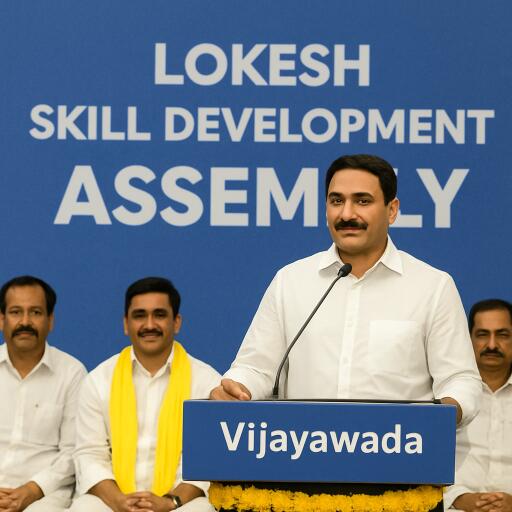
25_Vij_MNS_25-Samdani-Assembly-Lokesh-Skill-Dev | Vijayawada News
Andhra Pradesh is preparing a dual push for jobs and green industry, pairing an AI-enabled skilling platform with a map of new industrial clusters across the state. State officials outlined a plan to connect young jobseekers to employers while building region-specific manufacturing ecosystems designed to spur investment, reduce logistics costs and encourage cleaner technologies.
AI-first skill portal to launch by March-end
The government plans to unveil an AI-driven skill and employment portal by the end of March. The platform will provide Aadhaar-based credential verification, resume-building tools, adaptive courses powered by artificial intelligence, self-assessment modules, and interview coaching. Crucially, it will aggregate job opportunities using AI, matching candidates with openings based on skills and preferences. The initiative is positioned as a cornerstone for delivering the administration’s multi-year employment commitments.
Cluster-based growth for “one capital, distributed development” vision
To spread economic activity beyond a single hub, the state has identified 22 industrial clusters to anchor manufacturing and services. The model emphasizes vertical and horizontal integration—bringing core producers, component makers, and allied services into tightly knit supply chains for speed, resilience, and local value addition.
Key clusters now in the pipeline include:
- Automotive: Rayalaseema and Anantapur
- Renewable energy and cement: Kurnool
- Electronics manufacturing: Kadapa and Chittoor
- Glass and air-conditioner manufacturing: Nellore
- Compressed biogas: Prakasam
- Quantum computing: Amaravati
- Aquaculture: Godavari districts
- Pharmaceuticals, medical devices and steel: North Andhra
In parallel, the administration is laying groundwork for a “drone city” and a “space city,” aiming to seed advanced-tech ecosystems that can draw global suppliers and R&D partnerships.
Electronics and ACs: scaling from strength
Talks are underway with the University of New South Wales to establish a rapid prototyping, testing and design centre at IIT Tirupati, intended to backstop wafer and electronics manufacturing coming up in north Andhra and Rayalaseema. On the consumer durables front, Andhra Pradesh already manufactures roughly half of India’s air-conditioners, with major firms such as Daikin, LG Electronics and Blue Star expanding capacity. Officials project the state’s share could climb to around 70% within two years, contingent on supplier integration and faster product testing cycles.
Manufacturers have sought closer alignment with ITIs, curriculum updates, and access to local heat-pump and AC testing facilities to cut the time and expense of overseas certification. A ministerial group is monitoring 760 signed MoUs, while sector-specific industry leaders are being tasked with building out vendor bases and logistics backbones around each cluster.
Skilling, placements and overseas opportunities
The state reports that 1,587 job fairs have been conducted to date, drawing 11,373 participating companies and resulting in 108,747 placements. Training programs run via APSSDC, SEEDAP and the National Academy of Construction (NAC) have reached 73,000 candidates, with 40,000 securing jobs so far.
To tap international demand, especially in healthcare, language training is being used to prepare nursing and paramedical professionals. Officials say 150 candidates have already secured overseas placements, with an ambitious target to facilitate opportunities for up to 500,000 youth abroad over time. Meanwhile, NAC is set for a rapid upgrade within 90 days to produce globally competitive construction workers, with enhanced monitoring—such as CCTV and facial recognition—promised to track attendance and training quality.
Green industrialization: the biogas and renewables link
From an ecological and energy perspective, the proposed compressed biogas cluster in Prakasam is notable. If executed at scale, it could convert agricultural residues and organic waste into low-carbon fuel, reduce open burning, and create circular-economy income streams for farmers. The renewable energy and cement pairing in Kurnool could also open pathways to lower-carbon materials if green power is integrated into clinker and grinding operations and if waste heat recovery is prioritized.
Electronics and quantum computing clusters come with their own sustainability challenges—particularly energy intensity and waste management. The state’s emphasis on tightly integrated ecosystems and local testing centres could shorten supply chains and reduce transport emissions, provided renewable power access and e-waste stewardship are built in from the start.
What to watch next
- Launch and performance of the AI skill portal, including how effectively it matches candidates to roles and recognizes informal skills.
- Concrete timelines for testing centres and standards labs to lower certification costs and accelerate product cycles within clusters.
- Integration of MSME suppliers, skilling pipelines, and last-mile logistics in each cluster to keep value-add local.
- Renewable power commitments, waste-to-energy uptake in the biogas cluster, and environmental safeguards for aquaculture and heavy industries.
Andhra Pradesh’s cluster strategy and skilling push aim to marry industrial momentum with greener growth. The scale is ambitious—both in job creation and in building end-to-end supply chains—but the outcome will hinge on execution: standards, training quality, clean energy integration and the speed at which testing and procurement bottlenecks are cleared.



Leave a Reply