

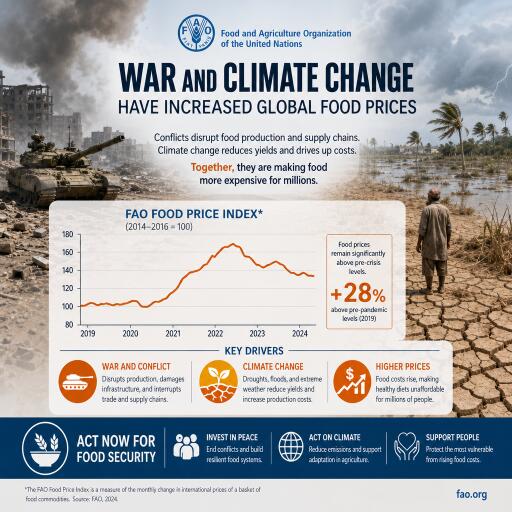
FAO: War and climate change have increased global food prices
Global food prices jumped in August to their highest level since November 2022, according to the UN Food and Agriculture Organization (FAO). The rebound, driven by conflict-related trade disruptions and extreme weather on multiple continents, has reignited worries about food security and affordability for millions of people.
Prices climb across the board
The FAO Food Price Index, which tracks a basket of internationally traded food commodities, rose to 133.3 points in August from 130.8 in July. That marks the strongest reading in nearly two years and signals mounting pressure across global supply chains.
All major components advanced during the month—cereals, vegetable oils, sugar, meat, and dairy—pointing to broad-based stress rather than a spike isolated to one category.
- Cereals: up 2.2%, reaching 116.3 points, the highest since May 2024, amid tighter export flows and weaker harvest expectations in parts of Europe.
- Sugar: up 11.9% to 106.4 points, the highest since June 2025, on concerns about production in both Europe and Asia.
Climate shocks are squeezing supplies
A summer of extremes has weighed on production prospects. Prolonged heat and drought across parts of Europe have dimmed the outlook for corn and sugar beet harvests and added stress to livestock systems. At the same time, a strong El Niño pattern has unsettled growing conditions in Asia, with implications for palm oil and sugar output. Combined, these weather shocks have tightened global markets just as inventories were expected to rebuild.
Conflict is disrupting trade and inputs
Geopolitical tensions continue to reverberate through commodity routes and input markets. Escalating attacks and security risks in the Black Sea have curbed grain shipments from the region, complicating logistics and insurance and raising costs. In parallel, frictions in and around the Persian Gulf have hindered the movement of chemical fertilizers—an essential input for global crop yields—given the Gulf’s significant share of the world fertilizer trade. Concerns about disruptions around key chokepoints, including the Strait of Hormuz, have further unsettled fertilizer supply chains and pricing.
A warning sign for food security
FAO’s chief economist has cautioned that the August upswing signals risk is returning to food markets as climate shocks, geopolitical tensions, and trade bottlenecks reduce available supply. For import-dependent countries, the combination of higher commodity prices, costly freight, and volatile currency markets can quickly translate into elevated retail prices and nutrition risks, particularly for low-income households.
Higher sugar and cereal values are especially significant. Grains are the backbone of global diets and animal feed systems, while sugar is both a staple and an input for processed foods. When both rise simultaneously, the inflationary pass-through can spread rapidly across food baskets.
Outlook: elevated risks ahead
With El Niño still influencing weather patterns and conflicts showing little sign of easing, further price volatility cannot be ruled out in the coming months. A poor finish to the Northern Hemisphere growing season or renewed interruptions along critical trade corridors could tighten markets further.
Experts note that prudent policy steps could mitigate the fallout:
- Reinforce strategic grain and fertilizer reserves in vulnerable, import-reliant countries.
- Keep trade channels open and predictable, avoiding restrictions that amplify global scarcity.
- Diversify import sources and logistics routes to spread risk.
- Scale up social protection and nutrition programs to shield low-income households from price spikes.
- Invest in climate-resilient agriculture, including drought-tolerant crops, efficient irrigation, and weather-indexed risk tools.
The bottom line
August’s jump in the FAO Food Price Index—to 133.3 points, with cereals at 116.3 and sugar at 106.4—underscores how a convergence of climate stress and geopolitical disruption is reshaping food markets. Without steps to stabilize trade, secure inputs like fertilizer, and bolster climate resilience, the risk of persistent food inflation—and the human costs that come with it—will remain elevated.



Leave a Reply