

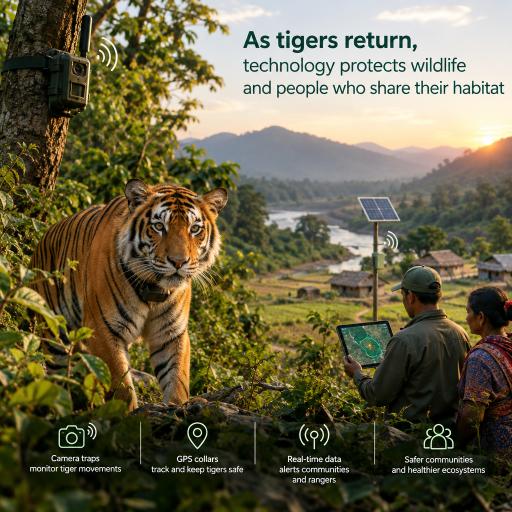
As tigers return, technology protects wildlife and people who share their habitat
Deep in the forests of northeast China, conservation cameras recently recorded an extraordinary scene: a female Amur tiger moving through the trees with five cubs close behind. For wildlife experts, the moment was more than striking footage. It was evidence that one of the world’s most endangered big cats is finding room to recover.
The images were captured inside the Northeast China Tiger and Leopard National Park, a vast protected landscape that has become a key refuge for Amur tigers and Amur leopards. The park’s monitoring network sent the footage almost immediately to conservation teams, allowing them to document the family group and follow its progress without disturbing the animals in the wild.
Officials say some of the cubs have already begun separating from their mother, a normal sign of growth and dispersal. The sighting is especially important because litters this large are rarely documented in the wild. It also adds to growing signs that stronger protection, habitat repair and digital monitoring are helping these predators reclaim part of their former range.
What makes this recovery story unusual is the scale of the technology now supporting it. Across the park, an extensive monitoring system combines satellite observation, thousands of infrared camera traps, wireless data transmission and drone patrols. Together, these tools create a near real-time view of wildlife movements across a huge forested region stretching over Jilin and Heilongjiang provinces.
Building that system has not been simple. Remote mountain terrain makes communications difficult, so operators have had to install dozens of wireless base stations to connect equipment scattered through the forest. With roughly 30,000 cameras deployed, much of the park can now be watched continuously, and many images can be delivered to park managers within about a minute of capture.
Artificial intelligence has become an important layer in this network. Software can sort through large volumes of images, flag the presence of more than 30 species and make an initial match for individual tigers and leopards by reading their unique stripe and spot patterns. Human researchers then verify those results using additional physical features, helping build long-term records for each animal.
That combination of automation and expert review is changing conservation work. Instead of relying only on time-consuming field patrols, researchers can map where animals travel, identify breeding activity and respond more quickly to changes in population trends. It also reduces the need for staff to spend long periods moving through rugged habitat where access is difficult and dangerous.
For frontline forest workers, the change has been dramatic. In earlier years, checking camera traps often meant carrying batteries and replacement gear for many kilometers through steep terrain, then returning with memory cards to see what had been recorded. It was slow, physically demanding and risky in areas inhabited by large carnivores. Wireless systems now do much of that work instantly, freeing rangers to focus their patrols where they are most needed.
The park’s strategy extends beyond watching animals. Conservation teams have also worked to improve habitat quality and reconnect fragmented forest. In some border areas, sections of fencing that once blocked wildlife movement have been removed, opening routes used by tigers and leopards. Better ecological connectivity is crucial for wide-ranging predators that need large territories and access to mates.
The numbers suggest that these combined efforts are making a difference. Since the late 2010s, the population of wild Amur tigers in the park has climbed sharply, while Amur leopards have also increased. The return of prey species such as sika deer and roe deer offers another sign that the ecosystem is strengthening. Where prey becomes more abundant, top predators are more likely to survive and reproduce.
Yet the return of large carnivores brings new challenges for nearby communities. In several parts of the park, villages sit close to forest habitat, and the boundary between human activity and wildlife movement is not always clear. As tiger and leopard territories expand, so does the need to prevent dangerous encounters.
Here too, technology is playing a central role. Cameras installed near settlements can detect the arrival of tigers, leopards, bears or wild boars in areas considered high risk. When that happens, alerts can be sent to patrol units and local residents, giving people time to avoid the area. Early warning systems are turning wildlife monitoring into a public safety tool as much as a conservation one.
Local information-sharing networks help spread those warnings quickly. Rangers can notify residents when a big cat has been seen nearby, reducing surprise encounters and helping communities adapt to living alongside recovering wildlife populations. The goal is not to keep people out of the forest entirely, but to create enough notice and awareness for both people and animals to move safely.
This approach reflects a broader shift in conservation: protecting predators now means managing relationships as much as landscapes. Cameras, drones and AI are not replacing rangers or ecological expertise, but they are making both more effective. They help narrow patrol routes, identify threats faster and reduce unnecessary disturbance in sensitive habitat.
The image of a tigress and her five cubs is powerful on its own. But its real significance lies in what it represents: a forest where top predators are breeding again, a monitoring system advanced enough to observe that recovery in detail and a conservation model trying to balance ecological revival with human safety. In a region once defined by decline, technology is helping make coexistence a little more possible.



Leave a Reply