

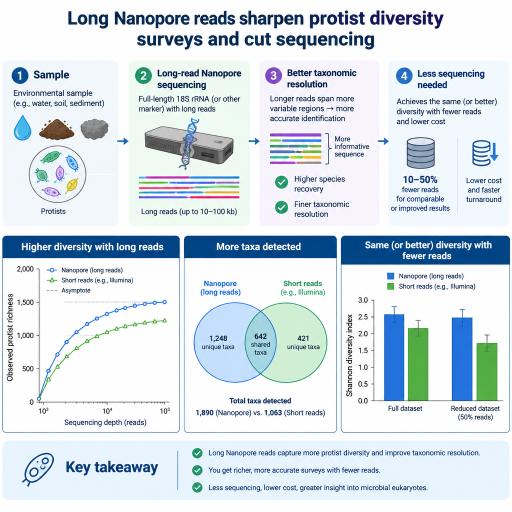
Long Nanopore reads sharpen protist diversity surveys and cut sequencing
Protists are microscopic eukaryotes found in lakes, seas, and sediments, and they make up a huge share of Earth’s hidden biodiversity. Yet tracking them has always been difficult. Many cannot be easily grown in the lab, so scientists often rely on environmental DNA collected directly from nature. By sequencing genetic traces in water samples, researchers can estimate which protists are present and how communities shift across habitats and seasons.
For years, most of these surveys have depended on short-read sequencing, which captures only a small section of a commonly used marker gene. That method has been useful, but its limited length can blur species-level identification and sometimes exaggerate diversity. New work now shows that much longer DNA reads can provide a clearer picture of protist life while remaining compatible with older datasets.
Why longer reads matter
The study compared two sequencing strategies using both controlled test material and real environmental samples from freshwater lakes and the Mediterranean Sea. The standard approach used short Illumina reads targeting the V4 region of the 18S ribosomal RNA gene, a fragment widely adopted in protist metabarcoding. The alternative used Oxford Nanopore sequencing to read a much longer fragment spanning nearly the full ribosomal DNA region, including the complete 18S gene and neighboring genetic segments that improve taxonomic precision.
This added length matters because small DNA fragments often do not contain enough variation to reliably distinguish closely related species. Longer sequences offer more signals for classification and also support phylogenetic analysis, helping researchers understand how unknown organisms are related to known groups rather than simply assigning them to a broad label.
A new workflow built for noisy long-read data
Long-read sequencing has historically faced skepticism in biodiversity studies because it tends to generate more errors than short-read platforms. These mistakes, especially insertions and deletions, can complicate efforts to separate true biological diversity from technical noise.
To address that problem, the researchers developed a dedicated analysis workflow called BaNaNA. Instead of relying on denoising methods designed for Illumina data, the pipeline groups Nanopore reads into operational taxonomic units and then builds polished consensus sequences from each cluster. It filters reads for quality and expected structure, reconstructs cleaner sequences, removes chimeras, and produces final taxonomic units suited for ecological analysis.
The result is a workflow tailored to the strengths and weaknesses of long-read sequencing, making the approach far more practical for routine protist surveys.
Mock community tests exposed the limits of short reads
The head-to-head comparison began with a mock community composed of seven known protist species. This type of test is valuable because the expected makeup of the sample is already known, allowing a direct check on sequencing accuracy.
Short-read sequencing returned far more sequence variants than expected, suggesting inflation from technical artifacts and false positives. It also misrepresented the abundance of several organisms. Some protist groups appeared much more common than they should have been, while others were strongly underestimated.
By contrast, the long-read Nanopore approach tracked the known composition more closely. It generated fewer misleading signals and improved species-level identification. In some cases, full-length sequences correctly identified a species that became ambiguous when only the short V4 segment was examined. That finding underscores a central point: the more of the gene that can be read reliably, the more confidently scientists can name what they find.
Real-world ecosystems showed similar ecological patterns
The researchers then tested natural communities from lakes and marine waters. At broad taxonomic levels, both sequencing platforms produced similar ecological patterns. Freshwater and marine samples separated clearly, and marine surface communities differed from deeper ones. This suggests that both methods can capture major environmental structure.
Even so, the long-read method delivered advantages. It recovered fewer apparently spurious units, supported finer taxonomic assignments, and detected some groups that were missed by short reads. Those differences are especially important for surveys focused on rare, parasitic, or poorly documented protists, where slight gains in resolution can reshape ecological interpretation.
Long reads exposed large gaps in biodiversity databases
One of the strongest outcomes of the study was the discovery of many protist sequences that did not closely match entries in current reference databases. Hundreds of long-read units fell well below perfect similarity to known references, indicating that they may represent undocumented or poorly sampled lineages.
The gap was especially striking in freshwater samples, where a much larger share of sequences had low similarity to known records. That pattern points to a chronic imbalance in reference collections: marine protists have generally been studied more intensively than freshwater ones. As a result, lake ecosystems may still contain a substantial reservoir of undescribed microbial eukaryotic diversity.
Because the new sequences are long, they do more than expand a checklist. They can also be used in evolutionary trees, helping researchers place unknown organisms within broader branches of the eukaryotic world. Some may even belong to lineages that have not yet been recognized clearly.
Compatibility with older datasets lowers the barrier to adoption
A major practical benefit of long reads is that they can still be linked back to years of previously collected short-read data. Since the full-length ribosomal region contains standard barcode sections such as V4, scientists can digitally extract those shorter fragments and compare them directly with historical Illumina datasets.
That means labs do not have to abandon their existing biodiversity records to move toward longer sequencing. Instead, they can combine legacy surveys with new, richer Nanopore data and preserve continuity in long-term monitoring programs.
Less sequencing waste, more useful information
The broader implication is that protist metabarcoding may be entering a more efficient phase. Rather than generating large amounts of short sequence data that can overstate diversity or stop at genus-level assignments, researchers can now obtain longer, more informative reads that reduce false positives and improve species resolution.
For ecology, that is a meaningful advance. Better identification sharpens biodiversity estimates, improves tracking of environmental change, and helps reveal hidden branches of microbial life. As long-read chemistry and databases continue to improve, full-length ribosomal sequencing is poised to become a core tool for studying the protist world.
In short, the new evidence suggests that long-read Nanopore metabarcoding is no longer just an experimental alternative. It is emerging as a robust option for surveying protist diversity with greater clarity, stronger phylogenetic value, and potentially less sequencing waste than traditional short-read approaches.



Leave a Reply