

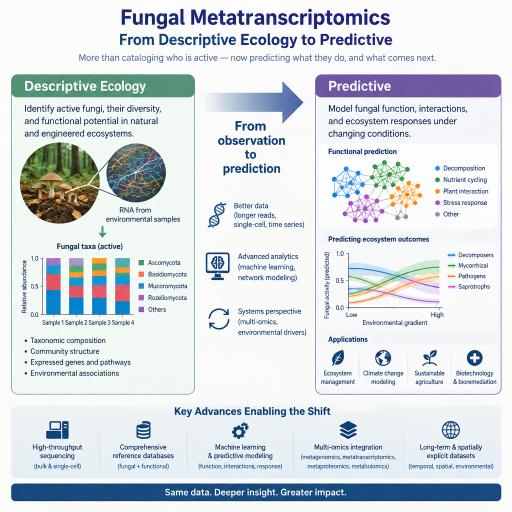
Fungal metatranscriptomics moves from descriptive ecology toward predictive
Fungi quietly run much of the living world. They decompose wood and leaf litter, trade nutrients with plant roots, influence animal digestion, and help regulate carbon and nitrogen cycles across land and sea. Yet science still knows only a small fraction of fungal diversity, and for years researchers have struggled with a basic problem: finding out not just which fungi are present in an environment, but what they are actively doing there.
That is why metatranscriptomics is drawing so much attention. Instead of focusing on DNA markers that mainly reveal identity, this method reads the RNA being produced in an environmental sample at a given moment. In practical terms, it offers a snapshot of fungal activity in real time, showing which genes are switched on and which ecological roles are being carried out.
Older methods based on targeted genetic markers transformed fungal ecology, but they also came with limits. They can distort community profiles because some groups amplify more easily than others, and they say little about function. A sample may show that certain fungi are present in soil, roots, or seawater, but not whether they are breaking down organic matter, transporting nitrogen, or responding to stress. Metatranscriptomics tackles that gap by linking identity to action.
Its value is already becoming clear in field studies. In forest root zones, researchers have detected fungi actively expressing genes tied to the breakdown of complex organic compounds, revealing metabolic roles that simpler surveys would miss. In marine systems, fungal transcripts associated with carbohydrate-processing enzymes have shown that these organisms help drive the degradation of organic carbon in coastal waters. Findings like these are shifting fungi from the margins of ecosystem models toward the center.
The laboratory process is demanding. Scientists begin by collecting material such as soil, plant tissue, litter, sediment, or water, then extract total RNA from the sample. Because fungal RNA is often only a tiny share of all genetic material present, it must be enriched before sequencing. Ribosomal RNA is typically removed, messenger RNA is concentrated, and the remaining material is converted into DNA libraries for high-throughput sequencing. The data then move into a bioinformatics pipeline for cleaning, filtering, and classification.
From there, two main computational strategies dominate. The first is assembly-based analysis. Here, short sequencing reads are stitched together into longer transcripts, making it easier to identify organisms and infer function with more confidence. This route is powerful because it can separate closely related fungi and sometimes detect previously unknown lineages. It also helps connect specific transcripts to ecological traits such as decomposition, nutrient acquisition, or symbiosis.
The second route is alignment-based analysis, which skips assembly and directly compares reads against reference databases. This approach is faster and more scalable, making it attractive for large studies. It performs especially well when supported by fungal-focused marker systems, even when samples are crowded with bacterial material. But speed comes with trade-offs: short reads can be hard to assign at the species level, and results depend heavily on how complete the reference databases are.
Functional interpretation follows a similar split. Assembly-based workflows rebuild longer gene sequences, predict protein-coding regions, and annotate them against databases of pathways, enzyme families, and cellular functions. That deeper view has helped researchers distinguish ecological roles among fungal groups: some are strongly tied to plant cell wall decay, while others emphasize nutrient transport and root association. Alignment-based functional profiling is more efficient, but can struggle when the same conserved genes are shared across fungi and bacteria, blurring attribution.
The technology is promising, but far from simple. Fungal genomes are often large, repetitive, and rich in introns, and many species generate multiple transcript variants from the same gene. Some transcripts appear only in specific environmental conditions or during interaction with hosts. That biological complexity makes reconstruction and annotation difficult, especially when environmental samples contain thousands of species mixed together.
Another bottleneck is the database problem. Genomic resources are heavily weighted toward a few well-studied fungal branches, while many early-diverging lineages remain poorly represented. Important fungal traits, including secondary metabolism and enzymes for breaking down lignocellulose, are still unevenly annotated. As a result, a significant share of environmental transcripts can remain unidentified or be classified only broadly.
Standardization is also lacking. Different studies use different extraction methods, enrichment steps, software tools, and reference sets. That makes direct comparison difficult and slows progress toward reproducible large-scale ecological forecasting. Without shared benchmarks and more consistent workflows, fungal metatranscriptomics risks remaining powerful but fragmented.
Still, the field is moving quickly. Long-read sequencing is beginning to improve the picture by capturing full-length transcripts instead of fragmented pieces. This allows cleaner gene models, better resolution of splice variants, and more accurate functional assignment. At the same time, fungal genome collections are expanding, steadily strengthening the reference base needed for both taxonomic and functional analysis.
Artificial intelligence is adding momentum. Machine-learning tools are improving gene prediction and annotation, while structure-prediction systems are helping infer the likely roles of poorly understood fungal proteins. Workflow frameworks are also making complex analyses easier to reproduce across labs, which could help turn isolated datasets into comparable global evidence.
The broader significance is substantial. As these methods mature, fungal ecology is starting to move beyond description and toward prediction. Researchers may soon be able to anticipate how active fungal communities respond to drought, warming, nutrient shifts, or land-use change—and how those responses affect carbon storage, decomposition, and plant health.
That shift matters well beyond mycology. In an era of climate instability and ecosystem stress, understanding the hidden labor of fungi could improve forest management, soil restoration, agriculture, and biodiversity conservation. Metatranscriptomics is not just revealing fungal life in sharper detail; it is opening the possibility of forecasting how these largely invisible organisms will shape the future of ecosystems.



Leave a Reply