

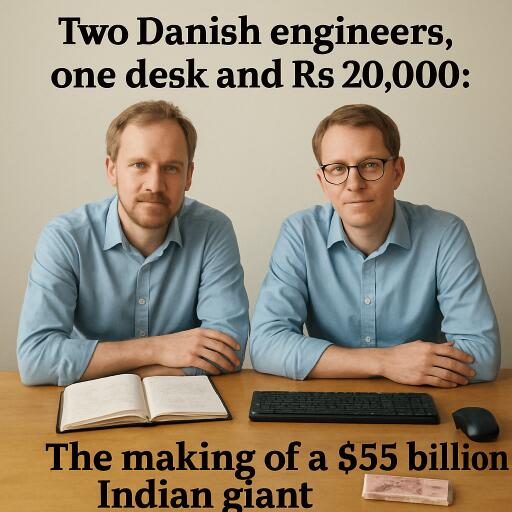
Two Danish engineers, one desk and Rs 20,000: The making of a $55 billion Indian giant
What began as a boss’s dismissive quip—“You’ll find it’s an illusion”—became one of India’s most consequential engineering stories. Eight decades on, the company born of that dare employs over 400,000 people, builds nuclear and space hardware, launches submarines and warships, and is worth nearly $55 billion.
Two temperaments, one idea
Henning Holck-Larsen (born 1907) and Søren Kristian Toubro (born 1906) met as Danish engineering students headed down different specialisations—chemistry for the former, civil for the latter. They converged at F.L. Smidth & Co., then diverged again—this time toward India on separate assignments tied to cement plants. The country changed them. Toubro was moved by the promise of an independent India creating opportunity for ordinary citizens; Holck-Larsen was drawn to the scale of what might be built.
The pair could not have been more different. Larsen chased horizons; Toubro measured twice, cut once. That push-pull would define the enterprise they founded together.
One room, one desk, Rs 20,000
On 1 May 1938, the two struck out on their own in Bombay, representing European engineering firms. The entire outfit fit inside a tiny room in Ballard Estate. There was cash for one desk, so they shared it—and the face time with clients—on a rotation. Their motto captured the ethic: “In Service Lies Success.”
War shuts doors; improvisation opens others
World War II severed their supply lines when Denmark fell to Germany in 1940. Instead of folding, they set up a small workshop on Calicut Street to make what they could no longer import, adding wartime ship repair. The British Admiralty handed them a captured Italian vessel, Hilda, and a new line—“Hilda Ltd”—was born.
Then came a stroke of luck: U.S. forces left behind fleets of Caterpillar tractors in northeast India. The firm became Caterpillar’s sales and service agent, a deal that demanded more capital than the founders had and nudged the company toward formal incorporation.
From agency to industrial backbone
Incorporated on 7 February 1946, the company launched Engineering Construction & Contracts a year earlier—the seed of today’s construction arm. Offices in Calcutta, Madras, and New Delhi followed by 1947; in 1948, it acquired marshland at Powai that would evolve into a major manufacturing base. When it went public in 1950 with Rs 20 lakh paid-up capital, annual turnover had reached Rs 1.09 crore—a leap from the single-desk days.
Atomic cores to rocket stages
The 1960s marked acceleration: Utkal Machinery (1960), Audco India (1961), and Eutectic Welding Alloys (1962) came into the fold; Tractor Engineers followed in 1963. At Homi Bhabha’s urging, the company began fabricating nuclear components, graduating by 1965 to building major reactor hardware. In the 1970s, Vikram Sarabhai drew the firm into ISRO’s orbit, cementing a role in India’s space ecosystem.
Construction scales up—and out
In 1976, the construction subsidiary bid for a marquee airport job in Abu Dhabi but lacked the financial heft to qualify. The solution: fold the unit into the parent. That move birthed what is today L&T Construction, which went on to become the group’s largest revenue engine.
An adopted homeland, and a counterweight
Holck-Larsen made India his second home, marrying in Mumbai, backing Indian technical journals, and supporting contemporary artists. Recognition followed: honours in Denmark, the Ramon Magsaysay Award (1976), knighthood in Denmark (1977), and India’s Padma Bhushan (2002). He often said India held a special place in his heart—and the feeling, clearly, was mutual.
Toubro, the steadying hand, stepped back from day-to-day management in the early 1960s but remained on the boards of the parent company and its construction arm until 1981. He maintained deep ties with India even from Denmark, and passed away in 1982 at 76.
A giant with no family throne
Unlike many Indian conglomerates, the company remained professionally managed and widely held. That made it resilient—and, paradoxically, vulnerable. With no promoter family as a bulwark, the late 1980s brought a test: Dubai-based investor Manu Chhabria accumulated shares, sparking fears of a hostile tilt.
Reliance Industries stepped in, building a stake of roughly 18% and joining the board. But with the firm deeply embedded in India’s strategic programmes—nuclear, space, defence—the prevailing view was that concentrated control was inappropriate. Government-linked institutions held the line; Reliance stayed passive for years.
Cement goes its own way; independence preserved
Reliance eventually sold its holding in 2001 to Grasim of the Aditya Birla Group, which sought the cement business. After an open offer in 2002, negotiations led by A.M. Naik produced a 2003 demerger: the cement operations moved to Grasim, forming the foundation of UltraTech Cement, while the engineering group remained independent. The Birla stake was sold to an employee trust, strengthening the company’s widely held structure.
From prey to predator in tech
By 2019, sitting on over $2 billion in cash, the group targeted scale in technology services. It purchased V.G. Siddhartha’s roughly 20% stake in Mindtree, then crossed 50% via market purchases and a public offer at Rs 980 a share. The bid was oversubscribed 120 times; control settled around 60% by June 2020, and Mindtree’s founders exited. The former takeover target had become a disciplined acquirer.
Scale, strategy, sustainability
From a room in Ballard Estate to a market cap near Rs 5.34 lakh crore, the group now spans EPC megaprojects, urban and transport infrastructure, defence platforms, and technology services. Its clean-energy work—renewables, grid-scale systems, and industrial decarbonisation—has become a defining growth vector alongside conventional engineering. It supports the Indian Navy with ships, submarines, and systems including the K9 Vajra howitzer, and has supplied critical equipment to ISRO for decades.
In FY26, revenue from operations rose 11.8% to about Rs 2.9 lakh crore; EBITDA increased 10.3% to Rs 29,151 crore with a 10.2% margin. Consolidated profit after tax reached Rs 16,084 crore; EPS improved to Rs 116.93. In March 2025, the company secured its biggest single order to date—a roughly $4 billion LNG project from QatarEnergy—underlining its global EPC heft even as it doubles down on low-carbon infrastructure at home.
A.M. Naik, who steered the company through fraught ownership battles, now serves as chairman emeritus. S.N. Subrahmanyan leads as chairman and managing director. The founders who once took turns at a single desk did not live to see this scale—but their contrasting instincts, blended into one enterprise, built a platform for India’s most ambitious projects, from reactors and rockets to renewables and resilient cities.



Leave a Reply