

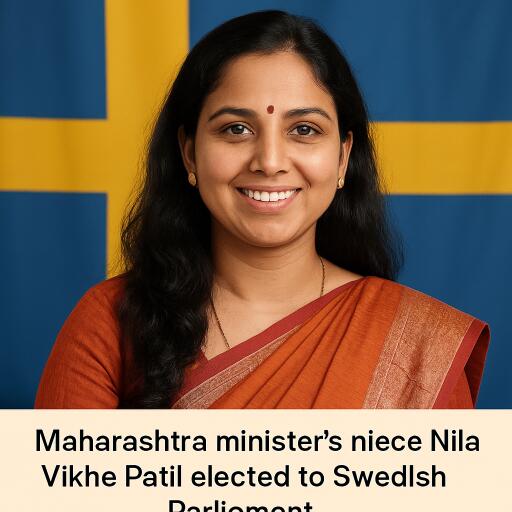
Maharashtra minister’s niece Nila Vikhe Patil elected to Swedish Parliament
Nila Vikhe Patil has been elected to Sweden’s Riksdag from the Stockholm City constituency, marking a notable intersection of South Asian heritage and Scandinavian politics. A longtime Green Party organizer, she steps into national office as the left-leaning bloc edges a narrow majority, positioning environmental policy, clean energy and social equity firmly in the spotlight.
A Green voice in a razor-thin majority
Sweden’s 349-seat Parliament will be closely divided, with the left-leaning opposition securing a slim edge at the polls (176 seats to 173 for the outgoing conservative-led bloc). Within that balance, the Greens’ agenda—prioritizing climate action, renewable energy expansion and nature protection—stands to gain renewed relevance. For Stockholm residents, where heat waves, urban flooding and air quality challenges increasingly intersect with housing and transport, the parliamentary outcome could shape a more climate-resilient urban future.
Vikhe Patil has long framed environmental policy as inseparable from social well-being. She has emphasized the importance of ensuring every child’s chance at a healthy future, and has signaled a determination to champion communities that lack a political voice—residents without voting rights among them. Her focus aligns with the Green Party’s push for pragmatic climate solutions, from decarbonized power and transit to nature-based resilience across cities and coasts.
Rooted in Maharashtra, shaped in Sweden
Born in Sweden and raised partly in Ahmednagar, Maharashtra, Vikhe Patil brings a cross-cultural lens to public life. She is the daughter of educationist Ashok Vikhe Patil, and part of a family with deep public service roots: her great-grandfather, Vithalrao Vikhe Patil, founded Asia’s first cooperative sugar factory, and her grandfather, Balasaheb Vikhe Patil, served as a Union minister in India. Her uncle, Radhakrishna Vikhe Patil, is a minister in Maharashtra. Those ties, she has said, helped instill both a sense of duty and an early interest in public finance—memories include working through budget documents as a teenager.
Educated at the Gothenburg School of Business, Economics and Law and at the Complutense University in Madrid, she combines a background in international business with an eye for fiscal detail—skills that often prove decisive in turning climate ambitions into bankable programs. She has previously served on the Stockholm City Council and worked as a political adviser in the Swedish Prime Minister’s Office during the Stefan Lofven administration, concentrating on finance, taxation and housing policy.
From finance to climate policy
Since 2020, Vikhe Patil has worked with PwC, gaining experience in strategy, technology and risk consulting. She became an authorized public accountant in April 2025—credentials that can be instrumental in scrutinizing the cost-effectiveness and risk profiles of large public investments, including renewable energy, grid upgrades, building retrofits and climate adaptation projects.
Her pathway into national politics follows roughly 25 years of activism within the Green Party, including a role on the Stockholm Green Party’s Election Committee. That longevity suggests a familiarity not only with climate science and policy frameworks but also with the on-the-ground realities of coalition-building and municipal implementation—where timelines, procurement, and public buy-in can make or break the energy transition.
What this could mean for Sweden’s green transition
While the legislative agenda will depend on coalition dynamics, several priorities are likely to be front and center for Green lawmakers from urban constituencies:
- Renewable power and grids: accelerating wind, solar and storage alongside flexible demand, while modernizing distribution networks to handle electrification of transport and buildings.
- Energy efficiency: scaling retrofits and heat-pump deployment to cut emissions and household energy costs—critical for affordability and resilience during cold snaps and energy price swings.
- Clean water and nature protection: strengthening watershed management, wetland restoration and biodiversity corridors to buffer floods, improve water quality and support urban cooling.
- Resilient housing and planning: integrating climate risk data into zoning and building codes, with attention to equitable outcomes in rapidly changing neighborhoods.
- Circular economy: advancing repair, reuse and recycling systems to curb waste, reduce resource extraction and create local green jobs.
In her first remarks after the vote, Vikhe Patil conveyed both gratitude and resolve, expressing readiness to contribute to the city and the country. She has spoken warmly of her ties to India and the influence of her grandfather, underscoring how personal history can shape public purpose. That blend of fiscal literacy, municipal experience and ecological commitment sets the stage for a lawmaker attuned to both the numbers and the neighborhoods behind Sweden’s climate goals.
With Sweden’s Parliament finely balanced, every seat—and every committee—will count. For Stockholm’s residents navigating the twin pressures of affordability and climate risk, the arrival of an urban-focused Green voice may help keep practical, measurable climate action on the national agenda.



Leave a Reply