

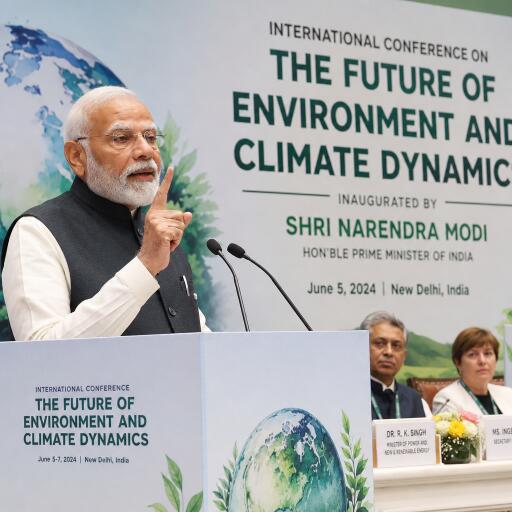
Delhi: PM Modi inaugurates international conference on The Future of Environment and Climate Dynamics
New Delhi, September 19 — Prime Minister Narendra Modi today opened a two-day international gathering on “The Future of Environment and Climate Dynamics,” convened by the National Green Tribunal (NGT) on September 19–20. The forum brings together judicial leaders, policy makers, scientists and administrators to chart responses to intensifying ecological stress and a rapidly changing climate.
The inaugural ceremony featured the presence of the Chief Justice of India Justice Surya Kant, Union Environment, Forest and Climate Change Minister Bhupender Yadav, Attorney General R. Venkataramani and NGT Chairperson Justice Prakash Shrivastava, alongside senior judges of the Supreme Court and High Courts, district judiciary, and top officials from multiple central and state institutions. Judicial representatives from 17 countries have also joined, underscoring the conference’s global legal and regulatory perspective.
Organisers describe the platform as a working arena to confront major environmental and climate risks, identify policy and implementation gaps, and exchange practices that have delivered results on the ground. Strengthening institutional cooperation—across courts, regulators, line ministries and scientific bodies—sits at the heart of the agenda, with environmental justice as a cross-cutting theme.
The event features four technical sessions addressing core ecological priorities and legal-regulatory pathways. Discussions are expected to examine:
- How to align climate mitigation and adaptation with inclusive development and just transitions.
- Strategies to improve environmental governance—from permitting and impact assessment to compliance and remediation.
- Protection and restoration of critical ecosystems, including wetlands and biodiversity-rich landscapes.
- Urban and industrial challenges such as air and water pollution, waste management and resource efficiency.
Participants include Secretaries of key ministries, senior officers from central and state departments, representatives of State Judicial Academies and State Legal Services Authorities, State Expert Appraisal Committees (SEACs) and State Environment Impact Assessment Authorities (SEIAAs), State Wetland Authorities and a broad spectrum of stakeholders from research and civil society. The legal fraternity’s deep involvement reflects how courts and tribunals increasingly shape environmental outcomes—interpreting constitutional protections, enforcing standards and ensuring timely remedies.
The NGT has framed the conference as an opportunity to turn dialogue into an actionable roadmap for both immediate and longer-term environmental and climate challenges. Outcomes are expected to focus on tightening execution of existing rules, elevating science-based decision-making, and scaling proven interventions—while creating space for innovation where current approaches fall short.
India’s climate and ecological realities give the deliberations particular urgency. Heatwaves, erratic monsoons, flooding, coastal risk and air quality pressures are testing infrastructure and public health, even as the country pursues rapid economic growth. Sessions are therefore poised to explore how environmental protection can be embedded in development choices—from land use and infrastructure planning to industrial policy and energy systems—so that resilience and sustainability become default design features, not afterthoughts.
Legal practitioners and regulators attending the conference noted that predictable, transparent and enforceable processes—especially in environmental impact assessment, monitoring and compliance—can reduce conflict and delays while improving environmental outcomes. Strengthening data systems, public participation and inter-agency coordination emerged as recurrent themes in pre-conference discussions.
The valedictory session on Sunday, September 20, will be attended by President Droupadi Murmu, Supreme Court judge Justice P.S. Narasimha, NGT Chairperson Justice Prakash Shrivastava, Solicitor General Tushar Mehta and senior Union leadership. The closing will consolidate recommendations from the technical tracks and outline next steps for institutional collaboration across jurisdictions.
By convening voices from the bench, the executive and expert communities—within India and from 17 partner countries—the conference signals a push for practical, coordinated solutions. As climate and ecological pressures intensify, the emphasis on environmental justice and cooperative governance aims to ensure that policy ambition translates into measurable improvements for people and nature alike.



Leave a Reply