

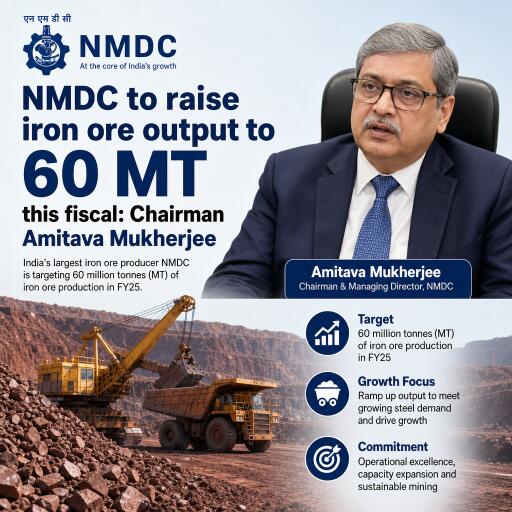
NMDC to raise iron ore output to 60 MT this fiscal: Chairman Amitava Mukherjee
India’s largest iron ore miner is preparing a sharp production ramp-up to meet surging domestic steel demand. NMDC aims to lift iron ore output to 60 million tonnes (MT) in the current fiscal year, a rise of roughly 20 percent over last year, according to Chairman Amitava Mukherjee. The plan builds on the company crossing the 50 MT production milestone in FY26 and reflects an accelerated push to secure raw material for India’s expanding steel sector.
The road to 60 MT will rely on squeezing more from existing mines and integrating capacity from the NMDC-CMDC Limited (NCL) joint venture. To enable the expansion, the company has sought environmental clearances for select deposits from the Union Ministry of Environment, Forest and Climate Change. Parallel upgrades to mine logistics and processing are underway or tendered, including new belt conveying systems, crushers, and breakers—measures that can both lift throughput and reduce the environmental footprint compared with diesel-heavy trucking.
This year’s target is a stepping stone toward a longer-term ambition: 100 MT of iron ore by 2030–31. That trajectory aligns with the National Steel Policy 2017, which envisions 300 MT of domestic steelmaking capacity over the same period. NMDC says it remains on track to meet the 100 MT goal, underpinned by infrastructure development at multiple sites and the progressive commissioning of new facilities.
Operationally, the company works through four major mechanised complexes across the Bailadila range in Chhattisgarh and the Donimalai sector in Karnataka. Together, these mines typically meet about one-fifth of India’s iron ore requirement. Financially, NMDC posted record revenue of Rs 31,554 crore in FY26, up 33 percent from Rs 23,668 crore in FY25, providing firepower for capital investments and environmental safeguards.
Diversification is also gathering pace. NMDC plans to begin commercial production of thermal coal in the October–December quarter and aims to sell around 1 MT of the fuel in FY27. A coking coal project is slated for development in FY27, with first output targeted as early as FY28. By 2030, the company intends to derive at least 20 percent of its revenue from minerals beyond iron ore.
These industrial milestones arrive with significant ecological responsibilities. The Bailadila belt lies within a biodiverse and forested landscape that supports wildlife and local communities. Scaling production in such areas demands rigorous environmental assessments, transparent community engagement, and tangible mitigation measures to minimize habitat disturbance, water stress, and air pollution. Done well, efficiency upgrades can lower the environmental intensity of each tonne mined, but they must be matched with strong oversight and local consent.
Key safeguards that can align NMDC’s ramp-up with climate and conservation priorities include:
- Transparent, science-based environmental impact assessments and cumulative impact reviews for clustered mines.
- Water stewardship plans with recycling, sediment control, and protections for downstream users during monsoon and dry seasons.
- Real-time air quality monitoring, dust suppression, and covered, low-emission ore evacuation systems such as conveyors and rail.
- Biodiversity management: avoidance of critical habitats, wildlife corridor mapping, and measurable restoration offsets.
- Concurrent reclamation of waste dumps, erosion control, and progressive mine-closure provisioning.
- Community participation in decision-making, benefit-sharing, and grievance redressal mechanisms.
- Electrification of mine operations and sourcing more renewable power to cut Scope 1 and 2 emissions.
Iron ore itself is not carbon-intensive to produce relative to many metals, but the steel it enables is a major source of industrial emissions. Boosting domestic ore supply can shorten supply chains and stabilize input quality for greener steelmaking routes. Higher-grade ore and consistent pellet feedstocks help direct reduced iron (DRI) processes and electric arc furnaces operate more efficiently, especially as green hydrogen and cleaner electricity scale up. For India’s climate goals, synchronizing ore quality improvements with investments in low-carbon steel technologies is essential.
NMDC’s coal diversification, meanwhile, underscores a delicate transition. Thermal coal remains emissions-heavy and risks locking in carbon if lifespans extend far into the 2030s. Coking coal, while currently critical for blast furnace operations, should be paired with a clear decarbonization roadmap—greater scrap utilization, DRI-EAF adoption, and pilots for hydrogen-based ironmaking—to ensure that today’s capacity additions do not slow tomorrow’s emissions cuts. A just transition framework for workers and communities will be pivotal as markets and technologies evolve.
Delivering 60 MT this fiscal will hinge on timely environmental approvals, logistics capacity, and strong partnerships with host communities. Monsoon variability, sedimentation control, and the integrity of waste dumps and slopes remain operational watchpoints in iron ore terrains. If NMDC couples its expansion with robust environmental governance and transparent reporting, the company can support India’s steel self-reliance while keeping its ecological footprint in check.
The bigger test lies ahead: scaling to 100 MT by the end of the decade in a carbon-constrained world. Success will be measured not only in tonnes mined and revenues booked, but in how effectively those tonnes enable cleaner steel, protect biodiversity, and safeguard the rights and health of people who live closest to the mines.



Leave a Reply