

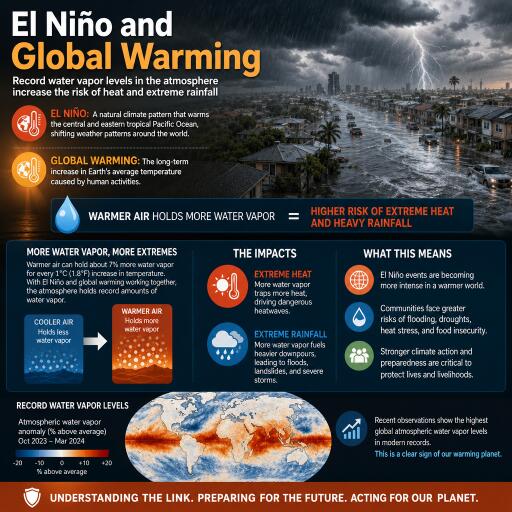
El Niño and global warming / Record water vapor levels in the atmosphere increase the risk of heat and extreme rainfall
August set a new global high for atmospheric moisture, a milestone that raises the odds of punishing heat waves and violent downpours across many regions. As the planet warms, the air’s capacity to hold water expands, and this year’s El Niño has further supercharged evaporation over the oceans—together pushing humidity in the air column to unprecedented levels.
What the new record means
Global “total column” water vapor—essentially the mass of water vapor stacked above each square meter of Earth’s surface—reached 27.35 kilograms per square meter in August. That edged past the previous peak set just a month earlier by 0.04 kg/m². While the number may seem small, added up across the planet it equates to roughly 20 trillion extra liters of water suspended in the atmosphere compared with the prior record.
Analyses from the Copernicus Climate Change Service indicate the surge is consistent with August’s exceptionally high global temperatures. A fundamental thermodynamic rule applies: for each 1°C of warming, the atmosphere can hold about 7% more water vapor. With oceans—especially in the tropics—running remarkably warm and El Niño strengthening in the Pacific, evaporation has ramped up, feeding the moisture increase.
Why more vapor intensifies extremes
More moisture makes heavy rain heavier. When saturated air is lifted in storms, the excess water vapor condenses, releasing heat that energizes clouds and can intensify downpours, thunderstorms, and tropical cyclones. That added latent heat acts like fuel, amplifying storm dynamics and increasing the likelihood of high-impact rainfall events that can overwhelm drainage, trigger flash floods, and saturate soils to the point of landslides.
Elevated humidity also worsens heat stress. Moist air slows the body’s ability to cool via sweat, raises the “feels-like” temperature, and keeps nights warmer by limiting radiative cooling. This combination reduces recovery time during heat waves, increasing health risks for outdoor workers, older adults, and people with underlying conditions. In cities, where heat lingers over concrete and asphalt, high humidity can turn already stifling evenings into dangerous conditions.
August: among the hottest on record
Long-term climate datasets show August ranking among the hottest months measured since the mid-20th century. A separate, longer global temperature series that extends back to the 1800s also classified August as the hottest month in its record. The overall trend is clear: heat driven by greenhouse gas emissions is raising the global baseline, while El Niño adds an extra nudge that pushes temperature and humidity into record territory.
Water vapor’s feedback in a warming world
Water vapor is itself a potent greenhouse gas. As temperatures rise, the air takes up more moisture, which then traps additional heat—an amplifying feedback that accelerates warming. This is a core feature of Earth’s climate system: the primary driver of long-term warming is the buildup of heat-trapping gases from human activities, and the resulting increase in atmospheric moisture further reinforces that warming.
El Niño’s role now and ahead
The ongoing El Niño in the tropical Pacific, projected to be among the stronger episodes observed, is amplifying sea-surface temperatures and evaporation. Its influence often peaks over several seasons, meaning its warming and moisture-loading effects can carry into the following year. Regions historically sensitive to El Niño—parts of the Americas, East Africa, and the western Pacific, among others—should prepare for a heightened risk of heat extremes and heavier-than-normal rainfall episodes, though local outcomes will vary.
What to watch next
- Rainfall intensity: Expect a greater share of precipitation to fall in short, extreme bursts, increasing flood risk.
- Compounded heat: Persistently high nighttime temperatures and high humidity can escalate health impacts during heat waves.
- Storm power: Moisture-rich environments provide more energy to developing storms, including tropical cyclones.
While the recent jump in atmospheric moisture may appear incremental, it is part of a steady climb that reshapes risk. Each small uptick stacks the deck toward more frequent and severe extremes. Reducing greenhouse gas emissions remains essential to slow the underlying warming. In the meantime, upgrading flood defenses, expanding shade and cooling centers, improving early warning systems, and strengthening building and stormwater codes are practical steps that can save lives and livelihoods in a wetter, hotter climate.



Leave a Reply