

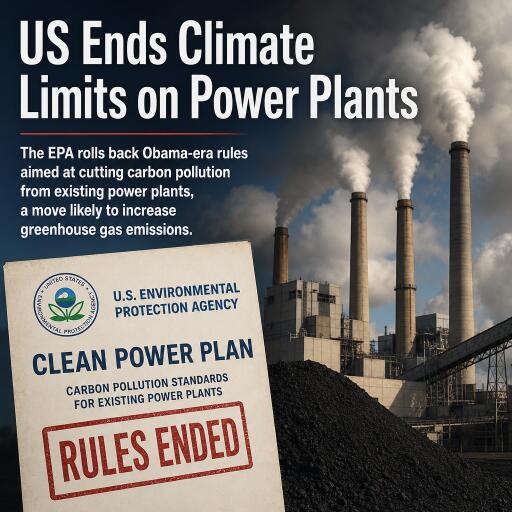
US Ends Climate Limits on Power Plants
In a sweeping reversal of federal climate policy, the US Environmental Protection Agency has moved to nullify carbon dioxide limits for coal- and gas-fired power plants. The now-scrapped framework would have compelled facilities to cut emissions by up to 90 percent or close by 2039.
The agency argued that the previous standards were legally and technically unworkable. It said climate change, while a concern, does not justify imposing restrictions it views as impossible for industry to meet. According to the EPA’s statement, modeling shows power-plant emissions have a limited influence on climate outcomes, adding that “if all carbon dioxide emissions were eliminated tomorrow, there would be no meaningful climate impact.” It further contended that because emissions and their effects are global and complex, specific health harms cannot be confidently attributed to the US power sector alone.
By lifting these rules, the agency expects to bolster grid reliability and relieve cost pressures on consumers, contending that dispatchable coal and natural gas plants provide steady electricity irrespective of weather conditions. Lower wholesale power prices, officials said, should follow as more conventional generation remains online.
EPA Administrator Lee Zeldin framed the move as the largest deregulatory action the power sector has ever seen. He said the agency would not reinterpret the law to satisfy what he characterized as climate activism, and he criticized earlier administrations for policies he described as a “war on coal.” Zeldin argued that reversing course would protect affordable, reliable power and promised that Americans would begin to see relief on their electric bills, adding that the effort to “unlock the full potential of American energy” has only just begun.
Energy Secretary Chris Wright emphasized the role of coal and natural gas in meeting peak demand and backstopping the grid. He said reversing climate-driven mandates would help ensure that electricity is available precisely when it’s needed most, unlike energy sources that depend on wind or sunlight. Wright maintained that the administration’s approach prioritizes reliability and affordability for households and businesses.
EPA analysts project significant compliance cost savings from the rollback—more than $310 billion, by the agency’s estimate. The EPA also proposed rescinding a suite of other greenhouse gas requirements it considers duplicative or of limited benefit, forecasting an additional $370 billion in avoided costs if those changes are finalized. The agency’s outlook anticipates a sharp uptick in coal production for power generation—more than a tenfold increase—once the restrictions are formally withdrawn.
The decision initiates a formal rulemaking process. The EPA said a public comment period will follow, offering states, utilities, labor groups, communities, and other stakeholders an opportunity to weigh in before any changes become final.
Supporters of the rollback argue that it will stabilize the grid during periods of extreme heat or cold, lessen the risk of outages, and rein in electricity prices by keeping a broad mix of fuel sources available. They contend that the previous limits imposed heavy costs for uncertain benefits and risked shuttering plants faster than the system could replace them.
Critics, however, warn that loosening controls on fossil-fueled generation could lock in higher emissions for years and slow investment in cleaner technologies. Public health advocates have historically linked power-plant pollution to a range of respiratory and cardiovascular risks, while climate researchers point to the sector’s sizable role in national greenhouse gas totals. Those broader debates are likely to resurface as the proposal moves through the notice-and-comment period.
For now, the agency’s move signals a decisive shift in federal oversight of the power sector: away from stringent, long-term carbon reduction mandates and toward a near-term focus on dispatchable capacity and ratepayer costs. The outcome of the rulemaking—and potential court challenges to follow—will shape investment decisions, state policies, and the country’s electricity mix for years to come.



Leave a Reply