

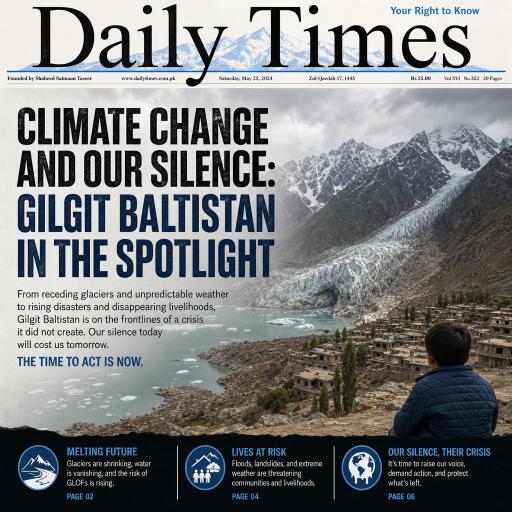
Climate Change and Our Silence: Gilgit Baltistan in the Spotlight – Daily Times
A generation ago, climate change felt like a research puzzle for labs and lecture halls. Today it is chiseling the landscape and livelihoods of northern Pakistan in real time. The world’s poorest contributed least to the problem, yet now carry the heaviest load: erratic seasons, flash floods, punishing heat, and water stress. Nowhere is this collision of physics and policy more stark than in Gilgit-Baltistan (GB), a high-mountain region stitched into the Hindu Kush–Karakoram–Himalaya, home to K2, Rakaposhi, and vast ice reserves that once behaved like reliable water towers for millions downstream.
These glaciers feed the Indus, the artery that gathers in China-Tibet-Ladakh, tumbles through GB, and then fans out across the plains of Punjab, Balochistan, and Sindh before forming the Indus Delta near Thatta. Along roughly 3,100 kilometers, this river binds farms, cities, industry, and coastal ecosystems into one delicate system. Any jolt to Indus flows hits GB first—but the shock radiates to every province. The 1991 Water Apportionment Accord depends on some semblance of predictable supply; volatility puts that compact under strain. Downstream, the delta’s mangrove forests—natural storm barriers and nurseries for fisheries—depend on sufficient freshwater to hold back seawater intrusion.
Upstream hydrology is a geopolitical as well as an ecological question. Concerns over upstream controls on the Jhelum, Chenab, Ravi, and Sutlej persist despite longstanding treaty frameworks. But the most immediate threat is written in rising temperatures and shifting precipitation. Warmer air supercharges glacier melt in some basins and destabilizes ice-dammed lakes. It also amplifies extreme rainfall when the monsoon pushes into mountain valleys already loaded with meltwater.
What the mountains are telling us
Over the past decade, GB has endured a new normal: glacial lake outburst floods (GLOFs), sudden flash floods, cloudbursts, heavy snowfalls followed by landslides, and increasingly frequent heat waves. Since 2020, reports indicate a rise in unstable lakes and flood episodes, with thousands of homes, fields, and roads damaged. Landslides slice through vital mountain highways, choking trade and emergency access. Water insecurity grows paradoxically—too much water, too fast in summer, and not enough when communities need it for drinking and irrigation.
Deforestation and land-use change magnify the hazard. Over roughly two decades, forest cover in parts of GB is reported to have fallen dramatically—from an estimated 640,000 hectares to about 295,000. Trees that once stabilized slopes, shaded streams, and buffered floods are giving way to hard infrastructure and expanding road corridors. The result: faster runoff, more erosion, and greater exposure to disaster.
How our choices make it worse
Climate change is the spark; poor planning is the fuel. Unchecked hotel and guesthouse construction along riverbanks and flood channels narrows waterways and creates dangerous bottlenecks. The near-total absence of wastewater treatment in many towns contaminates rivers and springs. Tourist litter—especially plastic bottles—clogs natural drains. Road-widening often means aggressive tree cutting without compensatory planting. Vehicle emissions spike during peak seasons. Add it up, and the region’s natural buffers are stripped just as the climate throws harder punches.
The public health toll is mounting. Waterborne illnesses are rising, particularly in rural and highland areas where records can be patchy. Children are especially vulnerable. Without clean water systems and robust waste management, seasonal floods become vectors for disease even as they destroy crops and infrastructure. Local surveys suggest the vast majority of farmers report harm to livelihoods—less reliable water, lower yields, and damaged fields. It is a slow-drip emergency that hollows communities from within.
A national issue wearing a mountain face
What happens in GB does not stay in GB. A destabilized cryosphere—glaciers melting too quickly, lakes forming and bursting—reverberates from alpine villages to delta mangroves. The Indus is the thread sewing together food security, hydropower, and coastal protection. If that thread frays, the consequences—economic, social, even security-related—follow downstream.
Five urgent shifts we can make now
- Protect the river’s room: Enforce land-use rules that keep construction away from floodplains and active channels; reopen blocked drainage pathways; map high-risk zones and shift vulnerable facilities and housing accordingly.
- Prepare for GLOFs: Expand glacier and lake monitoring, community-based early warning, and evacuation routes; invest in slope stabilization and selective drainage of unstable lakes where feasible.
- Rebuild natural defenses: Launch large-scale reforestation with native species, riparian buffers along streams, and watershed restoration; pair any new road or hotel project with mandatory tree planting and runoff controls.
- Clean water, clean cities: Install decentralized wastewater treatment for mountain towns; regulate tourism waste with deposit-return systems for plastics; fund modern solid-waste management and regular river cleanups.
- Plan for a hotter, wilder climate: Climate-proof bridges, roads, and power lines; support farmers with micro-irrigation, drought/heat-resilient crops, and water storage; improve public health surveillance and safe drinking water access.
These are not new ideas. Earlier regional assessments have already set out practical steps; the failure lies in implementation and enforcement. Climate finance should prioritize readiness—alerts, resilient infrastructure, and livelihoods—over conferences and photo-ops. Tourism must be managed, not merely marketed: caps during peak periods, green transport, waste audits for lodge operators, and strict penalties for violations.
Listen to the river
Silence has a cost. If we continue to build in floodways, poison waterways, and strip forests while temperatures climb, the Indus will become more erratic and less forgiving. Safeguarding GB is not a favor to a distant region; it is self-preservation for the country’s farms, cities, and coasts. The mountains are sending clear warnings. It is time to answer with planning, protection, and the political will to make both stick.



Leave a Reply