

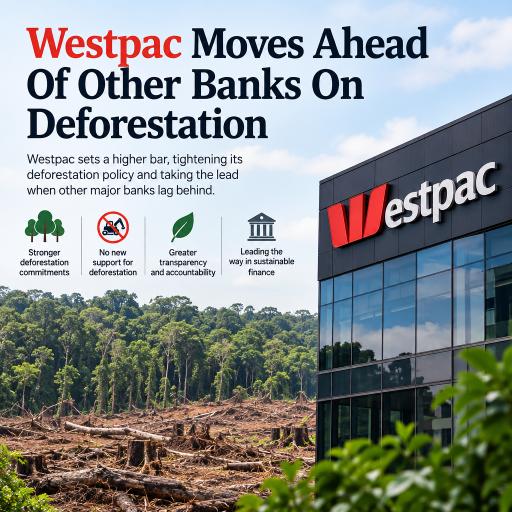
Westpac Moves Ahead Of Other Banks On Deforestation
Westpac has taken a notable step in Australia’s banking sector by strengthening its approach to deforestation and broader nature-related risks, setting a pace that few major lenders in the country have matched.
In its latest sustainability disclosures, the bank outlined a dedicated position on nature-related risks alongside a Nature Action Plan, signaling a more structured effort to address the environmental damage linked to finance, especially in agriculture. The move places biodiversity and ecosystem protection more firmly within the bank’s risk framework.
One of the most significant elements of the update is Westpac’s tougher stance on deforestation among agribusiness clients. While the bank has not adopted a blanket ban on financing all customers connected to land clearing, it has introduced new expectations for borrowers with lending exposure above A$3 million. These clients are expected to follow a mitigation hierarchy that puts avoiding deforestation first, before reducing any remaining impacts.
This approach reflects a growing recognition in finance that forest loss is not only an environmental issue but also a material business risk. Deforestation can undermine soil health, water cycles, climate stability and long-term agricultural productivity, all of which affect the resilience of farms, supply chains and lenders alike.
Westpac also reviewed more than 2,000 agribusiness customers to gauge how they are managing deforestation risk. The assessment found that slightly less than half had what the bank considered a comprehensive approach. That result highlights both progress and a major gap: many businesses are still falling short of best practice at a time when scrutiny of land use impacts is intensifying.
Environmental advocates have welcomed the bank’s definitions of forests and deforestation, describing them as consistent with current science. Clear definitions matter because they determine how land conversion is identified, measured and acted upon. Weak or vague standards can leave room for harmful clearing to continue under a sustainability label.
Attention is now shifting from policy design to enforcement. Conservation groups are calling for the bank to apply its customer requirements swiftly and to take stronger action where clients fail to meet expectations. In practice, that means consequences must exist for customers whose operations continue to damage native ecosystems or who cannot demonstrate credible plans to avoid nature loss.
The bank’s evolving framework is also being seen as an opportunity to support farmers who are already adopting lower-impact methods. Measures such as guidance on natural capital and nature-friendly land management could help producers adapt to rising expectations from lenders, markets and regulators. For many rural businesses, the transition will require not just pressure, but practical support and investment.
Beyond deforestation, Westpac’s broader nature position acknowledges the accelerating decline of biodiversity and the risks that ecosystem degradation creates for business operations and financial stability. This is an important shift in tone for the banking industry, which has historically focused more heavily on climate emissions than on habitat destruction, species loss and ecosystem collapse.
The bank has also aligned its direction with the long-term global ambition of restoring humanity’s relationship with nature by mid-century. That commitment suggests a wider strategic view of environmental risk, one that looks beyond carbon alone and recognizes the economic value of healthy forests, waterways, soils and wildlife.
Even so, campaigners argue that stronger near-term ambition will be necessary if financial institutions are to play a meaningful role in reversing biodiversity decline. Long-range goals can set direction, but the real test will be whether banks tighten lending conditions, improve transparency and act decisively when clients contribute to ecosystem damage.
Westpac’s latest move may now increase pressure on rival banks to strengthen their own policies. As awareness grows of the links between finance, land clearing and biodiversity loss, lenders are being asked not only to measure nature-related risk, but to help prevent it. In that respect, Westpac has moved further than many of its domestic peers, though the effectiveness of its approach will depend on how firmly it is implemented in the years ahead.



Leave a Reply