

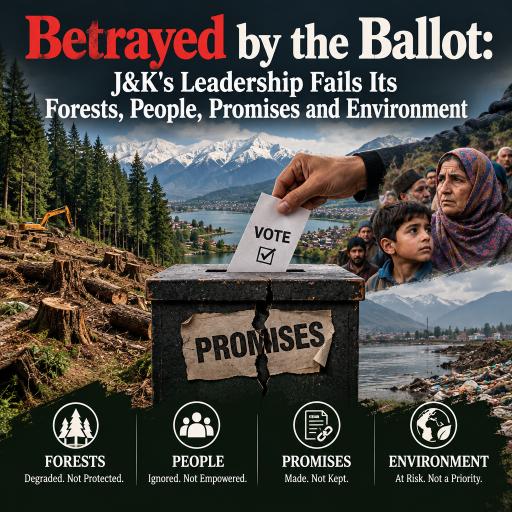
Betrayed by the Ballot: J&K’s Leadership Fails Its Forests, People, Promises and Environment
Jammu and Kashmir is moving through a dangerous contradiction: the region is gaining faster roads, bigger transport corridors and highly visible construction, yet losing the forests, water systems and ecological balance that have long sustained life in the mountains and valleys. What is being presented as progress is increasingly leaving behind heat, instability and environmental loss.
Across the Union Territory, large infrastructure works have pushed deep into fragile terrain. Highways are being widened, ring roads extended and hillsides cut open, but there is little public confidence that an equally serious plan exists to repair damaged landscapes. Slopes are disturbed, soils loosened and natural drainage routes altered, while restoration remains weak, delayed or absent.
The silence from political leadership has become part of the crisis. Those elected to protect public interest appear more comfortable launching beautification drives, ceremonial events and publicity-friendly programmes than confronting the long-term environmental costs of reckless construction. The result is a model of governance that celebrates ribbon-cutting but neglects ecological repair.
One of the clearest symbols of this failure is the destruction of mature roadside tree cover that once defined major routes in the Valley. Long stretches that used to be shaded by stately chinar, poplar and willow now stand exposed after mass felling for road expansion. The wider carriageway may speed travel, but it has also stripped the landscape of cooling cover, habitat and character. What was once living green infrastructure has been replaced by bare asphalt and rising surface temperatures.
This is not an isolated change. Tree loss on a massive scale, combined with blasting in geologically sensitive zones, is increasing vulnerability across the region. Such interventions fragment ecosystems, destabilise mountainsides and send more sediment into rivers and lakes. In a landscape already sensitive to extreme weather, these disruptions carry serious risks.
Those risks are no longer theoretical. Jammu and Kashmir has already been facing warmer conditions, irregular precipitation, heavy downpours, flash floods and growing pressure on glaciers and water systems. Yet encroachments continue along riverbanks, floodplains and natural channels that should serve as buffers during intense rainfall. When these spaces are occupied or narrowed, disaster impacts become more severe for homes, farms and roads downstream.
Urban planning has also failed to keep pace with environmental reality. Many towns and expanding settlements still lack robust drainage restructuring, slope stabilisation and flood-resilient land-use planning. Instead of protecting recharge areas and no-build zones, the dominant pattern has been reactive governance—intervening after damage, not before it.
At the same time, forests and public lands remain under pressure from encroachment and weak enforcement. Illegal occupation, shrinking wetlands, unregulated waste dumping, plastic pollution and aggressive extraction are steadily eroding ecosystems that support agriculture, fisheries, tourism and local water security. The cumulative effect is not only ecological decline but also a direct assault on livelihoods.
The collapse of environmental stewardship is unfolding alongside social and economic frustration. Thousands of young people remain trapped between qualifications and joblessness, while many public sector vacancies stay unfilled. Daily wage workers still wait for durable relief and regularisation. For many families, survival pressures are immediate, making it harder to organise around slower-moving issues like forest protection, water quality or land-use regulation.
This disconnect benefits a style of politics built on spectacle. New roads, buildings and public events are easy to market during elections because they are visible and immediate. Ecological restoration, by contrast, is quieter, slower and less politically rewarding. That imbalance helps explain why preventive action is repeatedly deferred even as environmental warning signs multiply.
The pressures are especially visible in fields and orchards. Farmers and fruit growers are often drawn into input-heavy systems dependent on chemical pesticides and fertilisers, raising concerns about soil degradation, contaminated water and human exposure. As ecological stress combines with weak oversight, public health also enters the picture. Environmental decline does not remain in forests or riverbeds; it reaches kitchens, workplaces and communities.
What makes the situation more alarming is the absence of a strong policy framework that treats development and ecology as inseparable. Sensitive slopes need strict zoning. Large projects should carry binding restoration obligations. Independent monitoring must become routine rather than symbolic. Violations should lead to meaningful penalties, not paperwork. Without these safeguards, “development” becomes a euphemism for irreversible damage.
There is also a democratic cost. When public debate is dominated by polarising rhetoric and short-term political messaging, attention is diverted from land degradation, illegal occupation, water stress, poor waste management and the weakening of regulatory institutions. Citizens are encouraged to react emotionally while foundational governance failures continue in the background.
The burden then falls on ordinary people twice over. First, they lose the natural systems that protect them—forests that anchor slopes, wetlands that absorb floods, trees that cool roads, and rivers that sustain farms and settlements. Second, they are left with leadership that often fails to deliver jobs, basic services and meaningful ecological accountability.
Jammu and Kashmir does not need a choice between connectivity and conservation. It needs planning that respects both. Roads can be built with slope protection, compensatory plantation that actually survives, habitat-sensitive alignments, floodplain protection and transparent environmental audits. Urban growth can be guided away from natural drainage lines and recharge zones. Forest land can be defended as critical infrastructure, not empty space waiting for conversion.
The region’s future depends on treating water, soil, forests and biodiversity as core public assets rather than expendable obstacles to construction. Political leaders should be judged not only by the number of kilometres they build, but by the ecological condition they leave behind. If this shift does not happen, Jammu and Kashmir risks trading its natural resilience for a brief illusion of progress.
The warning is clear: a politics that ignores ecology eventually fails people as well. In J&K, the true test of leadership is no longer how quickly it can cut through mountains, but whether it can still protect the land, livelihoods and public trust before the damage becomes permanent.



Leave a Reply