

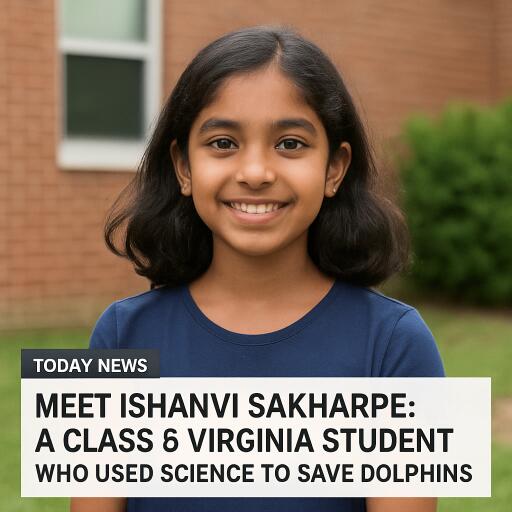
Meet Ishanvi Sakharpe: A Class 6 Virginia student who used science to save dolphins | Today News
In an era of crowded coastlines, faster boats, and growing pressure on marine habitats, one middle-school student in Virginia has drawn attention for turning a conservation concern into a science-based solution. Ishanvi Sakharpe, a Class 6 student, has been recognized for creating Dolphin Guard, a project designed to help protect dolphins from dangers in busy waterways.
Her idea focuses on a serious ecological problem. Dolphins living near heavily used coastal routes face multiple threats from human activity, including collisions with boats and entanglement in fishing equipment. These hazards can cause severe injuries or death, especially in areas where marine animals and vessels share the same space. Instead of treating such incidents as unavoidable, Sakharpe approached the issue as something science and technology might reduce.
Dolphin Guard is built around a preventive mindset. Rather than responding only after an animal has already been harmed, the project explores ways to identify danger early and lower the chance of accidents before they happen. That proactive approach reflects a broader shift in environmental thinking: conservation is most effective when it anticipates risk instead of reacting to disaster.
The project earned distinction in a national young scientist competition, where entries were judged on qualities such as originality, scientific understanding, clarity of communication, and the strength of the proposed solution. In a field filled with ambitious student ideas, Sakharpe’s work stood out for connecting classroom learning with a practical environmental challenge.
What makes the project especially striking is how it translates abstract STEM skills into a real-world ecological application. Designing a solution for dolphin safety requires more than concern for wildlife. It calls for observation, analysis, pattern recognition, and structured problem-solving — the same skills students develop through mathematics and scientific inquiry.
Sakharpe has also shown notable strength in competitive math, an area that often nurtures the kind of disciplined thinking needed for scientific innovation. That background likely helped her break down a complex conservation issue into manageable parts: identifying the threat, examining how and where it occurs, and imagining a system that could reduce harm.
Her achievement also speaks to a larger story about the role of young people in environmental technology. Many of the world’s ecological problems can feel overwhelming, particularly those involving oceans, climate, and biodiversity loss. Yet projects like Dolphin Guard show how even students at an early age can contribute meaningful ideas when education is tied to urgent, real-life problems.
Busy marine corridors are becoming more common as coastal economies expand. That means the challenge facing dolphins is unlikely to disappear on its own. Solutions will require a mix of policy, public awareness, habitat protection, and smarter technology. Student-led innovations may not solve the entire problem alone, but they can play an important role in shaping how future conservation tools are imagined.
Sakharpe’s work offers a hopeful example of that potential. By focusing on prevention and coexistence, she has highlighted a key principle of modern conservation: human activity does not have to be separated from wildlife protection if thoughtful design is part of the equation. Her project suggests that safer waterways for dolphins could begin with a simple but powerful question — how can science step in before danger turns into damage?
At a time when environmental news is often dominated by crisis, this story stands out for a different reason. It is about curiosity, problem-solving, and the idea that innovation can come from any age group. For one Virginia student, science became a tool not just for learning, but for defending life in the ocean.



Leave a Reply