

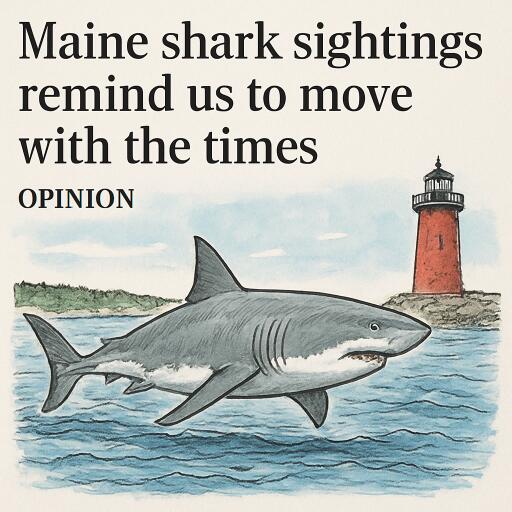
Maine shark sightings remind us to move with the times | Opinion
Reports of white sharks along Maine’s coast have unsettled beachgoers this year. A shark sighting temporarily cleared swimmers from the water in Wells. Warning flags appeared in other seaside communities. In Scarborough, a lifeguard was dragged underwater when a shark bit a rescue float. For many residents, such moments feel shocking, even unnatural.
But the real surprise is not that large predators are appearing. It is that so many of us came to think they wouldn’t.
For generations, people in New England grew used to a coastline missing much of its original wildlife. Marine ecosystems had already been heavily altered by hunting, fishing pressure and the removal of key species. As that diminished version of the ocean became familiar, it also became accepted as normal. When animals like white sharks rarely appeared, their absence stopped seeming unusual.
That is the trap of shifting baselines: each generation judges environmental health by what it first encounters, even if that condition is already degraded. So when a person says they spent a lifetime on the water without ever seeing a great white, that memory is sincere, but it does not define what the Gulf of Maine is supposed to be. It may simply reveal how much had already been erased.
White sharks are not strangers to these waters. Nor are the seals they often follow. For thousands of years, seals were part of the North Atlantic coastal system, and top predators moved through the same food web. Historical records show sharks in Maine long before today’s headlines. What changed was not the animals’ basic connection to the region, but the ecological conditions that once supported them.
As seal populations were reduced over the centuries, the coastal food landscape changed with them. In earlier eras, seals were widely blamed for competing with people for fish, and organized efforts sought to remove them. When those prey concentrations disappeared, so did many of the predictable circumstances that make white sharks more likely to be noticed close to shore.
Now that marine mammal protections and broader conservation measures have allowed some species to recover, parts of that older ecological network are reassembling. Seals have returned in greater numbers to stretches of the Northeast coast. And where prey gathers, predators are more likely to pass through.
This is not evidence of an “invasion.” It is evidence of ecological recovery.
At the same time, people are using the ocean more intensely and documenting it more constantly than ever before. Beaches are more crowded. More boats, drones, smartphones and social media posts turn isolated wildlife encounters into regional news within minutes. Increased awareness can make a gradual change feel sudden. A species may seem to be appearing everywhere at once, when in reality we are simply seeing and sharing more.
That distinction matters. If public discussion frames every shark sighting as proof that something has gone wrong, it obscures the larger story: a marine ecosystem is becoming more complete. Top predators are part of healthy food webs. Their presence can be inconvenient and at times intimidating, but inconvenience is not the same as ecological dysfunction.
For many coastal communities, the discomfort is psychological as much as practical. Modern life by the sea has been built around the expectation that people should be able to swim, surf, fish and paddle with minimal risk from large wild animals. That expectation was formed during a period when the ecosystem had already been simplified by human activity. In effect, we designed our habits around an abnormal quiet and then mistook that quiet for the natural state of things.
The return of sharks exposes that misunderstanding. It reminds us that the ocean is not a controlled recreation zone. It is a living system with its own rules, shaped by prey, temperature, migration and recovery. If conservation succeeds, wildlife will not stay politely out of sight forever.
There is an irony here. For decades, public policy aimed to protect marine life, rebuild damaged populations and restore ecological balance. Yet when those efforts begin producing visible results, the reaction is often frustration. We celebrate restoration in the abstract, but recoil when it changes how we use the coast.
That response should give us pause. Historically, resentment toward predators and marine mammals helped justify the very campaigns that stripped so much life from coastal waters in the first place. If society supports conservation only until wildlife becomes inconvenient, then the old mindset has not disappeared. It has simply adopted cleaner language.
None of this means public safety should be ignored. Beaches need clear warning systems, lifeguards need training, and the public deserves practical guidance about reducing risk in the water. Science-based monitoring, education and local planning are essential. But safety measures should help people adapt to a changing seascape, not feed the fantasy that the sea must conform to human expectations.
And change is broader than sharks alone. The Gulf of Maine is warming rapidly. Species are shifting their ranges. Food webs are reorganizing. Some returns will reflect successful protection; others will be driven by climate disruption. In either case, clinging to a fixed idea of how the coast used to feel is not a strategy. It is nostalgia standing in for ecological understanding.
The deeper lesson from Maine’s shark sightings is that the sea is not reverting to danger; it is revealing how incomplete our recent definition of “normal” has been. A coastline with more seals, more visible predators and more complex animal interactions may feel unfamiliar. But unfamiliar does not mean unnatural.
If a healthier ocean looks different from the one many people remember, that may be because memory began in an already diminished age. The task now is not to demand that the marine world return to a simplified version built for our comfort. It is to learn, with humility, how to live beside a wilder and more fully restored coast.



Leave a Reply