

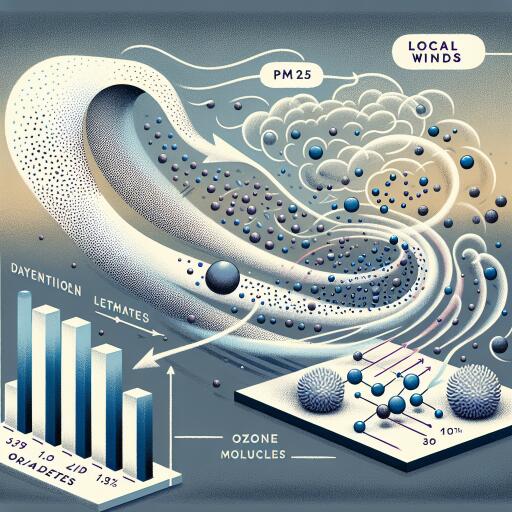
Local Winds Influence PM2.5 and Ozone Dynamics
Air quality doesn’t just depend on how much pollution we emit—it hinges on how local winds move and transform those pollutants once they’re in the air. In river valleys and mountain belts, daily wind cycles and terrain-guided breezes determine whether fine particles (PM2.5) and ozone (O3) disperse, accumulate, or chemically evolve into even more harmful forms.
When Terrain Shapes the Air We Breathe
Local wind systems—spanning a few to a few hundred kilometers—arise from contrasts in surface heating and the contours of the land. In complex terrain, these circulations can overpower broader regional flows. River corridors act like wind tunnels, while slopes and ridgelines steer air uphill by day and downhill at night. The result: neighborhoods just a few kilometers apart can experience starkly different pollution levels.
Valleys often breed overnight temperature inversions, capping cooler, denser air near the ground and trapping emissions until sunshine breaks the lid. During the day, upslope and up-valley breezes can vent pollution—but they may also carry precursors into sunlit layers where ozone forms rapidly. Along rivers, cool water and warmer land set up pressure differences that nudge air along the channel, creating convergence zones where pollutants pool and react.
PM2.5 and Ozone: A Coupled Problem
Ozone is not emitted directly; it forms when sunlight drives reactions among nitrogen oxides and volatile organic compounds. Those same chemical soups can generate secondary particles, boosting PM2.5. Local winds are the conveyor belt and the mixing spoon: they shuttle precursors into the right temperature, humidity, and light conditions for chemistry to accelerate.
Key meteorological ingredients include:
- Sunlight: Strong radiation intensifies photochemical smog, lifting ozone and spurring particle formation from gases.
- Humidity: Water vapor assists certain reactions, promoting growth of particle mass (for example, nitrate and organics that swell under moist conditions).
- Stagnation: Weak winds extend the lifetime of reactive gases, allowing more time for ozone and secondary aerosol to accumulate.
- Thermal layering: Inversions limit vertical mixing, packing PM2.5 near the surface where people breathe it.
Mountains vs. Rivers: Different Flows, Different Outcomes
In mountain regions, daytime upslope winds may briefly clear valley floors but transport pollution to elevated basins, where it can linger and transform. Nighttime downslope winds then drain cooler, polluted air back into low-lying communities before dawn, setting up morning peaks in PM2.5.
In riverine landscapes, channeling and along-river breezes help organize where emissions end up. Temperature contrasts between water and land can create sharp gradients that focus pollutants into narrow bands. These fine-scale features explain why one riverside town can suffer frequent ozone exceedances while a nearby ridge records cleaner air, despite similar emissions.
Why High-Resolution Science Matters
Capturing these dynamics requires blending ground measurements with fine-scale atmospheric models that resolve terrain and diurnal wind cycles. When models include local circulations, forecasts of PM2.5 and ozone improve, enabling targeted health alerts and more precise planning for pollution episodes. Coarse averages miss the hotspots; neighborhood-level analysis finds them.
Real-time data elevate this approach. Portable monitors, networks of low-cost sensors, and occasional drone sampling can map how a plume bends through a valley or pools in a river bend. Paired with satellite snapshots and Doppler wind observations, these tools sharpen forecasts and support rapid responses to spikes.
Applying the Science: What Communities Can Do
Local wind patterns offer practical levers for pollution management. Strategies that align with terrain-driven flows can deliver outsized benefits:
- Time-sensitive controls: Restrict the most reactive emissions (e.g., from traffic or industry) during afternoon ozone peaks and overnight inversion-prone hours.
- Topography-aware planning: Site major roads, warehouses, and loading zones away from valley bottoms and river confluences where stagnation recurs.
- Green buffers: Planting trees and restoring riparian zones can alter near-surface turbulence and capture some particle pollution while providing cooling that softens temperature gradients.
- Dynamic advisories: Issue neighborhood-scale alerts based on high-resolution forecasts, prioritizing schools, healthcare facilities, and outdoor workers.
- Clean transport corridors: Encourage electrified freight and public transit along river and valley routes prone to trapping emissions.
Health Stakes and Equity
PM2.5 penetrates deep into the lungs and bloodstream, elevating risks for cardiovascular and respiratory disease. Ozone irritates airways and aggravates asthma. In many mountainous and riverine areas, lower-income neighborhoods cluster where stagnation occurs most frequently. Fine-scale wind-aware policies can help close exposure gaps by targeting the places—and times—of greatest risk.
Climate Change Raises the Bar
Warming intensifies heatwaves, lengthens photochemical seasons, and can alter local wind regimes. More frequent stagnation and drought amplify ozone formation and particle levels from wildfires and dust. Future-ready air quality management must integrate changing wind patterns, hotter afternoons, and the likelihood of compounding events.
A Local Lens for Cleaner Air
The lesson is clear: tackling PM2.5 and ozone requires looking beyond regional averages to the winds that shape air from hill to harbor. When agencies incorporate terrain-driven circulations into monitoring networks and models, they gain the precision needed to protect public health—street by street, valley by valley. The path forward is local, data-rich, and dynamic: know the winds, and you can change the air.



Leave a Reply