

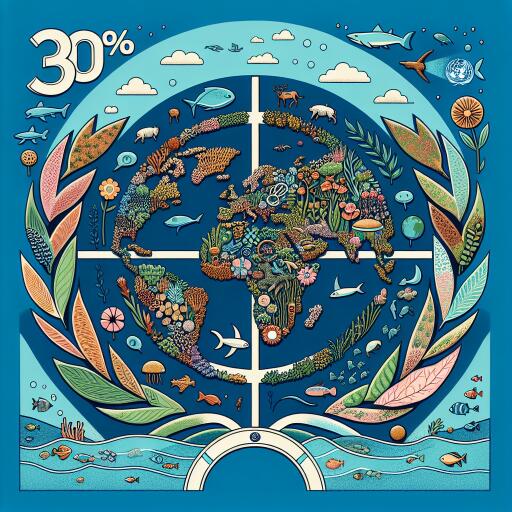
UN biodiversity treaty enters into force, aims to protect 30pc of oceans by 2030
A landmark United Nations agreement governing the high seas has officially taken effect, setting the stage for countries to protect 30 percent of the global ocean by 2030. The treaty establishes the first comprehensive, legally binding framework to conserve biodiversity in waters beyond national jurisdictions—vast areas that cover the majority of the ocean and nearly half of Earth’s surface.
Finalized in March 2023 after years of negotiations, the pact—widely known as the High Seas Treaty or Biodiversity Beyond National Jurisdiction (BBNJ)—opens the door to creating a global network of marine protected areas in international waters. It also requires countries to assess the environmental impacts of activities that could harm high-seas ecosystems and sets up rules for sharing benefits from marine genetic resources used in fields such as biotechnology and medicine.
From negotiation to implementation
The treaty crossed the threshold to enter into force when the 60th country deposited its ratification on September 19 last year, triggering a 120-day countdown. Since then, more nations have joined, with the number of ratifications now exceeding 80. Major ocean states including China, Brazil, and Japan have ratified. Others, such as the United Kingdom and Australia, are expected to follow. The United States has signed but not yet ratified.
Supporters are urging universal participation to ensure the treaty’s effectiveness, noting that widespread ratification will be crucial for building a coherent system of protection across the high seas. The first meeting of parties is expected to set procedures for designating protected areas, standardizing environmental impact assessments, and establishing scientific and technical bodies to guide implementation.
What the treaty changes on the water
Until now, activities on the high seas—fishing, shipping, bioprospecting, and more—have been overseen by a patchwork of regional and sectoral rules, leaving critical gaps in conservation. The new agreement introduces cross-cutting tools to manage cumulative impacts and safeguard biodiversity hotspots that lie outside national boundaries.
- Protected areas: Countries can collectively designate marine protected areas in international waters, with enforceable rules to conserve habitats, migratory corridors, and spawning grounds.
- Environmental assessments: Proposed activities with potential to affect ocean ecology will be subject to screening and assessment, improving transparency and accountability.
- Benefit-sharing: A framework for sharing benefits from marine genetic resources aims to ensure that discoveries derived from high-seas biodiversity contribute to global equity.
- Capacity support: Provisions are included to help developing states participate fully, including through scientific cooperation and technology transfer.
Racing toward “30 by 30”
Global leaders have pledged to protect at least 30 percent of land and sea by 2030. At sea, reaching that goal requires rapid action on the high seas, where governance has historically been weakest. Today, only about 8 percent of the ocean—roughly 29 million square kilometers—is under some level of protection, and protections on the high seas are even thinner.
Scientists and conservation groups say a sweeping expansion of protected zones will be required to meet the 2030 target. That will demand careful planning to prioritize ecologically significant areas, coordinate across regional fisheries bodies and shipping lanes, and ensure that protections are not just lines on maps but are actively monitored and enforced.
Limits and lingering threats
While the new regime is a major advance, it does not cover every pressure on the ocean. Seabed mineral extraction in international waters remains under the purview of the International Seabed Authority, which is developing rules for potential deep-sea mining. Many marine scientists warn that biodiversity in the deep ocean could be highly vulnerable to disturbance, adding urgency to calls for precautionary approaches across institutions.
Climate change compounds the challenge. Ocean warming, acidification, and deoxygenation are altering habitats and pushing species beyond historical ranges. The treaty is designed to help manage human impacts, but success will also depend on broader actions to reduce greenhouse gas emissions and curb pollution entering the sea from land.
What comes next
With the treaty now in force, attention shifts to the first conference of parties, where governments will agree on rules for proposing and approving high-seas protected areas, refine standards for environmental assessments, and establish scientific advisory structures. Clear funding mechanisms and compliance tools will be pivotal to translate legal texts into effective conservation at sea.
The agreement marks a turning point in ocean governance: a move from fragmented stewardship to a system capable of protecting biodiversity across the blue expanse that links all nations. The next few years will test whether governments can turn ambition into real protection—and whether the world can still meet the 2030 deadline for safeguarding nearly a third of the ocean.



Leave a Reply