

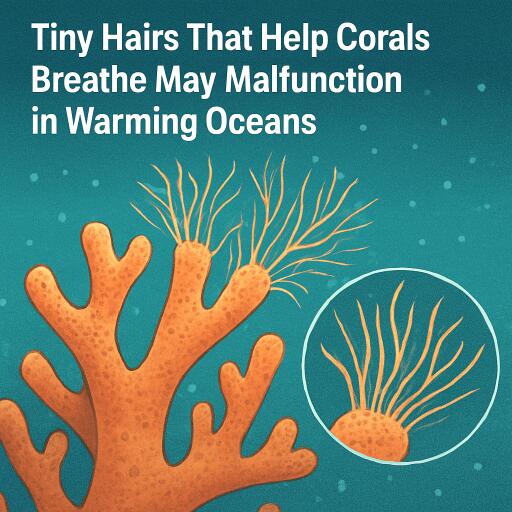
Tiny Hairs That Help Corals Breathe May Malfunction in Warming Oceans
Corals may look still and passive, but their survival depends on constant motion at a scale too small to see with the naked eye. Covering every coral colony is a paper-thin layer of water where flow slows dramatically. This narrow zone acts like a gatekeeper, controlling how oxygen, nutrients, waste, and chemical signals move between the animal and the surrounding sea.
For years, that slow-water layer was seen mostly as a problem. Because corals are fixed in place, they cannot move toward food or fresher water. They must rely on what arrives at their surface. Scientists long assumed that oxygen crossed this barrier mainly by diffusion, the slow process by which molecules spread from areas of high concentration to low concentration. But diffusion is inefficient over even tiny distances. For a coral with active tissues and constant metabolic demands, that posed a mystery: how do these animals get enough oxygen to function?
The answer appears to lie in microscopic hair-like structures called cilia. Rather than serving only as cleaning tools, these tiny projections actively stir the water directly above the coral’s surface. Their rapid beating creates miniature vortices that pull in oxygen-rich seawater and push away water depleted by respiration. In effect, they keep the coral’s immediate surroundings ventilated.
This discovery reshaped how researchers think about coral biology. The thin boundary of slow-moving water is not just an obstacle. It is part of a finely tuned microenvironment that corals actively manage. By moving water at such a small scale, cilia reduce the distance oxygen must travel to reach living tissue, helping the animal meet its energy needs far more efficiently than diffusion alone would allow.
The importance of that process becomes clear when considering how demanding reef life is. Corals need oxygen for growth, tissue repair, and the maintenance of their partnership with the algae living inside them. Those algae provide much of the coral’s energy through photosynthesis, while the coral offers protection and nutrients in return. That alliance underpins the productivity of reefs across the tropics.
But warming seas threaten this fragile arrangement in more ways than one. The best-known consequence is coral bleaching. When temperatures rise above the normal range, the algae inside coral tissues become stressed and begin producing harmful compounds. In response, corals expel them. The colony then turns pale or white and loses a major source of food and oxygen. If stressful conditions persist, the coral can die.
Yet bleaching does not explain everything scientists see in the field. During marine heatwaves, some corals bleach and recover, others bleach and die, and some decline without bleaching at all. Even neighboring colonies of the same reef can respond very differently. That inconsistency has pushed researchers to look for additional hidden points of failure inside the coral animal itself.
Cilia have emerged as one possible weak link. These structures are not passive fibers; they are complex biological machines built from proteins and powered by cellular energy. Under stable conditions, they beat rhythmically and maintain steady water mixing. As temperatures climb, however, the system may begin to break down. Heat can disrupt the proteins involved in movement, alter the mechanics of the cilia, and increase the coral’s overall energy stress. If the animal has less energy available, it may struggle to keep the cilia working at full speed.
That matters because a slowdown in cilia activity could quickly change conditions at the coral’s surface. If those tiny currents weaken, the boundary layer thickens and becomes more stagnant. Oxygen supply drops just where the coral needs it most, while waste products accumulate. A coral could effectively begin to suffocate in water that still contains plenty of oxygen overall, simply because that oxygen is no longer being delivered efficiently to its tissues.
This idea offers a new way to understand why heat stress can kill corals through more than one pathway. One colony may primarily suffer through bleaching and the loss of its algal partners. Another may retain its algae but experience failures in the microscopic machinery that keeps oxygen moving. In some cases, both processes may happen together, compounding the damage.
Researchers are now examining how warming affects cilia beat rates, water flow at the coral surface, and oxygen gradients inside that fragile boundary layer. The goal is to determine whether cilia performance can help predict which corals are likely to survive future heatwaves. If some species or individuals have cilia that remain functional at higher temperatures, that resilience could become highly valuable for reef conservation and restoration efforts.
The implications extend beyond basic biology. Coral reefs are often discussed at the scale of ecosystems, fisheries, or coastlines, but their fate may also be shaped by events unfolding within a zone thinner than a fingernail. Tiny failures in microscopic water flow can influence whether a colony keeps breathing, keeps growing, or slips into decline.
This emerging understanding makes coral reefs seem even more extraordinary. Far from being simple, motionless organisms, corals constantly engineer their surroundings. They do not merely sit in the current; they modify it, creating a protective microclimate around their bodies. The beating of countless microscopic hairs helps sustain one of the most diverse marine habitats on Earth.
It also sharpens the warning from climate science. Rising ocean temperatures do not only damage reefs in broad, visible ways. They may interfere with the minute biological systems that allow corals to function from moment to moment. That means the threat of warming reaches all the way down to the smallest moving parts of reef life.
Even so, this line of research offers practical hope. Understanding how cilia support coral respiration may help scientists identify heat-tolerant colonies, improve reef restoration strategies, and better forecast which populations are most at risk during prolonged warm periods. While no technological fix can substitute for cutting greenhouse gas emissions, deeper insight into these hidden mechanisms could help guide efforts to preserve reefs while there is still time.



Leave a Reply