

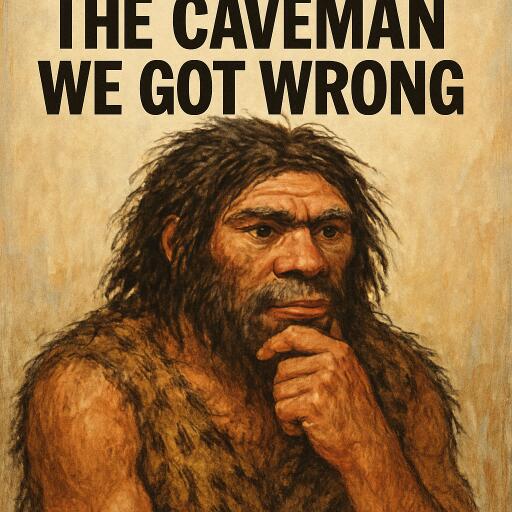
The Caveman We Got Wrong
The familiar image of the “caveman” is one of prehistory’s most stubborn myths: a hulking, dim-witted hunter dragging a club through a bleak landscape. It survives because it is simple, memorable, and easy to sketch. But the archaeological record paints a very different picture. Early humans were not crude caricatures. They were observant, adaptable, and deeply dependent on shared knowledge.
What survives from deep prehistory is fragmentary: stone tools, animal bones marked by cutting, traces of fire, plant residues, and campsites worn into the ground. From these remains, researchers can reconstruct practical aspects of life—how tools were made, what animals were butchered, which plants were processed, and where groups returned season after season. What cannot be recovered so easily are words, stories, social tensions, or the unspoken rules of daily life. Popular culture often fills those gaps with violence and brutishness. Evidence more often points toward cooperation, learning, and ecological skill.
The term “Stone Age” can also mislead. It sounds like a single chapter of human history shared equally across the globe, but it was nothing of the sort. It is an archaeological label for periods in which stone technology dominated, and these periods unfolded at different times in different places. Human societies did not march together along one neat path toward “civilisation.” They adapted according to local climates, plants, animals, and resources.
Broadly, archaeologists describe three long stages. The Paleolithic was marked by flaked stone tools and mobile communities that lived by hunting, gathering, and foraging. The Mesolithic saw a diversification of strategies after the last Ice Age, including microliths, fishing, and seasonal settlement patterns. The Neolithic introduced farming, herding, pottery, and more permanent villages. But these shifts were uneven and regional, not universal milestones reached on a single schedule.
Even the making of a stone tool required impressive mental precision. A toolmaker had to identify suitable raw material, understand how stone fractures, prepare a striking surface, and hit with just the right force to remove useful flakes. This was not random smashing. It was technical knowledge passed through observation and repetition. In South Asia, early stone-working traditions ranged from simple chopping tools to carefully shaped handaxes and cleavers. Quarry and workshop sites show that prehistoric people selected stone sources strategically and worked them in organized ways.
These tools were not used only for hunting. Wear patterns and residues suggest a far wider range of tasks: cutting meat, breaking bones for marrow, scraping hides, shaping wood, digging up roots, and processing plant foods. In other words, prehistoric toolkits supported an entire daily economy. They helped people turn landscapes into meals, shelters, clothing, and fuel.
Fire transformed that world even further. It likely began as opportunistic use of natural blazes before people learned to maintain flames, transport embers, and eventually create fire themselves. Mastery of fire did not happen in one dramatic moment. It was a gradual technological and social achievement.
A controlled hearth offered warmth, light, and protection. It made colder environments more livable and extended waking hours beyond sunset. Fire hardened wooden spear tips, altered certain stones to make them easier to shape, and changed diets by softening tough plants and meat. Cooking also helped reduce some natural toxins in wild foods. Yet fire was not only about survival. A hearth created a center: a place where tasks could be shared, food divided, and experience transmitted.
It is difficult to prove exactly what happened around prehistoric fires. Burned soil and ash can show fuel use and repeated occupation, but they cannot record conversations. Even so, it is reasonable to see fire as an engine of social life. It gathered people into a shared space and may have encouraged teaching, planning, and memory.
Diet in prehistory was equally diverse. There was no single “caveman menu.” Depending on region and season, people drew food from many sources: large mammals, small animals, birds, fish, shellfish, tubers, seeds, grasses, berries, and nuts. River valleys offered aquatic resources. Grasslands supported game herds. Forested areas often yielded rich plant foods. Survival depended on flexibility rather than reliance on one staple.
Modern archaeological science has widened this picture significantly. Researchers now study microscopic plant remains, starch grains, isotopes in ancient teeth and bones, and tiny traces preserved on stone edges. These methods show that prehistoric diets often included a broader range of plant foods than older narratives allowed. The stereotype of early humans as near-exclusive meat eaters no longer holds.
Hunting, where it occurred, was itself a demanding form of environmental intelligence. It required tracking footprints, reading disturbed vegetation, anticipating seasonal movements, and knowing where animals would gather for water. Large prey involved risk and likely demanded teamwork. A successful hunt was not the work of one heroic individual but of coordinated groups acting on shared knowledge. When hunts failed, people turned to roots, nuts, scavenging, or smaller animals. Resilience came from diversity and cooperation.
The “cave dweller” stereotype also owes much to preservation. Caves and rock shelters protect artifacts well, so they dominate the archaeological record. Open-air camps on riverbanks, lake edges, and woodland margins are far more vulnerable to erosion and disappearance. Yet these places were often central to prehistoric life. Many groups likely moved through a network of temporary camps, kill sites, raw-material sources, and seasonal gathering spots rather than living permanently in caves.
This mobility was shaped by ecology. People followed ripening plants, migrating animals, shrinking water sources, and reliable stone outcrops. Their lives were tuned to rhythms in the landscape. Far from being passive inhabitants of a harsh world, they constantly made decisions: where to camp, when to move, what to gather, which stone to carry, and how to divide food and labor.
Archaeology captures only part of that richness. A handaxe reveals skill. A hearth shows control of fire. A cut-marked bone records butchery. But these objects cannot fully recover emotion, belief, or imagination. They do, however, challenge the old insult embedded in the word “caveman.” Early humans were not simply surviving by brute force. They were studying ecosystems, solving practical problems, and building social worlds through cooperation.
The deeper the evidence is examined, the harder it becomes to sustain the cartoon. Prehistoric people were not lesser versions of us. They were intelligent communities shaped by attention, memory, and adaptation. If anything deserves to be retired, it is not the study of the Stone Age, but the lazy myth that its people were little more than beasts with tools.



Leave a Reply