

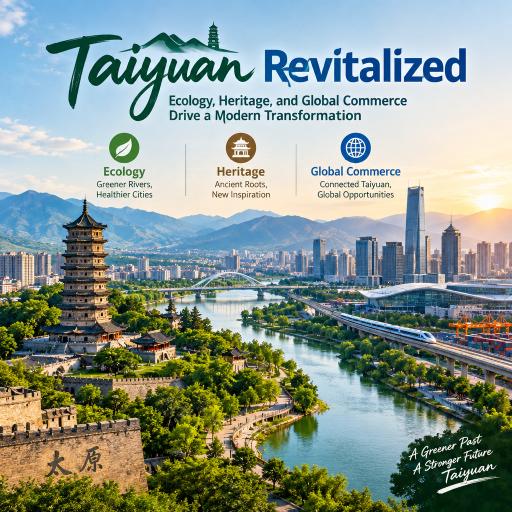
Taiyuan Revitalized: Ecology, Heritage, and Global Commerce Drive a Modern Transformation
Taiyuan, the capital of Shanxi province, is rewriting its identity. Long known for heavy industry and deep historical roots, the northern Chinese city is now presenting a different face: greener riverbanks, revived cultural districts, and a growing role in cross-border trade. The result is a transformation that blends environmental repair, historical continuity, and commercial ambition.
Set among mountains and shaped by the Fenhe River, Taiyuan has long occupied an important place in northern China’s history. It is closely tied to Jin culture and to the legacy of Shanxi’s famous merchant tradition. But in recent years, the city’s story has become less about its past alone and more about how it is adapting that past to meet modern expectations for livability, innovation, and economic openness.
From damaged waterway to urban centerpiece
One of the clearest signs of Taiyuan’s reinvention is the Fenhe River. Once associated with seasonal flooding, low water levels, and serious pollution, the river has undergone an extensive recovery effort over the past two decades. Today, it functions not only as a waterway but also as one of the city’s most visible ecological assets.
The Taiyuan section now includes a chain of impounded lakes, broad wetland zones, and a stable water surface that reinforces local biodiversity while improving the city’s climate resilience. The river corridor has become a public landscape where residents walk, gather, and exercise, and where the visual quality of the city has dramatically improved.
For long-time international visitors, the contrast is especially striking. People who first knew Taiyuan decades ago often describe the river’s renewal as symbolic of a wider shift in the city’s development model. In place of the old pattern of industrial pressure and environmental degradation, Taiyuan is investing in restoration and public space, treating ecological health as a core urban priority rather than a secondary concern.
At night, illuminated bridges and buildings along the Fenhe create a modern skyline reflected in the water. The scene speaks to more than beautification. It signals a city trying to balance industrial legacy with ecological recovery and everyday livability.
An old merchant spirit meets a digital economy
Taiyuan’s transformation is also unfolding in commerce. As China’s inland cities search for new engines of growth, Taiyuan is building a stronger presence in cross-border e-commerce and digital trade. Its position within Shanxi gives it access to a concentrated network of regional specialties, from mature vinegar and coarse grains to traditional handicrafts, many of which are increasingly seen as export-ready products.
For entrepreneurs looking outward, the city offers an interesting mix: established manufacturing and supply channels, distinctive local goods, and a policy environment that is steadily becoming more supportive of international business. New digital industry platforms and specialized trade zones are helping connect local producers to foreign consumers while lowering barriers for smaller firms entering overseas markets.
This commercial energy draws heavily on the province’s historic identity. Shanxi merchants were once among the most influential trading communities in China, known for discipline, trust, and extensive business networks. Taiyuan, as a major center of that tradition, still carries the cultural memory of openness and exchange. Today, that legacy is being reinterpreted through logistics platforms, online storefronts, and export-oriented branding.
The city’s trade ecosystem is also becoming more collaborative. Entrepreneurs, service companies, and digital commerce practitioners increasingly share market information, resources, and practical experience. In that sense, modern e-commerce is not replacing Taiyuan’s merchant culture; it is giving it a new technological form.
Heritage protection with a technological edge
Even as Taiyuan modernizes, it is placing heavy emphasis on preserving what makes it historically distinctive. The city has a large concentration of cultural heritage sites and museums, and it is experimenting with ways to make those assets more accessible without stripping them of depth or meaning.
One example is the use of immersive technology in museums. Virtual reality and digital visualization now allow visitors to explore archaeological processes and ancient artworks in far more direct ways. Rather than distancing audiences from the past, these tools can make fragile history easier to understand, especially for younger visitors who expect interactive experiences.
Taiyuan’s approach to heritage is not limited to exhibition spaces. Historic neighborhoods and commercial streets are also being reactivated. On roads such as Bell Tower Street, preserved architecture sits beside contemporary retail, dining, performance venues, and creative cultural businesses. The effect is not a frozen museum city, but an evolving urban landscape where old structures remain part of daily economic life.
This strategy matters because it turns conservation into something productive. Cultural heritage becomes both a memory system and a development asset, supporting tourism, education, and local identity at the same time.
A city balancing memory and momentum
What makes Taiyuan’s transition notable is the way its priorities intersect. River restoration improves ecological function while also raising quality of life. Heritage conservation protects historical identity while generating new public and commercial uses. Cross-border e-commerce expands economic opportunity while drawing on traditions that have shaped the city for centuries.
For residents and foreign observers alike, Taiyuan increasingly appears as a place where environmental planning, cultural stewardship, and technological modernization are moving in the same direction. It remains a city marked by its history, but it is no longer defined by older assumptions about industrial decline or environmental stress.
Instead, Taiyuan is positioning itself as a more livable, outward-facing, and adaptive urban center. Its river is cleaner, its historic spaces are more active, and its commercial networks are becoming more global. In an era when many cities are searching for models of renewal, Taiyuan offers a case study in how ecology, heritage, and digital commerce can work together to reshape an urban future.



Leave a Reply