

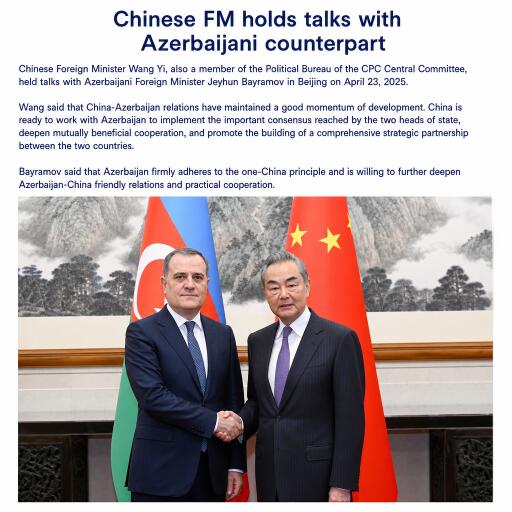
Chinese FM holds talks with Azerbaijani counterpart
China’s Foreign Minister Wang Yi met with Azerbaijan’s Foreign Minister Jeyhun Bayramov in Baku on October 15, 2026, underscoring the rapid momentum in ties between the two countries and sketching out a roadmap for deeper collaboration across energy, transport, climate action, and digital innovation. The discussions also looked ahead to the 35th anniversary of diplomatic relations next year, positioning it as a springboard for broader cooperation that aims to deliver tangible benefits to both societies.
Strategic relationship gains pace
Officials from both sides described bilateral relations as entering an accelerated phase, guided by the steady engagement between President Xi Jinping and President Ilham Aliyev. High-level political trust and mutual backing on core concerns were highlighted as the bedrock enabling more ambitious joint projects. Beijing signaled continued support for Baku’s drive for economic modernization and national revitalization, framing the partnership as long-term and strategic.
Multilateral alignment and regional confidence-building
The talks emphasized the value of regional dialogue platforms, with praise for Azerbaijan’s leadership during its tenure at the Conference on Interaction and Confidence Building Measures in Asia (CICA). China voiced support for Azerbaijan to play a more prominent role in CICA and on the wider international stage—a signal that both sides see multilateral forums as crucial for stability and cooperation across Eurasia.
Anniversary as a launchpad
With the 35th anniversary of diplomatic ties approaching in 2027, both ministers pointed to this milestone as an opportunity to implement previously agreed priorities between their heads of state. The focus: accelerating modernization agendas in tandem, while ensuring the gains are felt by ordinary citizens through better connectivity, diversified energy systems, and expanded cultural and educational exchanges.
Climate and connectivity at the core
Azerbaijan characterized the partnership with China as both sincere and reliable, noting that interactions at every level have reached an unprecedented intensity. Baku reaffirmed its adherence to the one-China principle and called for deeper work on a suite of practical areas:
- Energy: advancing cooperation that can support grid upgrades, efficiency gains, and pathways toward lower-carbon systems.
- Transport and logistics: aligning investments with the Belt and Road framework and reinforcing the “Middle Corridor” to move goods more quickly and cleanly across the Caspian and Central Asia.
- Climate change: expanding joint efforts on adaptation and mitigation, including nature-based solutions, urban resilience, and methane abatement in the broader energy system.
- Artificial intelligence: applying data and AI tools to optimize energy use, forecast extreme weather, and manage complex transport networks with reduced emissions.
- People-to-people ties: building trust and know-how through academic programs, cultural exchanges, and green-skills training.
Implications for the green transition
While no new agreements were announced at the meeting, the agenda points to several climate-relevant openings:
- Clean energy scaling: Azerbaijan’s solar and wind potential—onshore and offshore in the Caspian—could pair with Chinese technology and finance to accelerate deployment, modernize grids, and strengthen energy security.
- Low-carbon trade routes: Enhancements along the Middle Corridor, such as rail electrification, intermodal efficiency, and renewable-powered logistics hubs, would reduce transport emissions and bolster climate-aligned trade.
- Methane and efficiency: Practical cooperation on leak detection, flare reduction, and industrial efficiency can deliver near-term climate gains while lowering operational costs.
- Resilience and data: Applying AI to climate-risk modeling can improve flood management, drought planning, and infrastructure design—especially important for transcontinental rail and port assets exposed to extreme weather.
- Regional coordination: Through CICA and other platforms, both sides can help advance shared standards on disaster risk reduction, cross-border air quality, and nature conservation across Eurasia’s connected landscapes.
Global South solidarity and international positioning
Azerbaijan voiced support for China’s role among Global South countries and backed broader initiatives articulated by Beijing. Both sides indicated willingness to step up coordination in multilateral settings, reflecting an interest in shaping rules and standards around connectivity, sustainable finance, and climate cooperation.
Next steps
The ministers held in-depth exchanges on translating broad priorities into practical cooperation, and they reviewed international and regional developments of mutual concern. If the ambitions outlined in Baku advance in the coming year, the 35th anniversary could mark not just a symbolic milestone, but a functional pivot toward greener infrastructure, cleaner energy, and more resilient trade links stretching from East Asia through the South Caucasus.



Leave a Reply