

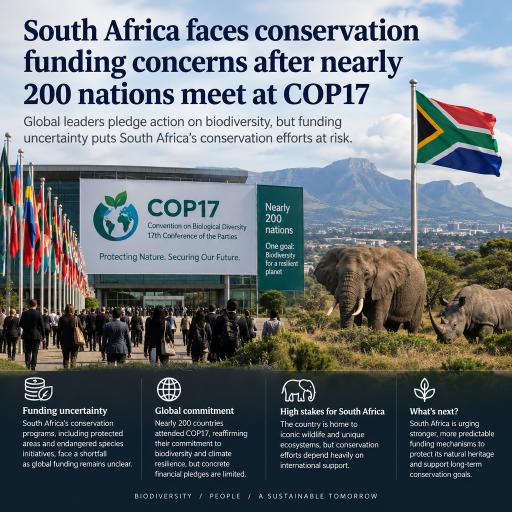
South Africa faces conservation funding concerns after nearly 200 nations meet at COP17
Nearly 200 governments concluded the latest UN biodiversity summit in Yerevan, Armenia, after extended negotiations produced a set of compromise decisions on protecting nature. But behind the formal closing of COP17, frustration was evident. Scientists, environmental advocates and several government representatives warned that the agreements reached do not match the scale or urgency of the global biodiversity crisis.
The gathering was intended to strengthen momentum toward major environmental goals for 2030, including expanding protected land and marine areas, curbing pollution, and controlling invasive species. Instead, the final outcome exposed deep disagreements over money, accountability and the balance of responsibility between richer and developing countries.
For South Africa, the summit’s unresolved finance debates are especially significant. The country is one of the planet’s most biologically rich regions, with ecosystems ranging from the Cape Floristic Region to savannas, wetlands and vulnerable coastal waters. Protecting these landscapes on the timetable expected under global agreements will require long-term investment that cannot easily be covered through domestic spending alone.
Much of the tension at COP17 centered on who should pay for conservation and how those funds should be raised. Negotiators struggled to move beyond broad statements when discussing subsidies that damage ecosystems, such as public support tied to destructive fishing practices, intensive agriculture and fossil fuel use. Calls for stronger language and firm deadlines were diluted during the talks, leaving no clear binding pathway for reform.
Another issue left unresolved was the role of the private sector. Debate continued over whether companies benefiting from natural resources should be compelled, or more strongly encouraged, to contribute to biodiversity funding. Rather than settle the question, delegates postponed substantial decisions to a future conference, delaying a potentially important source of support for conservation work in countries with limited public budgets.
That delay matters for South Africa. The country faces overlapping economic and social pressures, including unemployment, infrastructure challenges and the high costs of energy transition. At the same time, it is expected to help meet ambitious international biodiversity targets, including the goal of conserving 30% of land and ocean areas by 2030. Without larger and more predictable financial backing, those commitments become considerably harder to translate into action.
South Africa’s position at the summit aligned with a broader argument from developing nations: countries with greater historical wealth and stronger fiscal capacity should do more to fund global conservation. This view is rooted in the reality that many biodiversity-rich states are being asked to preserve ecosystems of international importance while also addressing urgent domestic development needs. In their view, conservation finance cannot rely on goodwill alone; it must include dependable funding, access to technology and fairer mechanisms for implementation.
The outcome of COP17 therefore leaves South Africa in a difficult position. On paper, international ambition remains high. In practice, however, the financial architecture needed to support that ambition is still incomplete. That gap creates uncertainty for governments responsible for vast ecological assets but limited by budget constraints.
The summit also highlighted a wider problem in global environmental diplomacy: scientific consensus does not automatically translate into political agreement. During the negotiations, disputes emerged over ecological evidence, industrial accountability and the pace of reform. In some cases, national economic interests appeared to outweigh environmental warnings, reinforcing concerns that international biodiversity talks are struggling to keep pace with environmental decline.
For South Africa, the stakes extend beyond wildlife tourism or national prestige. Biodiversity supports water systems, agriculture, fisheries, climate resilience and rural livelihoods. Degradation of these systems would carry direct economic and social costs. Conservation is therefore not only an environmental obligation, but also a development and stability issue.
What happens next will be shaped by whether wealthier countries strengthen their financial commitments before the next major round of negotiations. If funding disputes continue and corporate contributions remain undefined, countries like South Africa may be left trying to meet global conservation goals with inadequate tools.
COP17 kept the international process alive, but it did not settle the core question at its center: who will pay to protect nature at the speed science says is necessary? For South Africa, that unanswered question may prove to be the conference’s most important legacy.



Leave a Reply